For years, Titleist Pro V1 golf balls have been the standard. It’s the most played ball on professional tours and the benchmark against which other golf balls are measured.
In the 2025 MyGolfSpy Golf Ball Test, Pro V1 didn’t dominate every category. Instead, the data paints a clearer picture of why Pro V1 has earned its reputation and who should be playing with it. Here are five things the 2025 ball test reveals about Pro V1 and whether they belong in your bag.
Pro V1 Is the benchmark used to measure every other ball
One of the most overlooked details in the 2025 ball test is that Pro V1 was used as our calibration (control) ball throughout testing. That matters.
Using a control ball allows us to normalize data across multiple days, locations and environmental conditions. Pro V1 was selected because it delivers stable, repeatable results across speed, flight and spin.
This doesn’t automatically make Pro V1 “the best” but it does reinforce its role as a baseline for premium performance.
Pro V1 delivers a mid-spin, mid-flight profile across swing speeds
Across high, mid and low swing speed testing, Pro V1 consistently showed up in the mid-spin category. That consistency is one of its defining traits. The test data shows it pairs controlled driver spin with a playable flight window and enough spin to maintain control into greens without ballooning.
This makes Pro V1 one of the few premium balls that doesn’t materially change character as swing speed changes which helps explain why it continues to appeal to such a wide range of players.
Iron performance is one of Pro V1’s quiet strengths
At mid swing speeds, Pro V1 was identified as a strong option for golfers seeking iron distance paired with usable spin, rather than distance alone. It avoids the very low-spin profiles that can hurt stopping power. It also avoids drifting into overly spin-heavy territory.
Iron performance differences between balls are often more subtle than wedge differences but Pro V1 consistently delivered predictable flight, controlled spin and no surprises.
Pro V1 offers reliable greenside control, not maximum spin
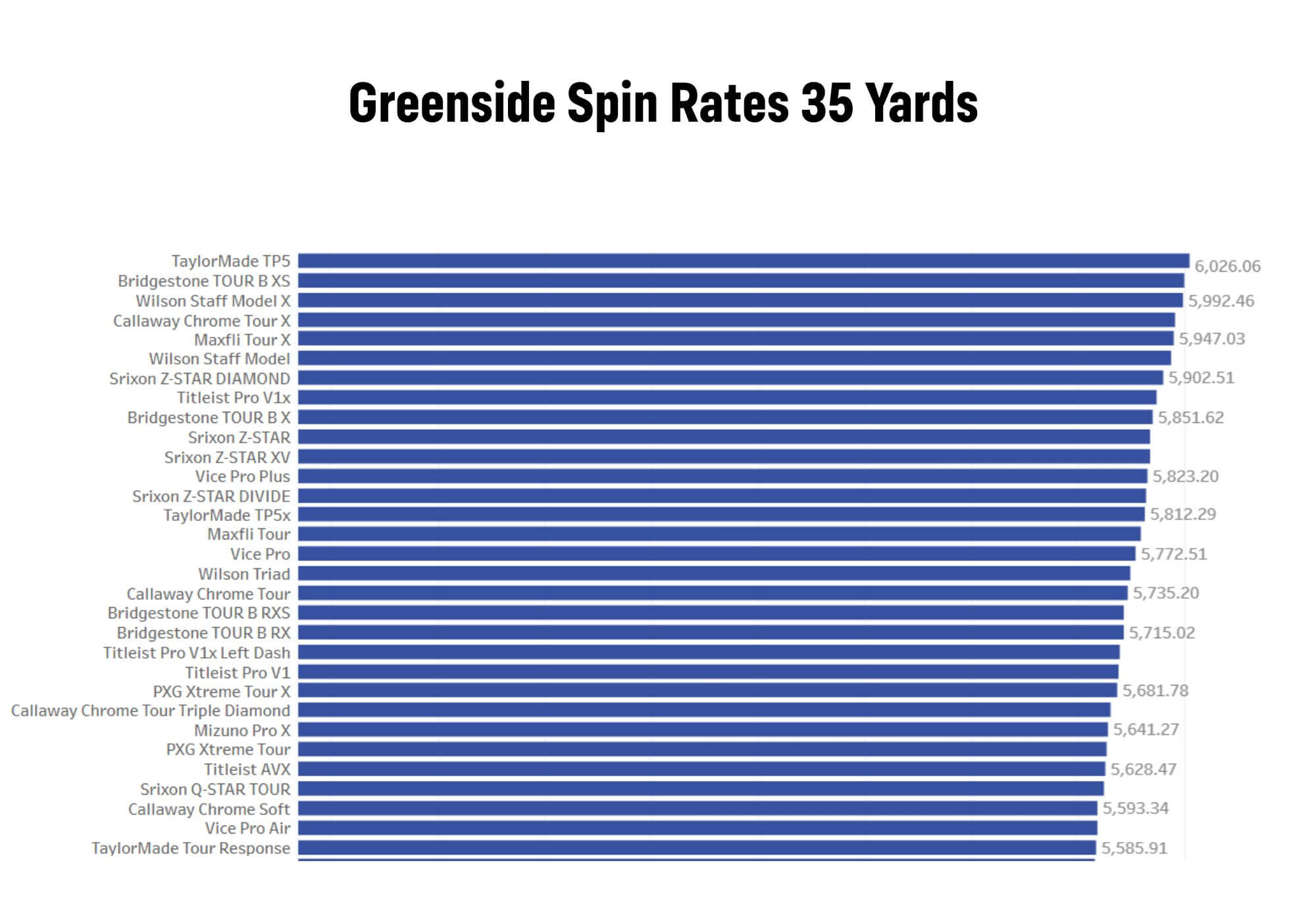
The 35-yard wedge test is where the largest performance gaps between balls show up and Pro V1 behaves exactly as expected for a premium urethane ball.
It does not lead the test in greenside spin. Balls like TP5, TOUR B XS and Chrome Tour X produce higher peak spin numbers. However, Pro V1 remains firmly in the urethane performance tier, offering substantially more control than any ionomer option.
Pro V1 makes sense if you value balance, not if you need extremes
The 2025 test data makes it clear that Pro V1 balls are built for golfers who want balanced performance without chasing a single trait.
You’re likely a good fit for Pro V1 if you:
- Want a mid-flight, mid-spin profile that works across the bag
- Value consistent iron performance and predictable wedge behavior
- Prefer a slightly softer feel than Pro V1x
You may want to look elsewhere if you:
- Need higher flight or more long-game spin (Pro V1x)
- Want the flattest, lowest-spin driver flight possible (Pro V1x Left Dash)
- Prioritize maximum greenside spin above all else
Final takeaway
Pro V1 balls continue to succeed by avoiding weaknesses, offering consistent performance across swing speeds, clubs and conditions. To learn more about how all of the Titleist golf balls performed in 2025 testing, check out this article: Best Titleist Golf Balls 2025.
The post 5 Things The 2025 Ball Test Reveals About Pro V1 Golf Balls (And If They Fit You) appeared first on MyGolfSpy.
