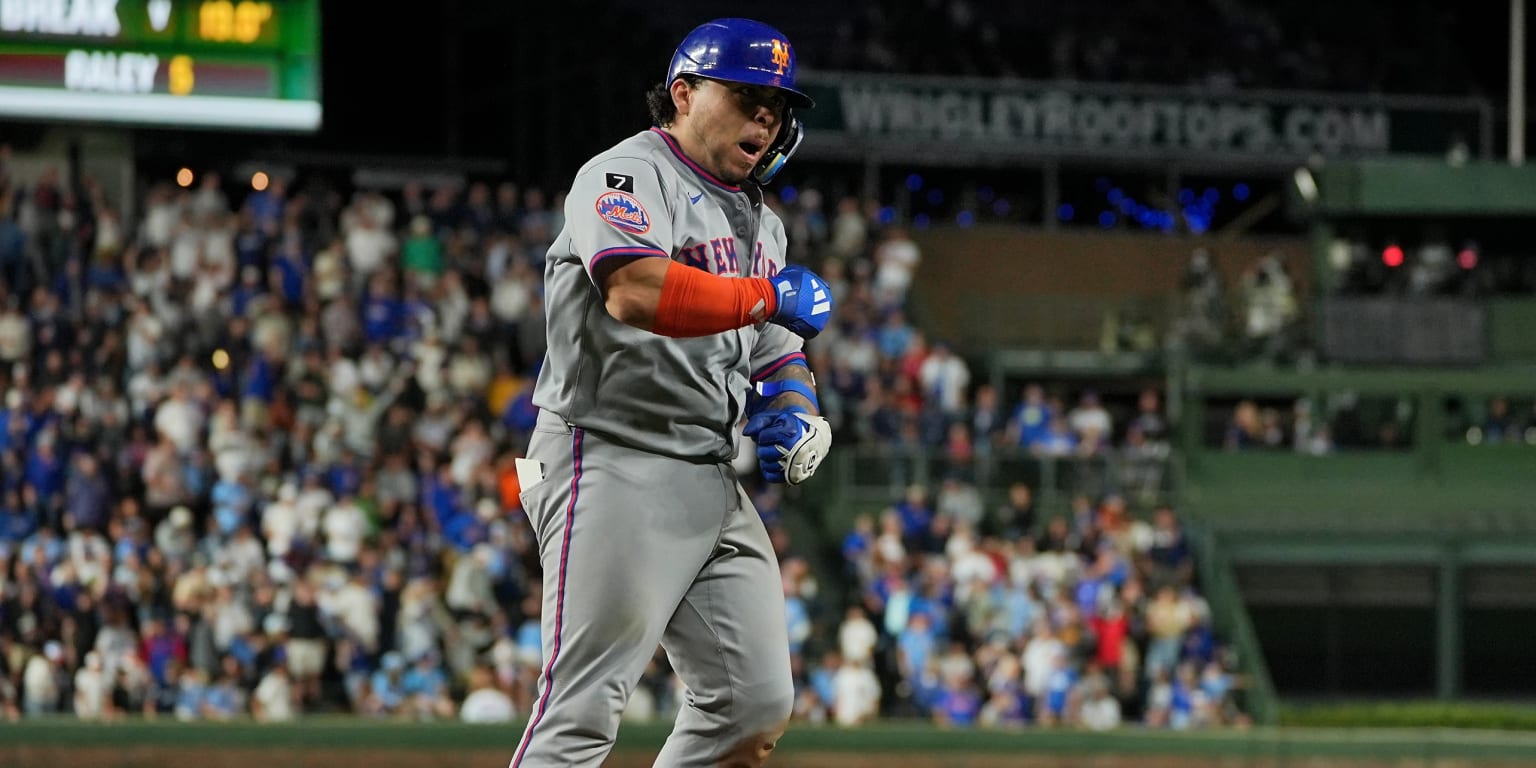
The expectation is that the 24-year-old Alvarez can build off the strides that he made late last season, following a month-long stint at Triple-A. His wRC+ across the final nine weeks of 2025 was a top-15 mark in the Majors, among all hitters with at least 150 plate appearances in that span.
What version of Alvarez the Mets receive in 2026 will go a long way towards dictating the team’s success.
The Mets demoted Alvarez to the Minors last June because they felt he had improvements to make on both sides of the ball. (Though, for the sake of this story, we’ll focus primarily on Alvarez’s evolution as a hitter.) Alvarez’s inability to hit the fastball was a repeated point of emphasis.
“He’s just being inconsistent, especially in being on time to hit the fastball,” Mets manager Carlos Mendoza said in May. “That’s the biggest thing. … One thing we’ve seen here is him not get to a position to pull the trigger and make good swing decisions. I just feel like they’re throwing fastballs by him.”
Mendoza’s assessment was spot on. Before his demotion to Triple-A, Alvarez posted a .317 wOBA with a 34.2% whiff rate on fastballs (four-seamers, sinkers, and cutters). He had little power, running a .338 slugging percentage on these pitches. In May, in two-strike counts, Alvarez actually saw more fastballs than breaking pitches. Pitchers were challenging him to hit fastballs over the plate, and he couldn’t punch back.
He sure took a roundabout way to get there, but Alvarez turned out to be correct.
His first hit after returning to the Majors last July came off a 96.6 mph fastball, which he drove off the wall in right-center field.
It was a sign of things to come. In 41 games following his recall, Alvarez had a .471 wOBA with a .661 slugging percentage and a 21.9% whiff rate against fastballs. He was even better against velocity, which we’ll define as all pitches 95+ mph.
Alvarez against velocity
First 35 games: .343 SLG and 31.6% whiff rate
Last 41 games: .690 SLG and 15.1% whiff rate
Against fastballs, Alvarez practically doubled his slugging percentage and cut his whiff rate in half. That’s incredible progress. Let’s try to figure out how it happened.
One of Alvarez’s first substantial swing changes occurred in April ’24, when Alvarez had one of the flattest swings in baseball, a 23° swing path. Having a flat swing is more of a stylistic choice than a binary good or bad thing. For Alvarez, a power hitter, it sure seemed like he veered too far in one direction, and had a difficult time creating loft with such a flat swing. We can see that he felt similarly: By September ’24, he steepened his swing to 29°, and it hasn’t been flatter than that since.
There were still other kinks to iron out. In the 2024 NLCS, Alvarez admitted that he felt “very late” to the fastball. He wanted to make wholesale changes to his swing, but it’s difficult to carry out that sort of overhaul during the season. So, last offseason, he revamped everything. “It’s going to be way different,” Alvarez said in Spring Training this past February. He took his bat off his shoulder, tweaked his leg kick, and eliminated a toe tap. But a hand injury robbed Alvarez the opportunity to work through his new mechanics in Spring Training. In the regular season, those adjustments didn’t quite work.
When Alvarez returned from the Minors in late July, he had changed again.
Over the course of the season, Alvarez stood more upright in the box, opened his stance (from 2° in May to 15° in September), and changed the position of his bat.
The other significant change that Alvarez made has to do with the timing of his swing. Recall earlier that Carlos Mendoza said Alvarez wasn’t “in a good position to swing” and that pitchers were throwing fastballs by him. In other words, Alvarez was late. His bat wasn’t moving the right way at the point of contact with the ball.
We can see this change play out by looking at Alvarez’s attack direction, a Statcast metric that measures the way the bat is moving on a horizontal plane at point of contact. It’s a timing metric measured in degrees “pull” or degrees “oppo.” Through the first two months of last season, Alvarez had one of the most oppo-oriented swings in baseball, with the bat moving 8° to right field, on average, when he hit the ball. That inside-out swing made it difficult for Alvarez to drive the ball, reminiscent of a slap hitter. He wasn’t getting his barrel around to pitches — perhaps because he was starting his swing too late, or maybe because he had too many moving parts. Whatever the case may be, he wasn’t quite on time, and his power output dipped.
From June on, Alvarez had an attack direction of 1° to the opposite field — more or less neutral. Or, in other words, he was more on time.
It’s also worth noting that “on time” doesn’t mean pulling the ball. In 2024, amid Alvarez’s season-long struggles, then-Mets hitting coach Eric Chavez said the catcher was too focused on pulling home runs. Yes, that’s one of the easiest ways for hitters to tap into their power. But Alvarez is built like a fire hydrant — he’s not like most hitters.
To drive the ball the other way, Alvarez had to be on plane and on time. That’s what his new swing mechanics allowed him to do in the second half of ’25.
Alvarez on balls to the opposite field
First 35 games: .652 SLG / .548 expected SLG
Last 41 games: 1.233 SLG / .958 expected SLG
From July 1 through the end of the season, only the A’s Nick Kurtz had a higher slugging percentage and expected slugging percentage on opposite-field batted balls than Alvarez (min. 30 batted balls).
Two additional hand injuries in August curtailed some of Alvarez’s progress; by the end of the year, he was playing through a torn thumb ligament and a fractured pinky. Still, it sure looks like the adjustments that Alvarez made worked out, and they bode well for his future in New York’s new-look lineup.
