Key takeaways
- Drone footage revealed constant violations of Mexico’s whale shark tourism rules,
even when far fewer boats were on the water than regulations allow. - Surprisingly, infractions increased when many whale sharks were present, as boats
spread out and accountability broke down. - The findings raise broader questions about whether popular wildlife encounters — from
manta rays and sea turtles to whales and even elephants — are truly “ecotourism” and
highlight the need for stronger monitoring and community-led stewardship.
By John Dudley, University Communications and Marketing
A new study led by University of South Florida biologist Lucas Griffin has found that
tour boats and swimmers routinely violate Mexico’s whale shark tourism rules — even
when the waters are far less crowded than the law allows.
The research, based on drone footage from 2016 and 2022, suggests that one of the
world’s busiest whale-shark destinations is struggling to manage the boom in demand,
and that the world’s biggest fish may be paying the price.
Despite their size — adults can reach nearly 60 feet long — whale sharks are known
as gentle filter-feeders and are vulnerable to human distractions that could disrupt
their feeding patterns.
Whale shark off Mexico’s Yucatán coast [Photo courtesy of Jessie Bujouves]
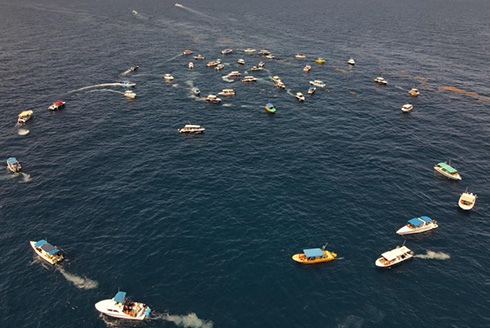
Boats circling whale sharks off off Mexico’s Yucatán coast [Photo courtesy of Kim
Ovitz]
The findings are newly published online in the Journal of Sustainable Tourism.
Griffin, the study’s senior author, first recognized the scale of the problem several
years ago during a family trip to Mexico with his father, Curtice, a biologist at
the University of Massachusetts Amherst and a co-author on the paper.
“We were on a whale shark tour and watched multiple groups of snorkelers converging
on a single whale shark,” he said. “It was chaotic, and it was clear something wasn’t
working.”
That experience led to a formal study of what happens during peak tourism weeks at
El Azul, a 400-square-kilometer aggregation site off Mexico’s Yucatán coast.
Using drones to observe boat behavior, swimmer interactions and the number of whale
sharks feeding at the surface, the team documented hundreds of rule violations — from
boats maneuvering too close to the animals to swimmers touching sharks or crowding
within prohibited distances.
At the time of the study, Mexican regulations limited each whale shark to a single
boat at a time and allowed only two swimmers and one guide in the water, all of whom
must stay at least five meters from the shark’s head and tail.
“We knew it was already pretty hectic, so we knew that our results were going to come
back showing that,” Griffin said.
What they expected held true: More boats and more tourists led to more infractions.
But one finding surprised them.
“What we weren’t expecting was that when there were a lot of whale sharks, infractions
actually continued to increase,” he said. “That’s a bit counter to what we would think.”
The team found that when dozens of whale sharks were present, boats tended to spread
out and pursue individual animals rather than following an orderly rotation. In theory,
this should relieve pressure. In practice, it reduced accountability.
“When there are a lot of whale sharks around, no one is really watching one another,”
Griffin said. “Every boat ends up with its own shark to do as it pleases, and any
sense of peer pressure or mutual enforcement just breaks down.”
Even more striking, violations were widespread even when boat numbers were far below
the regulatory cap of 120 vessels. The study recorded a maximum of 82 boats in 2016
and 68 in 2022 — yet drones still captured constant rule-breaking.
The presence of a patrol boat also made little difference. With so many vessels spread
across a large area, effective oversight was difficult, and swimmers often had no
idea that enforcement was nearby.
“If we’re disturbing them from their feeding behaviors, that could be energetically
expensive,” Griffin said. “You’ll also see a handful of prop scars on these whale
sharks from being run over.”
Large shipping vessels passing through the region can also strike sharks, he said,
though the extent of this impact is still being studied.
For local communities, whale sharks are more than wildlife — they’re a cultural touchstone
and an important economic driver. Tourist demand has skyrocketed since the early 2000s,
and giant murals, sculptures and even community nicknames celebrate the species.
That’s why the researchers stress that while government oversight is important, top-down
rules are only part of the answer.
“Certainly more enforcement, and more continuous enforcement, would help,” Griffin
said. “But it really comes down to self-regulation within the guiding community.”
While tour guides and boat captains already receive training, he added, “Clearly maybe
some more involvement needs to be taking place.”
The findings also matter beyond whale sharks. Griffin argues that the study reveals
a broader blind spot in wildlife tourism, which is often marketed as environmentally
friendly.
“When you really break it down, is it actually harming the species and can it be called
ecotourism?” he asked.
He added that similar questions apply across wildlife tourism worldwide, from manta
ray and sea turtle encounters to whale-watching and even elephant attractions. He
emphasized that any solution must also support the local communities that rely on
whale shark tourism, both economically and culturally.
Rafael de la Parra, a conservation scientist and local whale shark guide who is a
co-author on the paper, says the study’s findings underscore the need for both tour
operators and tourists seeking a once-in-a-lifetime whale shark encounter to recognize
their roles in keeping the animals safe.
Rules for how to safely and responsibly view whale sharks are commonly found on tour
operators’ websites. The operators are required to complete a government-approved
training workshop that covers not only regulations but also the biology and ecology
of the animals. Operators are also expected to verbally communicate guidelines to
tourists on their boats.
“The key is choosing responsible operators who clearly explain and actively enforce
current guidelines,” de la Parra said. “More broadly, tourists should think of themselves
as stewards of these animals. Maintaining your distance and respecting their space
ensures these encounters remain sustainable for future generations.”
He suggests asking operators upfront about group sizes and how they maintain proper
distances from whale sharks.
Like de la Parra, Griffin sees promise in approaches that combine better monitoring
tools — such as drones — with deeper community collaboration. He pointed to other
Mexican regions where co-developed codes of conduct and operator-driven data collection
have improved compliance, noting that progress is underway within local whale shark
tourism.
But such solutions require resources and long-term investment. Local agencies already
“are doing all the right steps and working towards that, including drones to help
monitor activity,” Griffin said. “But it’s challenging because they simply don’t have
the financial resources to fully support these initiatives.”
Griffin said the team is now turning to accelerometer-based tags – tools that record
fine-scale movement – to measure how tourism disturbances affect sharks’ energy use
and long-term health.
“Can we quantify those actual disturbance metrics now?” Griffin said. “We haven’t
solved that piece yet.”
The research was conducted in partnership with the University of Massachusetts Amherst
and Rafael de la Parra, a conservation scientist with Ch’ooj Ajuail AC and local whale
shark guide. Other co-authors include Hoa T.T. Ninh, Curtice R. Griffin and Andy J.
Danylchuk (University of Massachusetts Amherst); and Kimberly L. Ovitz (University
of Manitoba).
