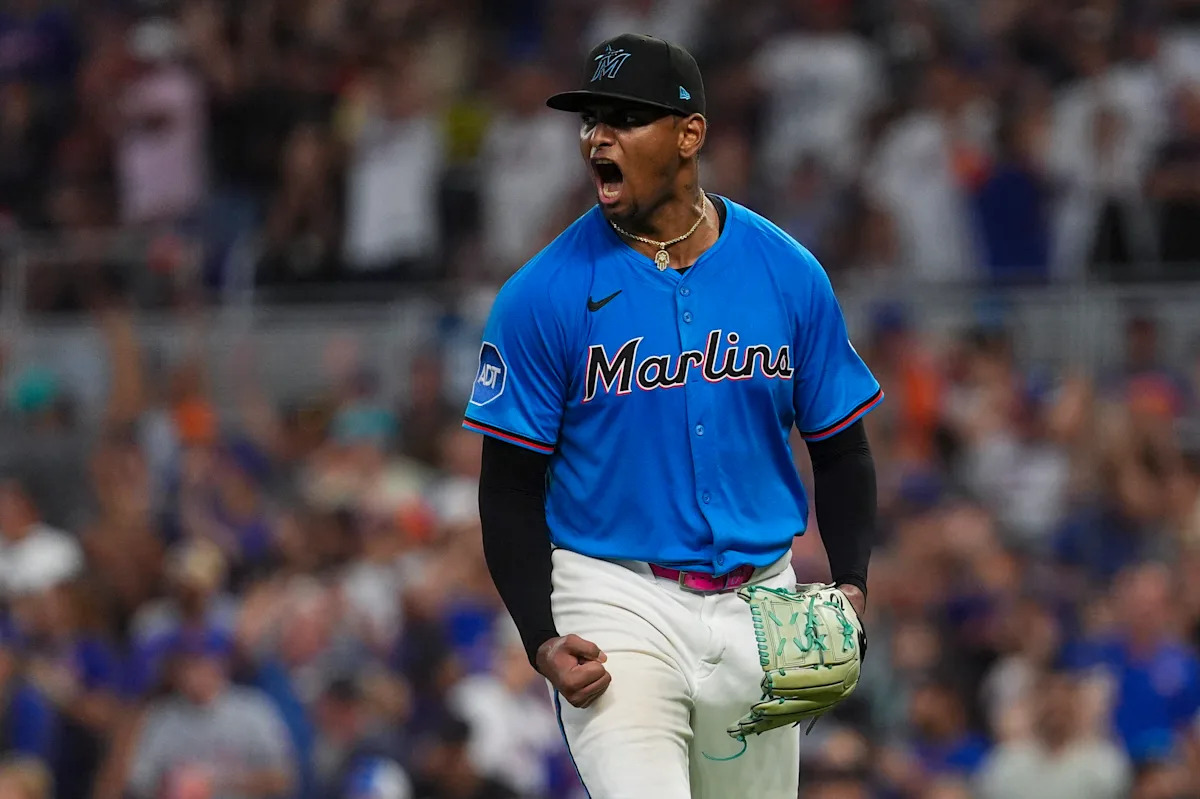
Situated high on the list of contending teams yet to make a splash this offseason, the Chicago Cubs finally made a major move Wednesday, agreeing to acquire right-handed pitcher Edward Cabrera in a trade with the Miami Marlins. In return, the Marlins will receive a trio of hitting prospects, most notably 23-year-old outfielder Owen Caissie, who made his MLB debut in 2025, plus two lower-level bats in shortstop Cristian Hernandez and corner infielder Edgardo De Leon.
To this point, fresh off their first postseason appearance since 2020, the Cubs’ winter activity had consisted almost entirely of signing free-agent relievers, with the return of left-hander Caleb Thielbar (one year, $3.75M), the additions of right-handers Phil Maton (two years, $14.5M), Hunter Harvey (one year, $6M) and Jacob Webb (one year, $1.5M), and the acquisition of another southpaw in Hoby Milner (one year, $3.75M).
Advertisement
While those signings addressed a bullpen that badly needed restocking, much larger questions loomed over Chicago’s offseason. Would the Cubs add an impact starting pitcher to upgrade a rotation that could use a boost, even after retaining lefty Shota Imanaga via the qualifying offer? And if they have no interest in pursuing a reunion with top free agent Kyle Tucker, would the Cubs pursue a different big-time bat to replace his production?
[Get more Chicago news: Cubs team feed]
Speculation continues regarding the plan for the position players. So far, the only hitter added to Chicago’s major-league roster has been first baseman Tyler Austin, returning to MLB for the first time since 2019 after a highly successful half-decade in Japan.
Advertisement
But the acquisition of Cabrera marks a serious effort by president of baseball operations Jed Hoyer to meaningfully improve the starting staff — the kind of move a lot of Cubs fans had been waiting for all winter. No, Cabrera does not come with the track record of high-end results normally befitting a significant offseason splash. But from an upside standpoint — and considering he’s under contract through 2028 — Cabrera unquestionably fits the bill as a worthwhile target and a pitcher for whom Chicago can project exciting growth with the right tweaks.
What the Cubs are getting in Cabrera
Cabrera has always thrown extremely hard, having first touched triple-digits nearly a decade ago as a teenager, in turn jumping on the radar as one of the Marlins’ most tantalizing pitching prospects. Injuries and occasionally severe struggles with command have interrupted his progress toward becoming a reliable rotation member, even once he finally arrived in the majors in 2021. But Cabrera has always had a deep enough pitch mix and thrown just enough strikes to avoid being converted to a reliever, and he rewarded Miami’s patience with a breakthrough in 2025.
Last season, Cabrera sharply decreased the usage of his four-seam fastball, from 27% to 13%, instead amplifying the use of a two-seamer while more effectively deploying his two fantastic secondary offerings: one of the nastiest curveballs in the league and a changeup that averages a ridiculous 94.2 mph. After a rough April (7.23 ERA in 18.2 IP), Cabrera’s upgraded mix helped him excel the rest of the way in 2025, with a 2.95 ERA across 119 frames, which ranked eighth-lowest among National League starting pitchers over that span. Add a career-low 8.3% walk rate — an encouraging step in the right direction after he began the season with a 13.3% free-pass percentage — and it’s no surprise that Cabrera was considered an alluring trade target this winter.
Advertisement
But for all the positive indicators in Cabrera’s profile, there’s also substantial risk involved. Beyond the inconsistent strike-throwing, the biggest reason Cabrera has yet to amass enough of a résumé to earn more of a reputation as a quality starting pitcher is his troubling injury history. Since his debut in 2021, the right-hander has repeatedly battled arm ailments, including elbow tendonitis in 2022, shoulder impingements in 2023 and 2024, and an elbow sprain at the start of September. He returned in time to make two starts at the end of the regular season and finished 2025 with a career-high 137 ⅔ innings, but that late-season scare is difficult to shrug off considering his spotty track record of durability.
This unavoidable red flag with Cabrera looms even larger considering it was just a year ago when the Marlins and Cubs nearly made a trade for Jesús Luzardo before Chicago reportedly backed out due to concerns about Luzardo’s medical records. Luzardo was eventually traded to Philadelphia and went on to throw a career-high 183 ⅔ innings, a reminder that predicting pitcher health is a fickle exercise. Perhaps Cabrera will prove more dependable than expected as a Cub, but his availability will certainly be something to monitor.
What the Marlins are getting in return
At first glance, Miami’s three-player return for Cabrera might look light compared to the four-prospects-plus-a-draft-pick haul that Tampa Bay netted last month for right-hander Shane Baz, another starter with three years of team control left and terrific stuff who has yet to fully actualize his potential. Perhaps Cabrera’s trade value was diminished by concerns about his durability, but it’s worth noting that the Marlins landed a headliner who is expected to contribute in the majors right away. Whereas the Rays netted a slew of exciting prospects who might not be big leaguers for a while (if ever), in Caissie, the Marlins added a player who could pay dividends immediately. As such, a lot is now riding on Caissie to validate the Marlins’ decision to build a Cabrera trade around him.
That’s not to dismiss Hernandez and De Leon, as both could emerge as useful players down the road. De Leon showed impressive power as an 18-year-old in the Arizona Complex League last summer. Hernandez’s shaky hit tool has slowed his development despite promising speed and defense, but his physical traits have enticed talent evaluators for years; he received one of the largest signing bonuses ($3M) in his international signing class in 2021.
Advertisement
But make no mistake: This deal is about Miami’s belief that Caissie can become an important part of its lineup for the long haul and could contribute to a winning ballclub in 2026. In the Marlins’ outfield, he’ll join Kyle Stowers and Jakob Marsee, two other left-handed hitters who were acquired in trades that blossomed in a big way for the Fish last season.
This is actually the second time Caissie has been traded in his young career, having been dealt to the Cubs in the trade for Yu Darvish just a few months after the Padres selected him out of a Canadian high school in the second round of the 2020 draft. Since then, Caissie has ascended the minor-league ladder, consistently demonstrating his premium left-handed power while working to keep his strikeouts at a manageable level. He has posted an above-average wRC+ at every minor-league level, thanks in large part to his power production but also due to his ability to take walks, ensuring strong on-base skills that have helped mask the elevated whiffs.
A crowded outfield depth chart in Chicago resulted in Caissie playing a whopping 226 games in Triple-A over the past two seasons — a uniquely bloated total for a top prospect — and he performed quite well across that sample (.887 OPS). With Tucker expected to depart in free agency, it seemed like the door was open for Caissie to finally get some real run as a Cub in 2026. Instead, Chicago traded him to address another roster deficiency, amplifying the existing questions about the team’s plan to replace Tucker in the outfield and the lineup in both the short and long term.
Advertisement
After a forgettable (and incredibly brief) big-league cameo in August, Caissie has yet to prove that his offensive profile will translate at the highest level. His 28% strikeout rate over a sizable sample of Triple-A plate appearances could portend an extended adjustment period in the majors. But nowadays, it’s hardly uncommon for some sluggers to be productive while striking out a bunch — just ask Caissie’s new teammate Stowers. And with another wave of promising arms prepared to backfill Cabrera’s innings, the Marlins were smart to target Caissie in this trade as they continue to build a more formidable position-player core.
