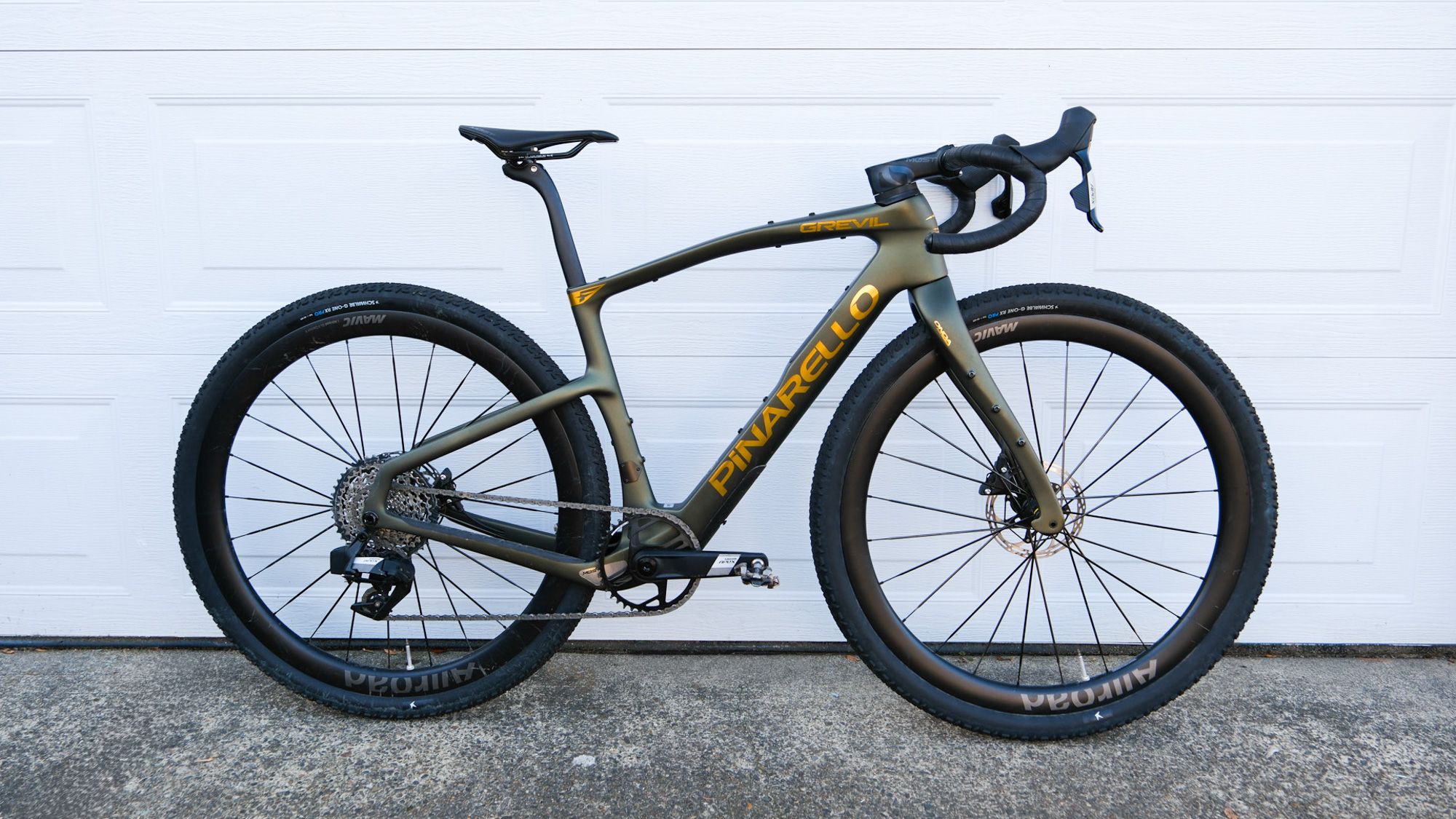
When Pinarello officially launched its Grevil F collection last July, it was old news, really. The Italian brand had already quietly rolled a handful of these bikes out at gravel’s biggest stage: Unbound Gravel in Kansas in May. And while the frames were given a branding-free, covert paint job (eye-catching in its own right), the signature wavy fork blades and sinuous tubing were a dead giveaway.
Unbound isn’t where you hide experimental ideas; it’s where you prove them. And Axelle Dubau-Prévot (yes, sister of Tour de France winner Pauline Ferrand-Prévot) lined up on one of these unreleased Grevil F and rode it to a top-30 result that weekend.
Meet the new Pinarello Grevil F
(Image credit: Anne-Marije Rook)
While the Pinarello Dogma GR is the light and aero race weapon of choice for riders like Tom Pidcock and Hugo Drechou at shorter events such as the UCI Gravel World Championships, the Grevil F was designed specifically for the long game. Think long, arduous and rough races like Unbound Gravel, The Rift and Gravel Burn, where stability, comfort and efficiency over many hours matter more than outright punch.
The original Grevil has been around since 2018 and was updated in 2021 to accommodate 50mm tyres, making it an early adopter of MTB-sized rubber in the gravel world. That same clearance carries over to the latest generation, along with a series of other endurance-focused features. These include in-frame storage, integrated rack and frame bag options that have been aero-optimised around the frame, and even dedicated gravel TT bars for those ultra-long solo efforts. To that end, the downtube itself has been reshaped to improve aerodynamic efficiency when running 750ml bottles.
Added comfort was also a consideration in the frame design. There’s a new adaptive seatpost that offers up to 10mm of longitudinal flex, working in tandem with the revised seatstay shaping to take the edge off rough surfaces over long distances.
Up front, cable routing has moved to Pinarello’s fully integrated TiCR system for a cleaner cockpit, and the Onda fork now comes with size-specific rake options to keep handling consistent across the size range.
The carbon layup structure has also been expanded into a clearer performance ladder. Following Pinarello’s naming convention, the F9 sits at the top of the range, with both the F9 and F7 using T900UD carbon. The F5 and F3 use T700UD, while the entry-level F1 uses T600. In simple terms, the higher-end models are lighter and stiffer, while the lower-tier frames trade a bit of performance for affordability and comfort.
We received the Grevil F3 in for review, finished in a lovely dark metallic green colourway, the brand calls Etna Black. It came equipped with a 1×12 SRAM Apex XPLR AXS drivetrain, aluminium cockpit and DT Swiss G1800 wheels wrapped in 40mm Vittoria Terreno T50 tyres.
Specs:

(Image credit: Anne-Marije Rook)
- Groupset: 1×12 SRAM APEX AXS XPLR wireless electronic
- Wheels: DT SWISS G1800
- Tyres: 40mm Vittoria Terreno T50 (stock tyres are 45mm Vittoria Terreno T50)
- Handlebars: MOST Jaguar XA GR TiCR
- Saddle: MOST Lynx
- 50 mm Tire Clearance
- In-frame downtube storage
- Tool-free Thru-Axles
- MSRP:
SRAM: $3700 / €4,300 / Not available in the UK
SHIMANO: €4,300 / £4,000 / Not available in the US
The Ride

(Image credit: Anne-Marije Rook)
When I first picked up the Pinarello Grevil F3 test bike, I honestly thought it was a bit of an odd duck. Granted, I probably should have been on a smaller size, but even so, the proportions felt off. The stack was tall, the bars were about two sizes too wide, the seatpost had more setback than I’d ever choose, and at 40mm, the tyres looked almost timid on a frame that’s clearly built to accommodate more. I stood there in the driveway looking at it, thinking: I’m not sure we’re going to get along.
For reference, I’m a former road racer with a propensity for underbiking (i.e. opting for a Specialized S-Works Crux at the 350-mile Unbound XL and then not feeling my hands for a week).
On paper, the numbers told a similar story. The stack on this 50cm Grevil is roughly 30mm taller than my personal gravel bike, yet the reach was only one millimetre shorter. So my first job was to get the bars down. I dropped the stem as far as the steerer would allow, which left an ungodly amount of steerer tube showing above the stem. Not the prettiest look, but function over form.

Ungodly amount of steerer above the stem, I know. But function over form…
(Image credit: Anne-Marije Rook)
Even then, between the wide bars, the laid-back seatpost and the upright front end, I set off for my first ride with more than a few reservations. I was half expecting the bike to handle like a limousine.
Instead, about ten minutes in, I literally laughed out loud. I didn’t just like the Grevil F — I really liked it.
Ripping through a city park on my way to a bigger loop, the bike immediately reminded me of a cyclocross bike. Where I was expecting an efficient yet somewhat dulled ride, the efficiency was paired with a playful snap and an eagerness I simply didn’t see coming.
On twisty singletrack and tight, rutted gravel lanes, it never felt like I was wrestling a long endurance machine. It encouraged me to flick it through corners, get out of the saddle and push push push. It keeps you planted while keeping the fun alive. In one word: sporty. For a bike that’s capable of going the distance and carrying all your stuff, it still has a pep in its step for a speedy hot lap or a lunchtime rip.

(Image credit: Anne-Marije Rook)
Even in this lower-tier build, with T700 carbon and a more accessible spec, it doesn’t feel compromised. In fact, that’s one of the biggest takeaways from riding this bike: the overall balance makes you forget that, in Pinarello terms, this sits at the more affordable end of the range.
The frame is excellent, and I’ve been a fan of the SRAM Apex AXS drivetrain since its release. The DT Swiss G1800 wheels aren’t exactly featherweight, but they do the job. During testing, I was quick to swap them out for a set of Mavic AllRoad SL Carbons wrapped in 50mm Schwalbe G-One RX tyres (incidentally, the same hoops Axelle Dubau-Prévot is running on her Grevil F). I wouldn’t say the stock wheels hold the bike back, per se, but a lighter package definitely brings more out of it.
The bike’s geometry wasn’t nearly the obstacle I first imagined it to be. And yet, it still puzzled me. While at first glance the Grevil appeared too tall, too big, too wide, after some time with the bike, I actually decided I wouldn’t want to go any smaller. The reach fit me well.
If this were my bike, I’d stick with the frame size, but I’d take a hacksaw to the steerer, go straight to 38cm bars, and swap the seatpost for a zero-setback option. I might even go a touch longer on the stem, and slam it, which usually isn’t my M.O. at all, but: stack height.
That said, I’m still a racer at heart, and these are mere preference tweaks. The underlying ride quality is there. The geometry works. The handling works. The racer in me would, perhaps, be better suited to a Dogma GR, but I also love nothing more than all-day (or all-weekend) adventures out in no-man’s land, where comfort and luggage capability are essential. With a few tweaks, the Grevil F can do both, and that’s the beauty of this bike.
Value & Conclusion

Plenty of mounting options on the Pinarello Grevil F3
(Image credit: Anne-Marije Rook)
The Grevil F was one of the more surprising, and also one of the most enjoyable, bikes I rode all year. And at $3,700, it’s a bike you can actually buy without breaking the bank.
I went into this test thinking the Grevil F would be competent, sensible and maybe a bit conservative. What I found instead was a bike that’s capable yet engaging, and genuinely fun to ride. It doesn’t feel like a compromise between race bike and adventure bike. It feels like a modern gravel bike that understands that long events still involve attacking, cornering and sprinting, and that the best thing about riding bikes is playing on them.
Just maybe go try one on for size before buying.
Image 1 of 4


