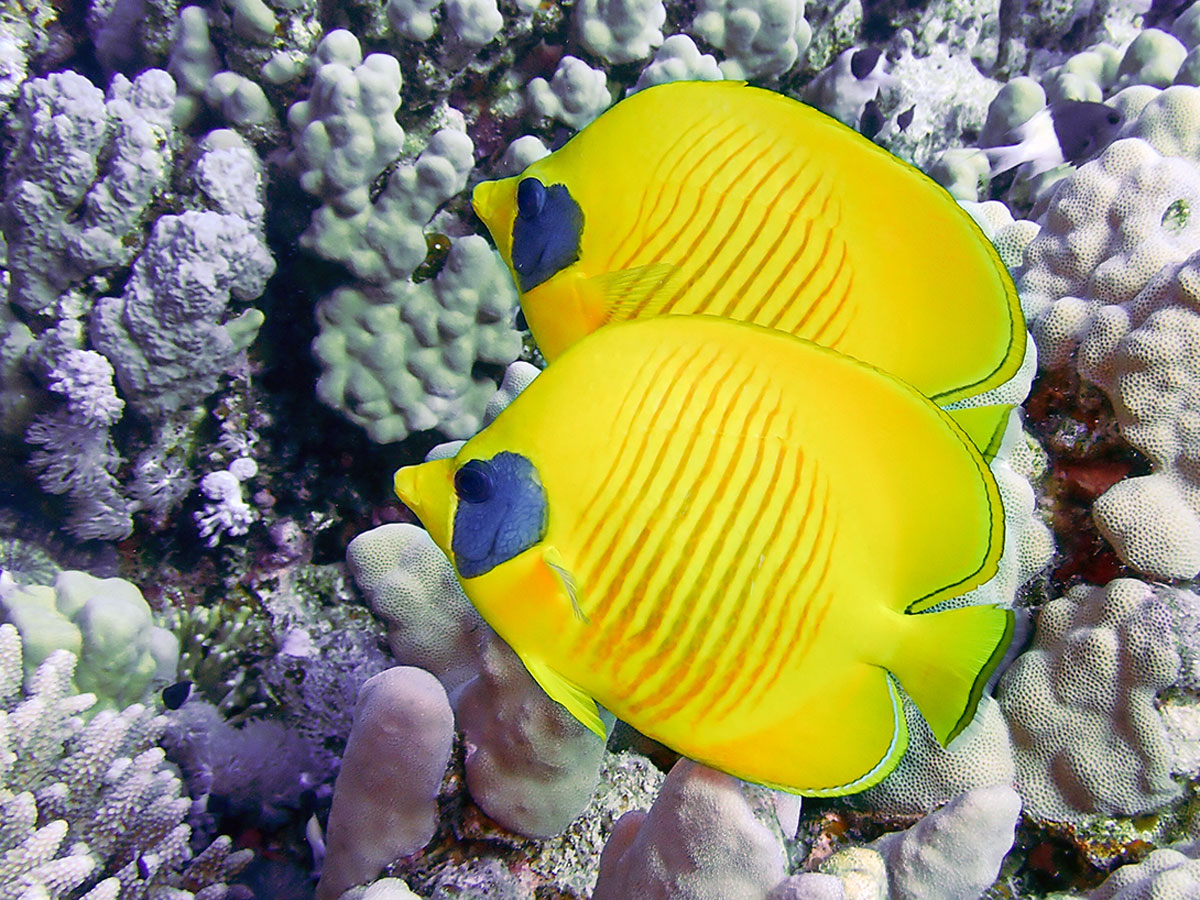
A beautiful golden yellow with a distinctive blue-grey eye patch, divers can easily spot and identify the masked butterflyfish in the Red Sea and the Gulf of Aden.
Taken in Soma Bay, Red Sea. Jill Studholme
The butterflyfish family, or Chaetodontidae, are small, colourful fishes with a continuous dorsal fin. At around 23 cm long, though, the masked butterfly fish is large for its family. Chaetodontidae is the Greek for bristle teeth and indeed they do have small, brush-like teeth. The specific part of the name, semilarvatus, means half masked in Latin.

Unusual behaviour
When preturbed the masked butterfly fish doesn’t immediately flee but turns sideways showing one side of their body to the potential predator. As their eye is hidden by the mask, the hunter’s normal primary target is concealed and the butterfly fish may zig zag back to safety. This behaviour makes photographing them somewhat easier than with many other fish.

Monogamous pair for life
The Masked butterfly fish form a faithful pair that remains together for years, if not life.

The longest monitoring study of the butterflyfish, over seven years, revealed that they stayed together throughout that time. (They live for more than 10 years.) As butterflyfish have planktonic larvae without any broodcare, monogamy hasn’t evolved in response looking after offspring as in many other vertebrate groups. It is probably territorial: a pair can protect their feeding territory more successfully than individuals.

Eats day and night (but mostly night)
The masked butterflyfish feeds on coral polyps by day and night. They seem to eat most during the night and late in the evening. Since coral tissue is poor in nutrients, the fish has to eat more often than carnivorous species.

A stand-out species
The masked butterflyfish is not only striking in appearance but also fascinating in behaviour. Its lifelong pairing, unique predator avoidance tactics, slow swimming and beauty make it a stand-out species on the reef.
References
Neudecker, S. (1989). Eye camouflage and false eyespots: chaetodontid responses to predators. In: Motta, P.J. (eds) The butterflyfishes: success on the coral reef. Developments in environmental biology of fishes, vol 9. Springer, Dordrecht.
Nowicki JP, O’Connell LA, Cowman PF, Walker SPW, Coker DJ, Pratchett MS. Variation in social systems within Chaetodon butterflyfishes, with special reference to pair bonding. PLoS One. 2018 Apr 11;13(4):e0194465.
Butterflyfishes of the Southern Red Sea. Zekeria. 2003
