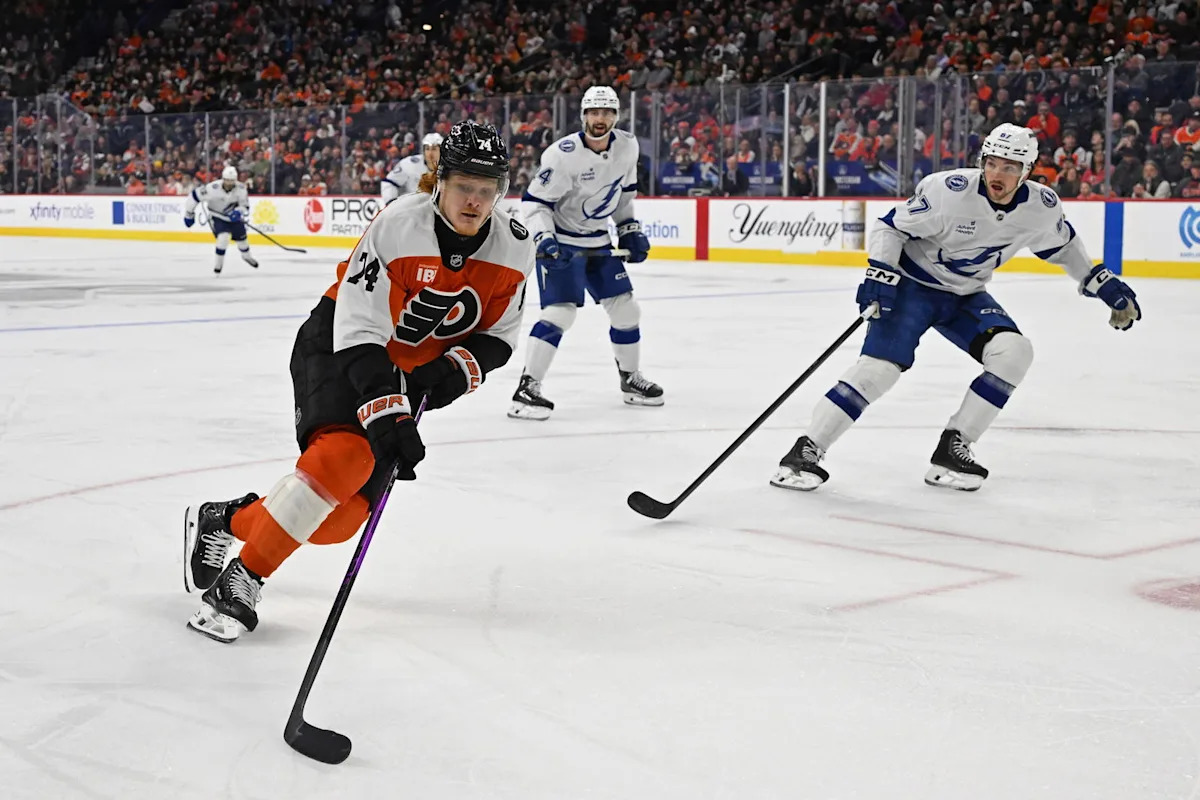
The final score tells the truth without offering much nuance. The details, as always, matter more.
The Philadelphia Flyers‘ 7–2 loss to the Tampa Bay Lightning was their second defeat in as many meetings this season against a team operating at a very specific, very unforgiving level right now. The Flyers will get one more chance to adjust when the season series concludes Monday, but Saturday’s game made clear how quickly the game slip away when structure slips against a team that thrives on pace, precision, and punishment.
1. This Was Not Purely a Goaltending Loss, Even If the Goaltender Wore It.
Sam Ersson had a difficult night. The goals came in waves, the building grew restless, and the optics were unkind. But inside the Flyers’ room, there was little appetite for assigning blame to the goaltender alone.
Advertisement
Tampa Bay scored by stretching the ice east-west, attacking seams before coverage could reset, and forcing Ersson into repeated lateral reads with traffic collapsing the crease. Those are high-danger looks even when executed imperfectly; Tampa executed them cleanly.
Ersson’s teammates recognized it immediately. Players went to him during the game to offer encouragement. Postgame, the decision not to make him available was organizational.
“We’ve gotta be better in front of him,” Owen Tippett said postgame. “Those are tough games to play… I don’t know if the sarcastic cheers are really appreciated, but we’ve gotta do a better job in front of him.”
Advertisement
Garnet Hathaway echoed that sentiment, revealing that his message to Ersson was to “keep his head up. I don’t think we played as defensively sound as we needed to. We’re a very offensive-minded team, and that’s not on him. He’s played great all year. So forget it; put it in the past.”
Rick Tocchet, meanwhile, struck a balance between accountability and protection.
“He’s struggling a little bit; you can tell a little bit,” Tocchet said. “You’re gonna have tough nights. If you have an NHL career, sometimes you’re gonna be in the mud, and you’ve gotta get yourself out of it. You’ve gotta work harder, you’ve gotta analyze things—not just [Ersson], anybody.”
Advertisement
Then, pointedly: “We’ve gotta work with him; we’ve gotta help him out, too—whatever we have to do to help him, mental or physical.”
This was a team loss. Ersson absorbed it because goaltenders always do, but the breakdowns began well before the puck reached him.
2. Tampa’s East-West Game Exposed Every Half-Second of Hesitation.
There are teams that beat you by volume. Tampa Bay beats you by speed of decision.
The Lightning punished the Flyers with an unrelenting east-west attack that forced defensive switches, pulled coverage out of shape, and turned small delays into open ice. Once Tampa established rhythm, Philadelphia struggled to disrupt passing lanes early enough to prevent those sequences from forming.
Advertisement
That’s not to say the Flyers were completely silent. They had moments—stretches where they generated chances, forced Andrei Vasilevskiy into difficult saves, and even tilted the ice briefly. But against a team this sharp, those windows close quickly.
Rick Tocchet’s assessment was that he “didn’t mind half the game. You’re gonna have those kinds of games, but we do need some better efforts. A couple of our guys that we count on to score turned the pucks over a little too much. You can’t play that way.”
3. The Flyers Generated Chances—They Just Didn’t Finish Them.
One of the more frustrating aspects of the loss was that it wasn’t devoid of offensive opportunity. The Flyers scored twice—Garnet Hathaway’s first goal of the season and Owen Tippett’s power-play marker, his 14th—but they left several other chances on the table.
Advertisement
Christian Dvorak extended his point streak to three games with an assist, while Noah Juulsen and Rodrigo Abols also contributed helpers. The offense existed, and noticeably so, but the execution did not.
Some of that credit belongs to Vasilevskiy, who was calm, square, and efficient. Some of it belongs to Tampa’s ability to recover defensively after initial breakdowns. And some of it falls on Philadelphia’s inability to capitalize when the game was still within reach.
Garnet Hathaway (19). (Megan DeRuchie-The Hockey News)
4. This Game Was a “Learning Lesson.”
The Flyers will play Tampa Bay again on Jan. 12, and both players and coach highlighted the importance of having short memories and taking this game as a learning opportunity so they can be better against the Lightning next time around.
Advertisement
“Everybody’s tired of hearing it, but it’s a learning lesson,” Tocchet said. “You learn, you apply it, and be better, which our team has done.”
What matters now is not how they felt leaving the ice, but what they retain from it—about puck management, defensive spacing, and how quickly games can get away from you when structure slips.
The Flyers didn’t lose because they stopped trying. They lost because Tampa never took their foot off the gas. That distinction is uncomfortable, but can be ultimately useful with such a quick turnaround.
