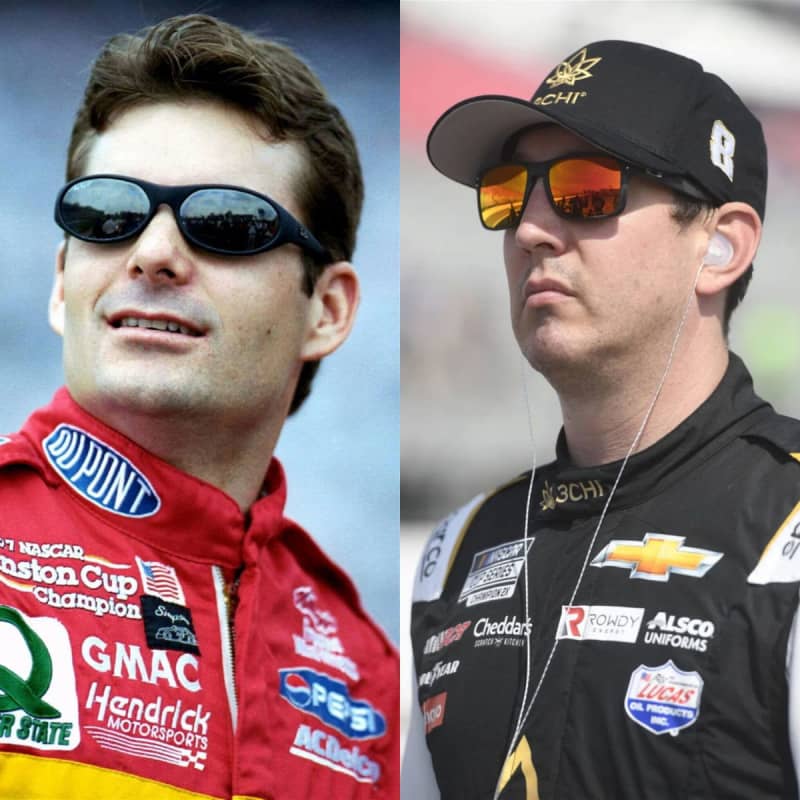
Jeff Gordon wasn’t just a driver at Hendrick Motorsports. He was Hendrick Motorsports. From his full-time debut in 1993 through his farewell in 2015, Gordon became the gold standard for what a franchise driver looks like. Four Cup Series championships (1995, 1997, 1998, 2001), 93 wins, clean racing craft, and an ability to elevate the entire organization made him Rick Hendrick’s unquestioned centerpiece.
He drove hard, but rarely crossed the line, combining raw speed with restraint and race-long intelligence. And that’s where the comparison begins. Because when Kyle Busch arrived at Joe Gibbs Racing, many wondered if he could become Gibbs’ version of Jeff Gordon. The results, however, told a very different story.
Advertisement
Arrival at Joe Gibbs Racing
When Kyle Busch signed with Joe Gibbs Racing in 2008 at age 23, expectations soared to Jeff Gordon heights. It was the perfect prodigy blueprint for transforming organizations. He had won the 2004 NASCAR Busch Series Rookie of the Year as well as the 2005 NASCAR Nextel Cup Series Rookie of the Year awards. This was thanks to his numerous wins in both series at tracks like Bristol and Phoenix.
Early success suggested that Busch was just getting started and that a full championship run with Gibbs could cement him as a generational superstar. And to his credit, Busch delivered fast results. In 2008 alone, Busch won at Atlanta, Talladega, Dover, and Daytona, to name a few. He finished the season in tenth place, announcing his arrival and cementing his place at the organization.
Kyle Busch eventually won two Cup Series championships (2015, 2019) and amassed 63 career Cup wins, putting him among the sport’s all-time leaders. But the broader pattern of his career at Gibbs revealed a more complex picture. Busch was an elite driver capable of winning almost anywhere, yet too often undone by inconsistency at critical moments.
Advertisement
Talent without taming
One of the most revealing statistics about Busch’s career isn’t his wins. Rather, it’s the wins he missed – his second-place finishes. In NASCAR Cup history among current drivers, Busch is among the leaders in runner-up results, a stat often overlooked but telling when evaluating peak execution. According to historical data, Busch’s runner-up finishes sit near the top of the all-time list, alongside legends like Jimmie Johnson and Denny Hamlin.
Active NASCAR Cup Series leaders in 2nd-place finishes:
Those numbers underline just how often Busch has been right there. He’s close enough to win, but not quite able to seal the deal. Now imagine if Busch had converted even half of those second-place finishes into victories. Adding 20 or so wins to his résumé would have vaulted him well past many NASCAR legends, placing him firmly alongside Jeff Gordon and Dale Earnhardt Sr., and perhaps even putting Richard Petty’s once-unthinkable record into conversation. But, sadly, it remains a would have!
Advertisement
The discipline gap
So why didn’t Kyle Busch become his team’s version of Jeff Gordon? The answer comes down to discipline under pressure. Jeff Gordon’s success wasn’t just a product of winning races. It was rooted in an ability to consistently extract maximum performance while minimizing mistakes. Gordon’s career numbers speak to that balance:
-
93 Cup wins – one of the highest totals in NASCAR history (3rd overall)
-
Multiple championships spread across years of dominance
-
Rarely a season derailed by high-profile incidents
Gordon was fierce in battles but surgical in execution. His discipline, especially in late-race situations, helped him convert opportunities that others (including Busch) often let slip.
via Imago
Busch, by contrast, has always been known as a high-risk driver. His approach worked wonders in open wheel and early stock car development, but in Cup-level competition, where margins are microscopic, those same instincts too often led to overdriving rather than outthinking the competition. The result? An elite talent who was simultaneously one of the most dangerous drivers and one who too often saw wins slip through his fingers.
Advertisement
Remember the 2015 Daytona crash? A moment that, in many ways, crystallized both Kyle Busch’s fearlessness and his flaw.
With just a few laps remaining in the Xfinity Series season-opener at Daytona, Busch’s No. 54 Toyota veered off the track, skidded through the grass, and slammed head-on into an interior concrete wall that lacked a SAFER barrier. The trigger wasn’t mechanical failure or bad luck.
Busch was trying to force the issue, pushing teammate Erik Jones through the middle of a tightly packed field. The consequences were brutal. Busch suffered a badly broken right leg and a broken left foot. The injuries sidelined him from the Daytona 500 the very next day and forced him to miss the following six Sprint Cup Series races.
That incident wasn’t an isolated moment; it was emblematic of Busch’s career arc. His willingness to push limits made him spectacular to watch and earned him the nickname “Rowdy.” But at the Cup level, where championships are often decided by restraint rather than bravado, that same mindset repeatedly worked against him. Busch wasn’t lacking talent—far from it. He was lacking containment.
Advertisement
Now, this isn’t to diminish Busch’s greatness. He’s a champion with a resume that belongs in the Hall of Fame and a competitor respected by peers for his sheer speed and racecraft. But when it comes to leading a team’s identity the way Jeff Gordon did at Hendrick Motorsports, Kyle Busch didn’t leave the same mark at Joe Gibbs Racing.
Conclusion: Talent isn’t enough
In the end, Kyle Busch and Jeff Gordon are both legends of the sport. But they represent two very different models of greatness.
Gordon’s legacy is one of precision, discipline, and franchise-defining leadership. Busch’s legacy is one of raw talent, competitiveness, and near-miss brilliance.
Advertisement
Busch simply lacked the blend that made Gordon not just a champion, but a standard-bearer for a team’s identity. He was a spectacular driver, ferocious and gifted, but never quite the heart of his organization in the same way. That distinction, more than anything else, explains why Busch could never become Joe Gibbs’s very own Jeff Gordon.
The post Why Kyle Busch Could Never Become Joe Gibbs’s Very Own Jeff Gordon? appeared first on EssentiallySports.
