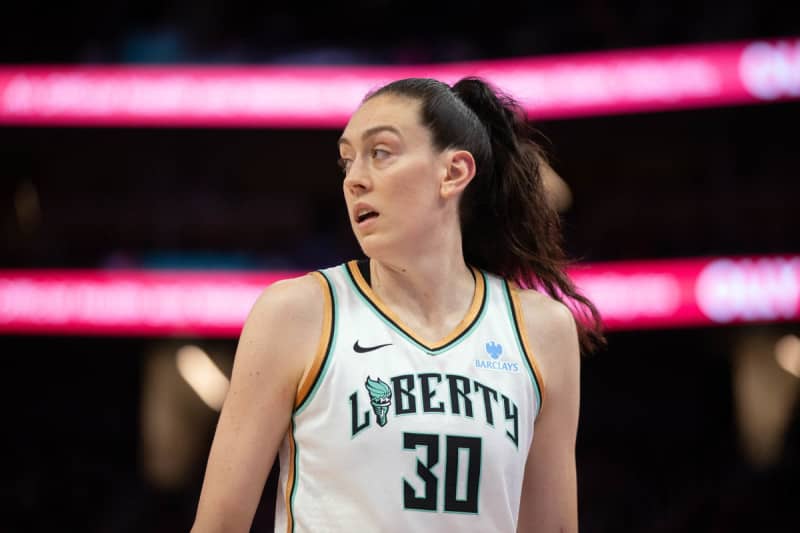
Fed up with the WNBA’s limits, Breanna Stewart and Napheesa Collier didn’t wait for change. In 2023, they created their own rules with the creation of Unrivaled. It is intended to be a 3 vs 3 offseason league catered to the players. They offered much higher salaries than the WNBA, a stake (for first-year players), and better conditions than playing overseas, while also providing a fast-paced 3×3 game format. Season 1 was a great success, and they are only perfecting the format in the second season.
“The last game I was warming up, and I was like, can you believe we did back-to-backs last year?” Breanna Stewart said on the TNT broadcast. In its inaugural season with 6 teams, they played only 3 nights per week, with a total of 15 back-to-back games happening over the course of the year. This season, they expanded to 8 teams with the addition of Breeze and Hive, but eliminated the back-to-backs as well. Instead, they are now playing 4 nights a week to accommodate the new teams. It’s a decision Stewart thinks plays a vital role in player welfare.
Advertisement
“Just the ability to know that you’re able to compete, give your all, and you have a day in between your next game is incredibly important because back-to-backs are tough, and we have more than one of them throughout the season,” She said. “It wears on your body, and here we’re able to have a good flow just from a week standpoint, where you get your work in individually, get your work in as a team, and then you go play.”
Back-to-back games have been a contentious point in basketball for years now. That is not limited to the WNBA, NBA, or even the international leagues, where the players have to endure tough schedules. If these players had to go outside the US, as they used to before Unrivaled, they would face the wrath of back-to-back games. On returning, they would be thrown in the condensed WNBA, which already had an adverse impact last year.
When the WNBA upped the schedule to 44 games, it kept the season length the same as earlier. That naturally increased the density of games. To make matters worse, the scheduling was disoriented. Some teams played 2 or 3 back-to-backs, but the Seattle Storm did not play any. The more sticking point, however, most teams like the Chicago Sky, Storm, Mercury, and others played 20+ games with just a day of rest. Keep in mind, these are 5 v 5 games at arguably higher intensity than Unrivaled. It led to a season record of 252 injuries, up from 204 in 2024 (per the IX).
There were notable injuries in the 2025 Unrivaled as well. For example, Betnijah Laney-Hamilton had a knee injury she sustained as a relief player in Unrivaled and missed the majority of the WNBA season. Removing back-to-backs is an important step in solving that problem. NBA studies suggest that playing back-to-backs can increase injury probability.
Advertisement
The urgent nature of the decision also indicates that the league is committed to working to give the best environment for the players. Breanna Stewart and Co. are trying to do the same with the upcoming CBA. However, they could be making it worse before making it better.
Possible 2026 Season Delay Set To Worsen WNBA Scheduling
The 2026 WNBA season is now in serious danger of being delayed. The deadline of January 9 passed without any extension as both sides entered a status quo. “We’re just going to continue to negotiate in good faith,” Breanna Stewart said. Now, the free agency has been frozen by a moratorium agreement.
“The moratorium will apply specifically to free agency, sources told FOS, including the sending out of qualifying offers, core designations, signings, and all negotiations,” Annie Costabile wrote. “An email was sent to front office executives on Monday evening explaining the terms of the moratorium, league sources told FOS. The free-agency pause will end once a new collective bargaining agreement is ratified.”
Advertisement
Free agency extension is effective until they agree to a new CBA. Based on the current signs, that will likely take some time. Even after the CBA is agreed upon, this is not a normal free agency. Most of the league (around 80%) is currently without a team in anticipation of the new ‘transformational’ CBA.
There will be a record number of deals signed and immense movement in the market. Everything of which will take some time. So, the league can’t assign a very limited period to get it over with. Then the WNBA has the 2025 Rookie draft and the expansion draft with two teams to complete. There could be a delay in starting the 2026 WNBA season, which would normally begin in mid-May.
You can’t extend beyond November because of the NBA and the rest of the American Sports seasons beginning. Many WNBA teams share facilities with them, and the league risks losing broadcasting slots as well. All in all, the league has an astronomical task to plan a normal regular season.
The post Co-Founder Breanna Stewart Pinpoints Key Unrivaled Advantage Players Rarely Get Elsewhere appeared first on EssentiallySports.
