Quality over quantity
Statistical overview (classical chess)
- Rating in January 2025: 2692
- Rating in January 2026: 2726
- Rating gain: +34 Elo points
- Total classical games: 54
- Total points: 35½
- Score percentage: 65.74%
- Wins: 19
- Draws: 33
- Losses: 2
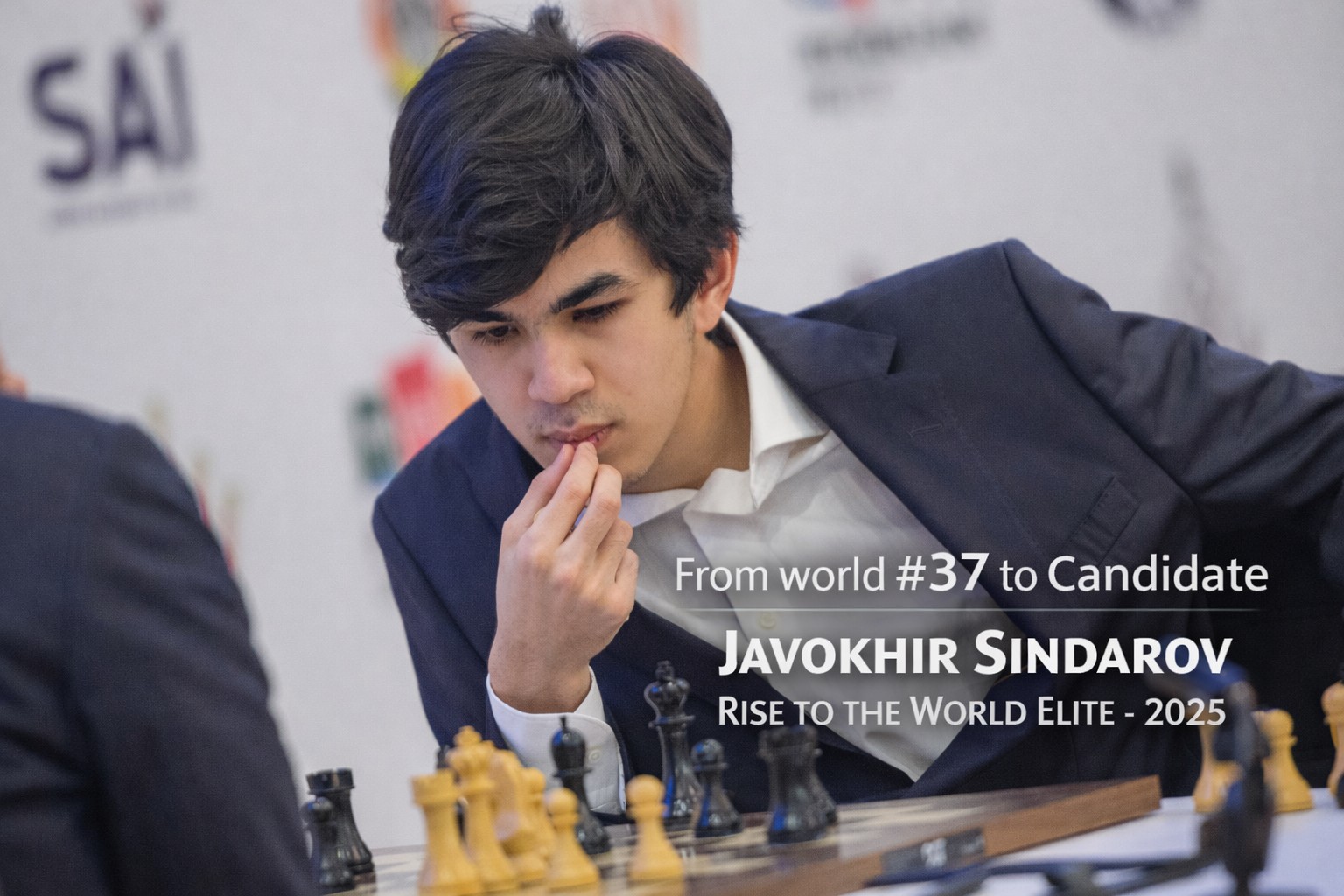
Born on 8 December 2005 in Tashkent, Javokhir Sindarov has long been regarded as one of Uzbekistan’s most promising talents. He became a grandmaster at the age of 12 years, 10 months and 8 days, then the second-youngest in history, a record that now places him fifth overall (Abhimanhyu Mishra and Yagiz Kaan Erdogmus joined the list ahead of him).
Unlike some of his contemporaries, such as Gukesh Dommaraju, Praggnanandhaa Rameshbabu and Vincent Keymer, Sindarov’s rise through the rating lists was gradual rather than rapid. Nevertheless, 2025 proved decisive, as he qualified for the Candidates Tournament and reached a new career-high Elo rating.
After getting the GM title and crossing 2500 at the end of 2018, Sindarov required more than three years to break the 2600 barrier, which he finally did in December 2021. A further two years passed before he exceeded 2700, briefly reaching 2701 in December 2023. He then stepped away from classical tournaments until March 2024, when a difficult outing at the Aeroflot Open dropped him back into the 2600–2700 range.
Sindarov entered 2025 rated 2692, and by the end of the year stood at 2726, the highest rating of his career.
Sindarov played a relatively light classical-chess schedule in 2025, competing in only five tournaments and a total of 54 games. A substantial portion of these games came in the German Bundesliga. During the 2024–25 season, he represented Düsseldorfer SK, helping the team claim the championship with an undefeated 12/14 score. He then began the 2025–26 season playing for OSG Baden-Baden. His league performances were a key element in maintaining stability and confidence throughout the year.
Outside the Bundesliga, Sindarov appeared in two invitational events. At the TePe Sigeman & Co. in Sweden, he won the tournament outright with 4½/7. Later, at the UzChess Cup, he scored 5½/9 and finished tied for first place – Praggnanandhaa took the title in Tashkent after beating Nodirbek Abdusattorov in a blitz playoff.

Javokhir Sindarov taking a stroll during the final round of the TePe Sigeman & Co. tournament in Malmö | Photo: Mikael Svensson
The King’s Indian Defence is one of the most dynamic openings in chess – and Pirc structures share much of the same DNA. With colours reversed (the King’s Indian Attack), these setups can be just as powerful. What may look modest at first often transforms into highly complex middlegames, where timing, precision, and a deep feel for dynamics make all the difference.
Free video sample: Introduction
Free video sample: Misplaced Pieces
The remaining two classical events of Sindarov’s year were the most consequential. At the FIDE Grand Swiss, he scored 6½/11, finishing 1½ points behind the winner Anish Giri. The defining moment came at the FIDE World Cup, a gruelling 206-player event in which Sindarov remained undefeated in classical games throughout. He went on to win the tournament, defeating Wei Yi in the final, thereby securing his Candidates berth.
Across all classical play in 2025, Sindarov suffered only 2 losses in 54 games, a striking statistic even when set against a relatively modest volume of games. Although his overall rating gain was limited and he ended the year only ranked 21st in the world, the results highlighted a particular strength: his ability to perform in high-pressure situations.
This quality had been evident earlier in his career, notably at the 2021 World Cup, where he eliminated Alireza Firouzja at the age of 15, and again at the 2023 World Cup, where he knocked out Maxime Vachier-Lagrave. At the 2023 Grand Swiss, he entered the tournament as the 43rd seed and finished 8th, obtaining upset victories over Vladislav Artemiev, Sam Sevian and super-GM Levon Aronian.
Taken together, these precedents underline why Sindarov is regarded as a dangerous opponent in top events. With the backing of the Uzbek Chess Federation and a proven capacity to deliver under intense pressure, 2025 stands as his clear breakthrough year and sets the stage for his toughest challenge yet at the 2026 Candidates Tournament.
ChessBase Magazine offers first-class training material for club players and professionals! World-class players analyse their best games and explain the ideas behind their moves. Opening specialists present the latest trends in opening theory and exciting ideas for your repertoire. Master trainers in tactics, strategy and endgames show you exactly the tricks and techniques you need to be a successful tournament player! Available as a download (including magazine as a PDF file) or as a magazine with download key by post.

Included in delivery: CBM #229 as a ‘ChessBase Book’ for iPad, tablet, Mac, etc.! At books.chessbase.com
Javokhir Sindarov – Classical chess games 2025
EXPAND YOUR CHESS HORIZONS
Data, plans, practice – the new Opening Report In ChessBase there are always attempts to show the typical plans of an opening variation. In the age of engines, chess is much more concrete than previously thought. But amateurs in particular love openings with clear plans, see the London System. In ChessBase ’26, three functions deal with the display of plans. The new opening report examines which piece moves or pawn advances are significant for each important variation. In the reference search you can now see on the board where the pieces usually go. If you start the new Monte Carlo analysis, the board also shows the most common figure paths.
