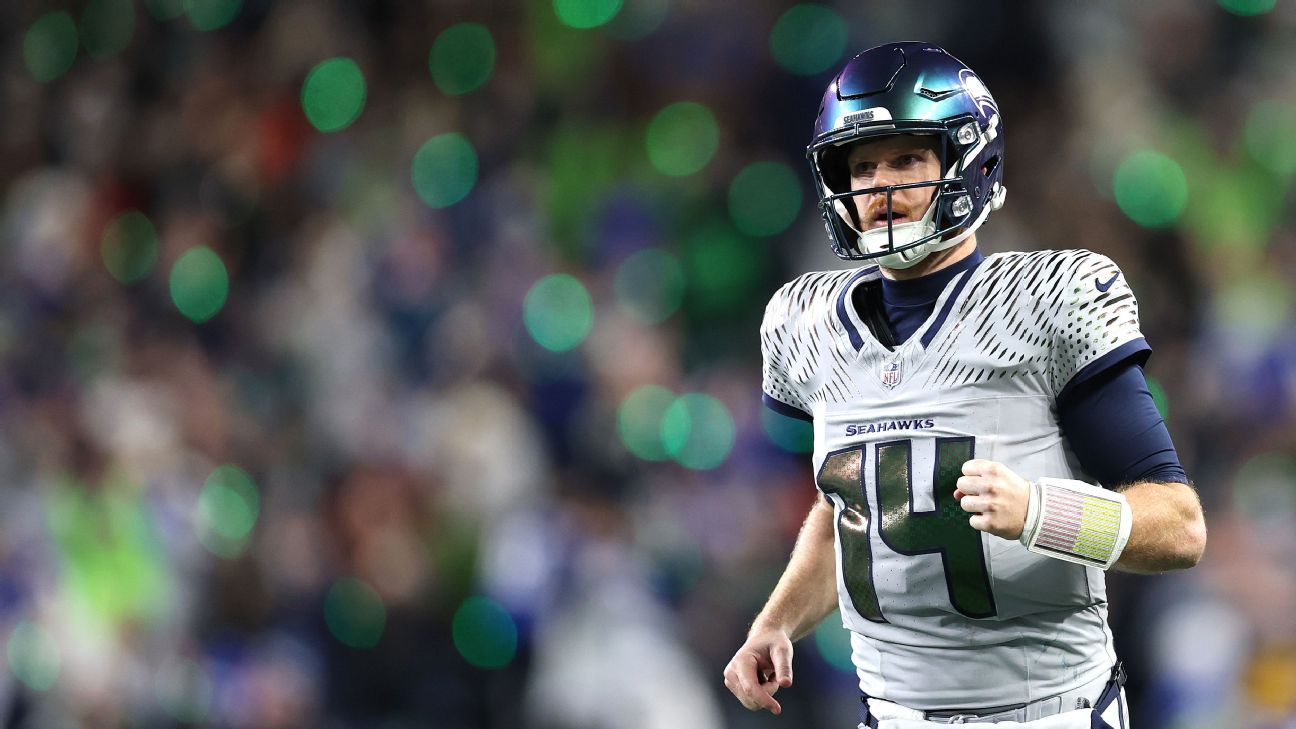
RENTON, Wash. — The Seattle Seahawks had just introduced Sam Darnold inside a packed auditorium at team headquarters on March 13 when general manager John Schneider, standing in front of reporters in an adjacent hallway, did his best to explain how their quarterback change had come to be.
He began by exhaling sharply, then pausing for several seconds.
Six days earlier, Schneider agreed to trade Geno Smith to the Las Vegas Raiders after a brief attempt to sign him to an extension. That led the GM and coach Mike Macdonald to turn their focus to Darnold, a free agent after his breakthrough Pro Bowl season with the Minnesota Vikings.
Ten months later, those two decisions stand near the top of the list of reasons why the Seahawks entered the playoffs as betting favorites to win Super Bowl LX, having claimed the NFC’s No. 1 seed after a 14-3 regular season. Their quest for the franchise’s second Lombardi Trophy begins Saturday (8 p.m. ET, Fox), when they host the San Francisco 49ers at Lumen Field in the divisional round.
How far the Seahawks go in the playoffs will depend largely on whether Darnold can avoid the mistakes that plagued him over the second half of the season. He played well enough — despite finishing with a league-high 20 turnovers — to make the Pro Bowl. He also made some NFL history along the way. Darnold joined Tom Brady (2019-20) as the only quarterback to win at least 14 games in consecutive seasons with different teams.
The Seahawks couldn’t have hoped for much more from Darnold, 28, when they signed him to a three-year, $100.5 million contract to replace Smith, 35.
But on the day that deal became official, the pressing questions weren’t just about the Seahawks’ new quarterback but about how they arrived at the decision to move on from their old one after Smith posted a 27-22 record (plus 0-1 in the playoffs) in three seasons as their full-time starter.
“We made an offer to Geno, tried to extend him,” Schneider said after his long pause. “It became apparent that we weren’t going to be able to get a deal done. It wasn’t a very long negotiation. So as a staff, we had to be prepared to pivot.”
That answer was merely the tip of the iceberg.
The full story includes a contract squabble with Smith in the summer of 2024, a disputed preseason absence and, later, a $70 million offer he rejected. It’s centered around the front office’s lukewarm view of Smith as the long-term answer at quarterback, skepticism fueled by inconsistent play and leadership style. The Smith era in Seattle ended when former Seahawks coach Pete Carroll offered to trade for him, and when the Vikings’ decision-makers positioned the Seahawks to land their top alternative in Darnold.
“It was an interesting series of events, for sure,” Macdonald said back in March.
Moving on from Geno
The paths of the Seahawks and Darnold began to converge in the summer of 2024, when Smith was briefly sidelined during training camp.
That offseason, Smith had seen several other quarterbacks sign extensions worth more than $50 million per year. Smith was entering Year 2 of the three-year, $75 million contract he signed after the 2022 season, when he won NFL Comeback Player of the Year and made the Pro Bowl after spending most of his previous seven seasons as a backup.
Over his first two seasons as Seattle’s starter, Smith ranked 11th in Total QBR. That was one spot behind the Lions’ Jared Goff and seven ahead of the Jaguars’ Trevor Lawrence, who were among a handful of quarterbacks whose annual salary now doubled Smith’s. With the $25 million average of his deal having fallen to 20th at the position, he wanted his own payday.
But neither the front office’s contract policy nor Seattle’s recent head coaching change were working in Smith’s favor. While Carroll had been his biggest supporter in Seattle, others in the organization were unsold on Smith’s viability as their long-term starter, according to sources familiar with the team’s thinking. That doubt led Schneider to acquire quarterback Sam Howell that March with the thought that the former Washington Commanders starter had a shot to eventually take over.
But even if the Seahawks viewed Smith as their QB of the future, a new deal at that time was a nonstarter. His agent, Chafie Fields, approached the Seahawks about an extension but was quickly rebuffed, with the team citing its long-standing position of not renegotiating contracts with more than one season remaining. Smith didn’t take it well, and he vehemently argued his case to Schneider.
“Before last season, I approached the general manager and had to talk with him one-on-one about … ‘What’s the direction we’re headed here?'” Smith told ESPN’s Ryan McFadden last summer in response to a question about his 2024 contract talks with Seattle. “I think that’s a fair question to ask anybody. They didn’t have a definitive answer … It was kind of up in the air. And so for me, going into the [2024] season, I was like, ‘OK, well, this may be my last season here.'”
At one practice during the opening week of camp, Smith was rolled up on. He missed three practices and a walk-through as he underwent testing on his hip and knee. The tests confirmed the team’s initial belief that the injuries were nothing serious. Smith’s track record of toughness and strong work ethic coupled with his reaction to not securing an extension led to a belief among Seahawks officials that his four-day absence was as more of a protest over his contract than it was injury-related.
When Smith spoke with reporters later in camp for the first time since returning to the field, he said the hip and knee injuries were “nothing to worry about.”
When asked if he had been paying attention to other quarterbacks who had recently received lucrative extensions, Smith said he had. “It’s hard not to see it,” he said. “We all see it. I’m really happy for those guys. Whatever they get they deserve. You pay attention to it, but you try to stay focused on what you have to stay focused on, which is my job here with the Seahawks.”
Smith then put together another uneven season. The good included the quarterback leading four game-winning drives and breaking his own franchise records for passing yards and completion rate despite an overmatched offensive line, an inconsistent run game and an unproven college scheme under a first-year coordinator in Ryan Grubb. But Smith also finished 21st in QBR (53.8) and threw 15 interceptions compared to 21 touchdown passes, with a league-high four picks coming in the red zone.
Schneider doesn’t view turnover avoidance as a be-all, end-all trait for quarterbacks, having come up in the Green Bay Packers front office during the Brett Favre years. But what also gave the front office reservations with Smith was his leadership style, according to sources familiar with the team’s thinking. In 2022, Carroll, who would later call Smith one of his “all-time favorite guys,” described him as a “hothead” and “fierce competitor” whose competitive streak would sometimes flare when things went sideways.
Upon replacing Carroll, Macdonald said during the 2024 offseason that he and his staff challenged Smith to “take the next step as a leader,” wanting him to better mind his demeanor and serve as “the voice of poise” in chaotic situations.
“I’m really not a great loser,” Smith said in 2024, admitting that his emotions had gotten the best of him during a blowout loss to the Buffalo Bills. “It sucks. I hate it. I need to, overall, when I watch myself … just continue to uplift the guys, and if I’m being honest, do a better job at times when we’re down. Those are things that I’m constantly improving. I’m not going to say I’m perfect at it. I’m very emotional when it comes to winning, when it comes to doing the right thing. At times I let my emotions show, whether that’s good or bad, that’s a personal opinion.”
The Seahawks were prepared to ride with Smith as their starter for at least one more season in 2025. When they hired Klint Kubiak in January to replace Grubb, the coordinator publicly cited Smith as one of the job’s most appealing factors. Macdonald had publicly committed to Smith multiple times leading up to the 2025 combine, at one point calling him “a heck of a quarterback.”
But there was still the matter of his contract, with Smith eligible for an extension after his failed attempt to get one in the summer of 2024. By that point, Carroll was back in the NFL — and his new team was in need of a quarterback.
Setting sights on Darnold
The Seahawks were only half-heartedly traveling down the road of re-signing Smith when, at the NFL scouting combine last February, Carroll’s Raiders gave them an off-ramp.
Las Vegas first made a run at Matthew Stafford, who had been given permission by the Rams to speak to other teams. When Stafford agreed to return to Los Angeles on a revised deal, the Raiders approached the Seahawks about Smith.
Seattle’s plan was to offer Smith an extension, but in a free-flowing conversation at the combine, Schneider floated a potential trade that would have sent Smith and receiver DK Metcalf to Las Vegas in exchange for edge rusher Maxx Crosby, according to a source with knowledge of the conversation. The Raiders eventually shot the idea down and extended Crosby after the combine.
The Seahawks, meanwhile, made Smith their initial offer after returning from Indianapolis. According to a source familiar with the proposal, it was a two-year, $70 million extension that included $40 million in Year 1 — a figure they believed to be in the neighborhood of what Stafford was set to earn from the Rams on his reworked deal. With Smith feeling disrespected by the offer, his camp met the initial overture with silence, according to another source familiar with the interaction, followed by a response that the quarterback would rather play for less money elsewhere than take that deal from Seattle. Smith never asked for a trade, according to Schneider, nor did his side make a counteroffer.
Had the Seahawks been sold on Smith as their starter, they had plenty of time to work out an extension, with the quarterback under contract for another season. But what they perceived as an unwillingness on Smith’s part to engage in negotiations led them to revisit trade talks with Las Vegas. They wanted to move quickly on Smith so as to position themselves to find his replacement at the start of free agency.
“When it became obvious that, hey, this is not going to happen, well, you can’t just sit,” Macdonald said. “You don’t want to be caught without a chair at the end of the deal.”
Seattle had already been eying a group of alternatives headlined by Darnold, who was bound for free agency. The Vikings felt he had earned the right to be a starter, but it wasn’t going to be in Minnesota given that they were still committed to J.J. McCarthy after drafting him 10th overall the previous April. They elected not to use the franchise tag on Darnold because Vikings’ team officials thought they could re-sign Daniel Jones to pair with their second-year quarterback.
Aaron Rodgers was another option the Seahawks strongly considered, according to sources familiar with the team’s thinking, but Darnold was their top choice.
He was seven years younger than Smith and potentially cheaper to sign. Schneider had Macdonald and Kubiak watch his film and asked them whether they felt Smith was better.
Darnold’s season had ended with a pair of disastrous performances, first in Week 18 and then in the wild-card round, in which he was sacked nine times. But he had impressed Macdonald and Schneider when he threw three touchdown passes — including the game winner late in the fourth quarter — to beat the Seahawks at Lumen Field in December.
Watching his tape strengthened Seattle’s belief that Darnold — with his movement skills and ability to throw on the run — would be an ideal fit for Kubiak’s scheme. They also thought he would be an ideal leader, with several of their assistants — including Kubiak with the 49ers in 2023 and two others at USC — having coached him in the past. Vikings coach Kevin O’Connell personally vouched for Darnold, according to a source familiar with the conversation.
With their sights now set on Darnold, the Seahawks agreed to send Smith to the Raiders for a third-round pick, reuniting him with Carroll.
“We made the trade,” Schneider said. “And we were able to get the guy at the top of the list.”
Darnold’s Pro Bowl season
During Seattle’s win over the Carolina Panthers in Week 17, the CBS broadcast found a Darnold lookalike in the crowd at Bank of America Stadium.
“Stan Darnold,” as play-by-play man Ian Eagle dubbed him, wore a No. 14 Darnold jersey, with his red hair and beard styled like the quarterback’s.
“That was epic,” Darnold said four days later, as the Seahawks were preparing for the regular-season finale against the 49ers, with the NFC’s No. 1 seed at stake.
“I don’t know who that guy is, but hopefully one day I can meet him and maybe sign a jersey for him.”
That Darnold wasn’t tense ahead of one of the biggest games of his career spoke to something Macdonald has repeatedly said: “Sam is the same guy every day.”
In terms of his play, though, Darnold’s season has been a tale of two quarterbacks.
He made the Pro Bowl on the strength of what he did over the first two months. Through 10 weeks, Darnold ranked first in Total QBR (78.2) and yards-per-attempt average (9.9) and third in completion percentage (71.1%) while leading the Seahawks to a 7-2 record.
That stretch hit its peak in Week 9, when he threw four first-half touchdown passes and completed his first 17 attempts in a blowout win over the Commanders in prime time. It was only the fourth instance of an NFL player recording a QBR of at least 97 to that point in the season, and Darnold was responsible for three of them.
“Sam’s execution right now,” Macdonald said postgame, “he’s just ridiculous.”
Two weeks later, Darnold threw four interceptions in a narrow loss to the Los Angeles Rams that dropped the Seahawks to 7-3. Their defense kept them in the game long enough for Darnold to mount a late comeback, shrugging off his disastrous mistakes to position Seattle for a 61-yard field goal that would have won it.
Afterward, linebacker Ernest Jones IV deflected blame off Darnold with a passionate and profane defense of his quarterback, making it clear the locker room had his back. It was one of many signs of how much Darnold had endeared himself to teammates on both sides of the ball.
“He’s a guy that you can talk to,” tight end Eric Saubert said. “Not everyone’s like that. He’s receptive to what you’ve got to say. He works with us, and he’s just a great person … a guy you want to play for, a guy that we’re going to follow into battle. He’s led the way thus far. He’s a special quarterback. I’m glad he’s on my team.”
But Darnold’s performance in the first Rams meeting marked the start of a downward trend. After entering the game with the NFL’s best QBR, Darnold ranked 27th (36.9) over the final eight games of the regular season, committing 10 turnovers in that span. He and the rest of Seattle’s offense have developed a tendency to start slow, failing to score more than nine points in the first half six times in a seven-game stretch.
The Seahawks won all eight games thanks to the NFL’s best scoring defense, the league’s top-rated special teams group, an emerging run game and enough big plays in critical moments by Darnold.
One of those victories was in the rematch with the Rams in December, when the Seahawks prevailed in a wild overtime finish after Darnold — who had thrown two more interceptions earlier in the game — rallied Seattle from a 16-point deficit midway through the fourth quarter. Against Carolina, his clutch throws on third down in the second half helped the Seahawks pull away and maintain control of the top seed. A week later, he didn’t throw a touchdown pass in their winner-take-all rematch with the 49ers at Levi’s Stadium — but he didn’t turn the ball over for only the third time in the last 11 games.
“Sam led us today,” Pro Bowl receiver Jaxon Smith-Njigba said after Seattle’s 13-3 win. “Sam was an absolute dog today. His demeanor, his approach, everything about what he did today was great … Of course there’s always going to be some things to fix, but … really the way he prepared all week to make sure his guys were ready is one-of-one stuff. I’m super happy for him.”
Through it all, Darnold has remained steady, a trait Macdonald deeply admires.
“It’s the hardest position to play in sports, in my opinion,” Macdonald said. “There is a lot of noise that goes with it. It’s us as a football team, too, I think we have to have a vision who we want to be as a player, as a person, as a team and just stick to that and just chase that all the time. But if you get out of whack from the results or conditions or the surroundings, things around you, it’s hard to stay on track. That’s how I see it.
“I also think it’s important as the personality of your offense as well. If things aren’t really going your way, everything is going haywire, he’s kind of a steadying force for those guys as well.”
Schneider’s decisions to move on from Smith and tab Darnold as his replacement helped the Seahawks get this far. But in order for Seattle to return to Levi’s Stadium for Super Bowl LX, the consistency of Darnold’s play will have to be closer to that of his demeanor.
“That’s our leader,” Smith-Njigba said. “We’re going to follow our leader. We’re going to follow his approach and his mindset, and he has the right mindset to do great things.”
ESPN’s Kevin Seifert contributed to this story.
