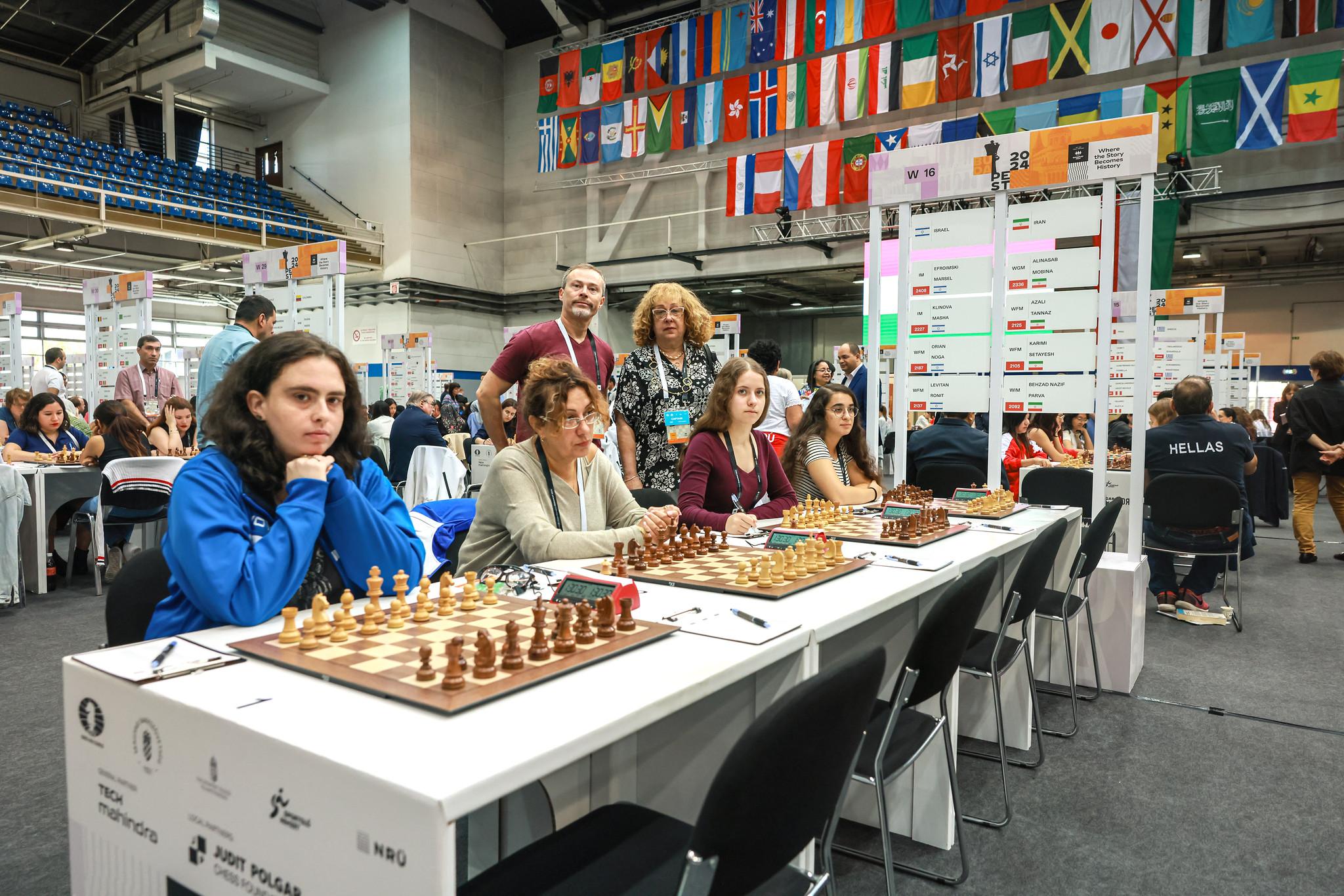
The FIDE Ethics & Disciplinary Commission (EDC) has fined the Iranian Chess Federation €25,000 for a deliberate boycott of the Israeli women’s national team during the 45th Chess Olympiad in Budapest, Hungary.
The EDC decision is dated January 9 and was published on EDC’s official website this week, and also widely covered by Israeli media.
The case stems from the final round of the Women’s section of the Chess Olympiad, on September 22, 2024, when Iran failed to appear for their match against Israel. The match resulted in a 4-0 forfeit victory for Israel.
A complaint was filed last year by the Israeli Chess Federation, which argued that the absence was not accidental, but part of a long-standing refusal by Iranian sports representatives to compete against Israeli opponents. Iran’s federation denied the allegation, claiming flooding in Budapest had prevented the team from reaching the venue on the final day of the Olympiad.
Iran argued that the team’s failure to attend was caused by “force majeure,” an unexpected rise of the Danube river in Budapest causing flooding and road blockage. They even provided a taxi receipt from the day of the match.
The defense was rejected by the panel after conducting their own investigation. According to testimony from several FIDE officials, the flooding issue had been resolved by the last day. No other teams were prevented from reaching the venue. The EDC also notes that the Iranian team in the Open group, who stayed at the same hotel, arrived on time to play Armenia for their match.
The EDC also notes that the chief arbiter had received indications in advance that suggested a potential boycott of the match, and that Iran did not provide any official explanation to tournament officials on the day of the match.
As a result, the Commission ruled that Iran had breached Article 4.4 of the FIDE Charter and Article 6.6 of the FIDE Ethics & Disciplinary Code, both of which prohibit discrimination based on nationality and political considerations.

The EDC imposed a €25,000 fine, payable within 21 days. Failure to pay would trigger a one-year suspension from participation in the FIDE General Assembly. The Commission also noted the need for deterrence and considered a mere warning or reprimand would be “manifestly inadequate.”
The ruling adds to a long history of Iranian sports representatives boycotting Israeli athletes. As in other sports, Iranian players have rarely faced an Israeli opponent, as their government does not recognize Israel as a legitimate state. Iranian athletes usually forfeit their game if paired against an Israeli opponent.
Iranian players who forfeited their games have been praised when returning home. GM Aryan Gholami, a 17-year-old IM at the time, refused to play Israeli GM Ariel Erenberg during the Rilton Cup in 2019, a decision that cost him a $10,000 prize. Gholami later told Swedish chess website Schack.se that he had no ill will towards the Israeli, but “would face serious consequences” if he were to play the game.
He was later praised by Supreme Leader Ali Khamenei for his actions. In the World Junior Championship later the same year, he forfeited his game against an Israeli opponent again.
Later that same year, during the 2019 World Junior Championship in Chennai, Gholami together with GM Amin Tabatabaei did not show up for games against Israeli opponents. While Gholami was expelled from the tournament, Tabatabaei was allowed to continue playing the remaining five rounds after a successful appeal where he provided a medical certificate, according to Indian newspaper The Hindu.
The sensitivity of the issue was in full display later that year, when Tabatabaei and his compatriot Parham Maghsoodloo did play against Israeli players without knowing their nationality at an informal blitz event during the Sunway Sitges Chess Festival.
IM Malcolm Pein, English delegate at the FIDE General Assembly, noted that the incident caused major problems for them. “Even before returning to Iran, they were forced to apologize. Parham, in order to protect himself, was forced to criticize the Israeli government.”

For Tabatabaei, now a strong grandmaster ranked 33rd in the world, this wasn’t the last controversy. After the FIDE World Rapid & Blitz Team Championship 2024, the Israeli Chess Federation along with a group of grandmasters filed a complaint to the EDC after Tabatabaei did not show up for a game against an Israeli-associated team. The Iranian grandmaster was acquitted after providing evidence of medical illness, even though the EDC found the timing “very suspicious.”
In the same complaint, a Syrian player was found guilty and sanctioned with a warning after admitting he boycotted his Israeli opponent due to what he said was “a necessary step to ensure my safety and compliance with the laws of my country.”
In 2019, Iran’s biggest star, GM Alireza Firouzja, decided to stop representing Iran. Two years later he completed the Switch to represent France, where he had been living.

There have also been examples of Iranian players who ignored the regime’s unofficial policy only to face repercussions when returning home. In 2017, FM Borna Derakshani was banned from national events after playing his game against Israeli GM Alexander Huzman at the 2017 Gibraltar Chess Festival. His sister, IM Dorsa Derakshani, was also faced with the same penalty for not wearing a headscarf. The siblings both emigrated to the United States and the United Kingdom, respectively.
Tournaments arbiters used to manually adjust pairings in order to avoid forfeits, but in December 2020 the FIDE General Assembly passed a resolution warning Iran that continued boycotts or “special pairings” would lead to severe sanctions.
While a motion to suspend the federation was dropped, FIDE President Arkady Dvorkovich did note:
While supporting diplomatic ways to resolve the remaining differences, the FIDE General Assembly gives full authority to Council to impose any necessary and proportionate restrictive measures on the [Iranian federation] and/or its officials should the circumstances warrant such actions. The same applies to all national chess federations, officials and players without exemptions and reservations.
The EDC decision against the Iranian Chess Federation comes amid ongoing unrest, with at least 2,000 people reported killed in the country during a major crackdown on nationwide protests, according to human rights groups. Iran is also currently experiencing a near total internet blackout during escalating anti-government protests.
Among the many Iranian-born chess players who have posted in solidarity with the protesters is Firouzja, with the following image.

Chess.com has reached out to the Iranian Chess Federation for a comment to this story.
