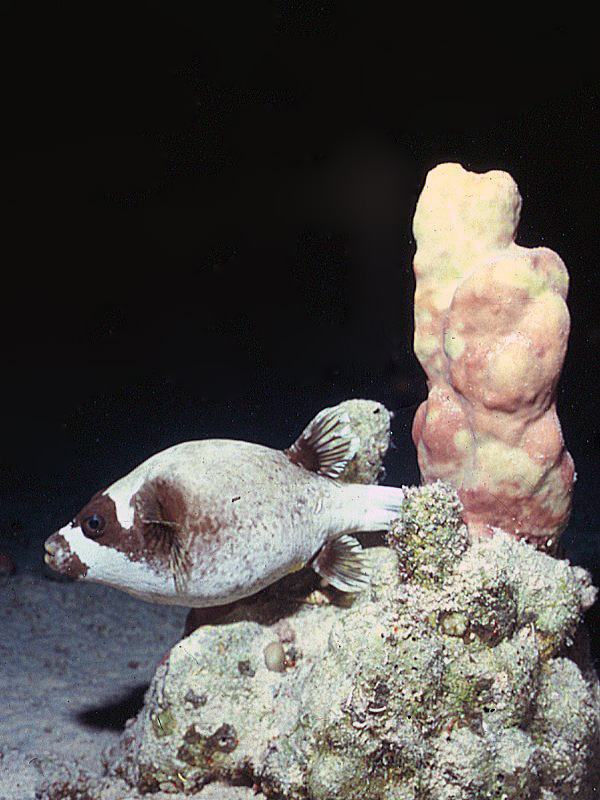
Photo copyright Tim Nicholson.
Taken on Sha’ab Hassan, Egyptian Red Sea.
Masked Puffer, Arothron diadematus (Rüppell).
Distinctive looking, this small pufferfish has a black
mask over its eyes reaching back to its pectoral fins,
and a black mouth. It is common on fringing coral reefs
in the Red Sea. Elsewhere it is replaced by
Arothron nigropunctatus (the Blackspotted Puffer).
However, some experts believe these to be the
same species.
Masters of Self Defence
Pufferfish are bulbous fishes with a scaleless, prickly,
skin. They are called pufferfish because when threatened
they greatly inflate themselves with water, making
themselves look much larger than they usually are. They do this by rapidly gulping water into their extending stomach. This makes them into a spiny ball three to four times their normal size. It can be stressful to the puffer fish though, so they only do this when seriously threatened. This defence mechanism is important because they move
so slowly through the water.
Their second line of
defence is their toxicity.
100 Times as deadly as the venom of the black widow spider
The Puffer is harmless, unless eaten. The liver,
intestines, gonads and skin are highly poisonous and
cause death in around 60% of people who eat it. If
prepared properly the puffer (or fugu) is edible and
considered a delicacy in Japan and Korea.
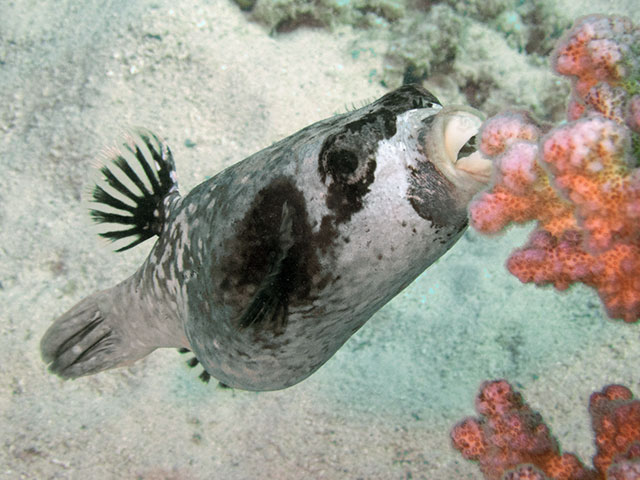
The Puffer’s toxin – tetrodotoxin – is produced within
the pufferfish by bacteria. The fish acquire the
bacteria by grazing on the reef and eating molluscs
and other invertebrates. Weight-for-weight,
tetrodotoxin is up to 100 times as deadly as the
venom of the black widow spider and one of the most
poisonous natural substances.
Pufferfish tetrodotoxin used to treat tumours
Researchers have shown that the masked pufferfish’s toxin can be used to treat breast cancer, increasing lifespan by 46% and decreasing the number of tumour cells.
Fused teeth which never stop growing
Adult puffer fish have just four teeth, fused together into one strong beak. They can use this to open clams or mussels, and graze on coral. These teeth can regenerate indefinitely, so they never become completely ground down. The four teeth gave rise to the name of their family: Tetraodontidae. This also gave rise to the name for their toxin, tetrodotoxin., so named in 1894 by Dr. Yoshizumi Tahara.

References
Jill Studholme, 10 Fascinating facts about puffer fish – the most poisonous fish on the planet, SCUBA News
FM Fouda, Anti-tumor activity of tetrodotoxin extracted from the Masked Puffer fish Arothron diadematus, Egyptian Journal of Biology
Tetrodotoxin Poisoning Associated With Eating Puffer Fish Transported from Japan
Jim Johnson, Tetrodotoxin…an ancient alkaloid from the sea…
