
With a level of fury that only VAR can provoke, many fans have expressed outrage at the decision to rule out Antoine Semenyo‘s second goal in Manchester City‘s 2-0 win over Newcastle United in the Carabao Cup semifinals on Tuesday.
It had all the hallmarks of a VAR nightmare: arguments over whether it was “clear and obvious,” a five-minute delay, and a goal ruled out at the end.
This season, we are taking a look at major incidents to examine and explain the process both in terms of VAR protocol and the Laws of the Game.
So, was VAR right to rule out Semenyo’s goal?
Screenshot credit: SkySports
Andy Davies (@andydaviesref) is a former Select Group referee, with over 12 seasons on the elite list, working across the Premier League and Championship. With extensive experience at the elite level, he has operated within the VAR space in the Premier League and offers a unique insight into the processes, rationale and protocols that are delivered on a Premier League matchday.
Newcastle United 0-2 Manchester City
Referee: Chris Kavanagh
VAR: Stuart Attwell
Time: 62 minutes
Incident: VAR ruled Erling Haaland offside, disallowing Antoine Semenyo’s goal
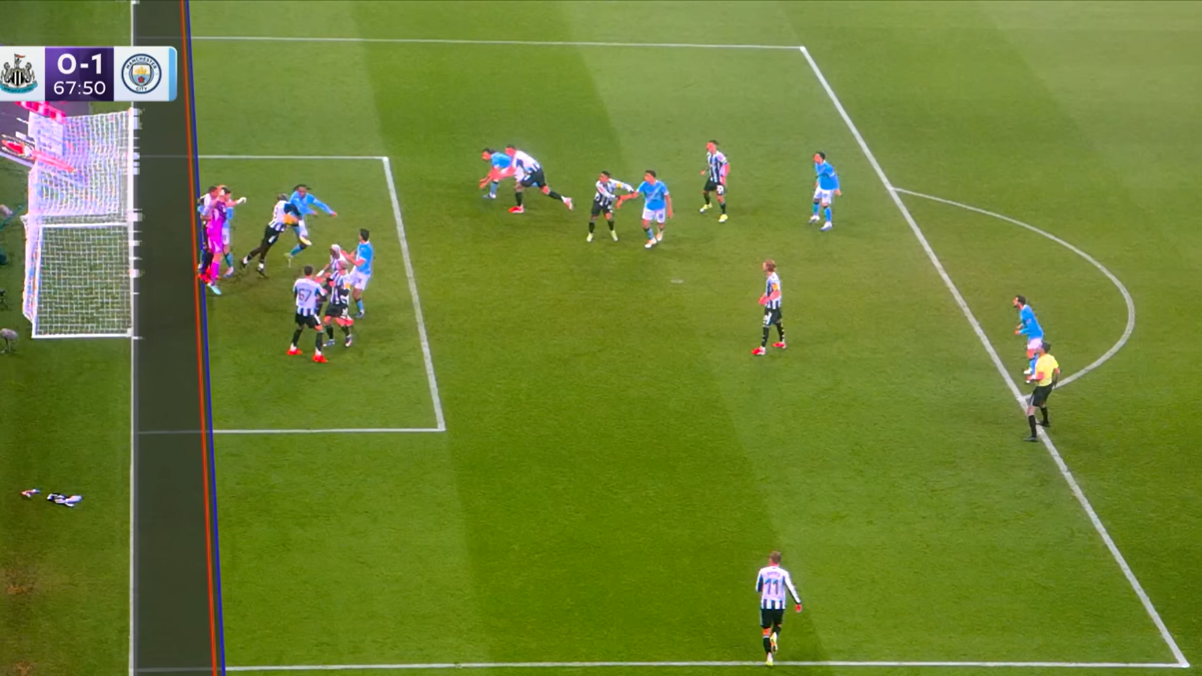
What happened: The score was 1-0 to City when Tijjani Reijnders delivered a corner into the box. Semenyo, who had already scored the game’s opener, nodded in what would been his third goal since joining City in January, but VAR ruled it out for a very tight offside on Erling Haaland.
VAR decision/review: VAR took five minutes to reach a decision after the semi-automated offside technology (SAOT) failed. It meant that VAR officials had to draw the lines manually and found that Haaland was offside by the very slightest of margins.
Verdict: This was the nightmare situation VAR Stuart Attwell would have wanted to avoid: Having to intervene on an incredibly marginal goal-deciding offside, with the SAOT not working.
With no active SAOT, Attwell was forced to provide help the old-fashioned way: by drawing the lines himself. That meant a lengthy delay to determine whether Haaland’s back foot was in an offside position.
That wasn’t the only thing Attwell had to take into account, though. He also had to judge whether Haaland had an impact on Newcastle defender Malick Thiaw‘s ability to play the ball. This, as it turns out, is rather straightforward, as the City striker was clearly hindering Thiaw.
Once Attwell had answered both — yes, Haaland’s foot was offside; yes, he was still impacting play — he recommended that Kavanagh make an on-field review to confirm that Haaland was affecting Thiaw.
These types of situations are considered as a subjective and not a factual offense in law, when the offender’s actions are a judgement of impact as opposed to a factual position of an attacker in a standard offside decision. Kavanagh took several looks at the monitor before agreeing with the advice from his VAR and disallowed the goal.
Technically, it is the correct outcome, but the eventual 5½-minute delay will promote a level of discomfort for everyone involved, not the least of them fans.
As I often say, the game doesn’t like what it doesn’t understand. In what is already perceived as an “anti-goal” law, it only creates further negative noise and criticism. Yet, the outcome is correct.
I feel Attwell is unfortunate that the SOAT let him down on the night — not for the first time — and he was forced into what was a very difficult manual process in an important moment of a semifinal.
That said, the time delay is not acceptable and will most certainly be a key area for discussion in the post-match review and reflection work at PGMO.
The question isn’t whether the decision was correct. It is why a technology failed and what happens when it does.
