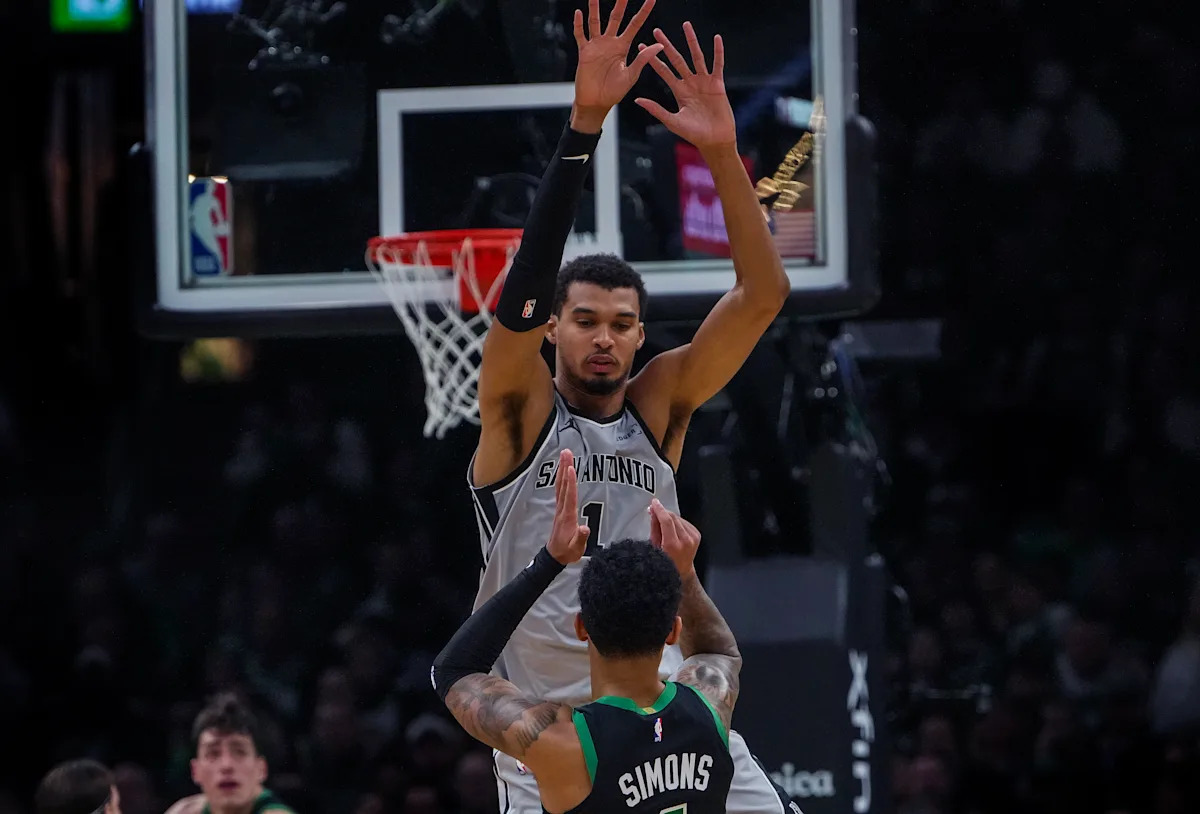
You don’t need me to tell you that Victor Wembanyama is a force defensively. There is a visual, visceral loudness to what Wemby brings to the table that can be seen by many. The question to me is: What are opposing teams trying to do about Wemby?
One of my favorite subplots is watching as announcers talk about the “Wemby Effect” (when teams stop driving), but Eurostep over the attempts coaches and players are making to poke at his impact. The blocks are fun, but let’s walk through the little things that have allowed Wemby’s defensive impact to stick night in and night out.
Advertisement
How the Spurs keep Wemby near the paint
One of the keys for San Antonio is the effort to keep Wembanyama in a position to rotate and protect the rim. Random possessions where an attack may look available feel a little different once you see Wembanyama’s presence in the paint.
[Subscribe to Yahoo Sports NBA on YouTube]
In an ideal setting, the Spurs operate at their best when Wembanyama is planted on the block with his primary assignment being whoever is in the corner. This allows the Spurs guards and wings to pressure, switch and funnel drives toward the paint. With Wembanyama’s size, speed and timing, openings can close quick and drives can be discouraged. If teams run pick-and-roll when Wembanyama is defending the weakside corner, he will rotate to take the roller, point for the guard to close out to his man, and, just like that, the Spurs’ defense is set again. Wembanyama is free to roam and protect the paint. And if teams put him back in action, he can take away the paint and switch if you dribble too far.
The tricky part is opponents have to understand how hard the Spurs work to get Wembanyama in that low-man, help position. The ability to contain drives or block shots at the rim will get all the rage, but I’m a fan of the little things. When the Spurs reset their defense after a made basket, watch Wembanyama. More times than not you’ll see him pointing and communicating, making sure everyone is matched up so he can get in his spot.
In the play above, Oklahoma City worked to get to a guard/guard screen with an empty right side. What initially looks like a ton of space for Jalen Williams to attack quickly comes with the price tag of Wemby’s help. The commitment is so strong that there is a moment where Shai Gilgeous-Alexander is just left without someone guarding him. The help on the drive discourages an extra attack and allows the Spurs to defend with activity knowing what is behind them.
Advertisement
How offenses can attack Wemby’s help
One thing to track as the season goes on is how offenses try to counter and poke at what the Spurs want to do. As difficult as it may be to deal with Wemby patrolling the paint, every defensive scheme has an opening. If the rotations are consistent, the offense has to work to find the advantage and make the defense pay.
In the clip below, when OKC has Shai Gilgeous-Alexander post up on the right side of the floor with everything clear, Wemby sees it and rotates over to help. On the kick, the Spurs are able to recover. But how set up are they for the next attack? OKC drives from the middle of the floor, Wemby is hanging around the paint, and it’s a 2v1 on the left side. A skip pass opens up a wide-open 3.
Another way to counter Wemby’s help is to work to get him on the strong side of the floor. The tricky part is teams have to disguise it to a degree. Because of the previously mentioned communication, if they try to set it up too early, the Spurs will work to switch their way out of it. Pushing him on the strong side of the floor should, in theory, remove him as the low man or the last man standing help-wise defensively.
OKC’s plan was to start with a guard/guard screen, but only use that as a setup for the real action. Notice the quick advance to Williams and Chet Holmgren going right into pick-and-roll. Williams is now attacking that left side, making Wemby a strong-side defender and leaving Harrison Barnes as the help as Holmgren rolls to the floor. OKC went back to the same set later in the first quarter and Wemby engaged, which opened up a kick to the corner for a 3.
Advertisement
(There is a world where teams can try to get Wemby to defend a shooter in that corner. The issue is how many times can you get back to it once you show it and, as much as a I love the X’s and O’s, the disguise of plays, the manipulation of defense, we have to be honest: Basketball is played with pace, space, tempo and randomness. It’s not easy to always tap those kinds of buttons within the flow of play.)
Wemby’s corner
What’s the counter to Wemby’s defense? An easy thing to point to is to work to get him out of the corner. Wemby’s presence defending that corner was so strong against Boston on Saturday that Joe Mazzulla was yelling at Baylor Scheierman to get out of the corner.
Was Scheierman involved in the action? Absolutely not. The most important thing is that he was no longer in that corner. And that meant that Wembanyama was also not in that corner, but on the move and not in a position to plant and help. The result? Jaylen Brown was able to attack Luke Kornet, turn the corner and finish.
Advertisement
The problem is that counter is not an automatic because of Wembanyama’s vision and communication. Adjustments get made and plans get changed. When Minnesota worked to move Wembanyama on Sunday, he refused to cooperate.
As Julius Randle clears the corner to go screen, Wembanyama is communicating a switch to keep him close to the block. When Jaden McDaniels sees that and decides to go screen, Wemby once again communicates a switch to keep him close to the block. It helps to have Anthony Edwards, who can go get a basket, but the Spurs’ overall defensive scheme was not poked at. Wemby was able to stay on the block, everyone else was able to stay out of rotation and reset. The communication and rotations allow the Spurs to maintain a consistent impact defensively when Wemby is on the court.
Pop quiz, offenses
The impact of Wembanyama staying near the block and roaming the paint to help exists partly because of two questions.
Advertisement
The first: Are offenses ready for the rotations around what Wemby is doing?
Because of Wemby’s size, length, ability to recover and ability to take space, there isn’t an automatic coverage you are going to receive. And behind him is a defense (when humming) that is connected and works to move to get Wemby back into optimal position.
When Brown gets a screen (below), Wembanyama starts at the nail at the free-throw line. If you take a snapshot, that feels like drop. As Luka Garza tries to find a screening angle, you can see how Wembanyama begins to lurk and churn space away quickly. That presence (and the hesitation it can produce) allows Stephon Castle to navigate and recover. And because the Spurs are aware of their rotations, instead of pressuring Wemby to rotate to the pop, it’s De’Aaron Fox who pulls over instead.
An easy answer may be to move whomever Wemby is guarding to the wing, but that unlocks what makes the Spurs’ defense hum and gets Wemby in his ideal help position.
Advertisement
When Boston goes with high pick-and-roll for Brown (below), Wemby has Derrick White on the wing. He’s not low, and technically the roll would not be his responsibility. Unfortunately for Boston, Wemby just takes the roller as he gets in the paint, the Spurs recover around it and, just like that, he’s back near the block. The ability to shape-shift, anticipate what an offense is doing and dictate terms is when the Spurs’ defense is at its best.
In another example, OKC goes with a guard/guard screen for Gilgeous-Alexander on the left side of the floor. Holmgren is spaced on the right wing to take Wemby out of that low, help position. You can see Wemby communicate with the weakside defenders to rotate so he can sink back to that low man position. The Spurs are able to rotate, and when OKC gets back to a high pick-and-roll guess who is waiting to take Holmgren’s roll? You guessed it, Wemby.
The second question: How much do you want to put Wembanyama in action?
Advertisement
In other words, are you going to get the results you want, and is that going to keep San Antonio from getting Wemby back into a help position?
In the clip below, Boston goes to pick-and-roll for Brown and Wemby switches. The key is not that the Spurs take away the drive and the pop, it’s what happens once Boston decides to go to the second side of the floor. Wemby immediately points to Barnes to rotate to Brown so he can get back to the block and, just like that, the Spurs have put you in the same dilemma. Pritchard is able to drive and finish, but the pressure is on teams to win matchups and counter Wemby’s help again.
In the clips after the make, notice the consistency of Wemby passing defenders off to make sure he stays low. The idea is to keep offenses in the same box, facing the same problem. Wemby is able to turn a switch into offenses facing the same problem: he’s the low man communicating switches, deterring drives and wishing you would tempt fate.
Advertisement
Does this mean the Spurs, currently a top-five defensive unit, will automatically vault to the best defense in the NBA? No, it does not. Teams will adjust. The best course of action is likely not one single thing, but working to move Wembanyama around the court and poking at the rotations behind what he brings to the table.
The issue for offenses is they will have to work to make sure that becomes a realistic equation because of how the Spurs work to keep Wembanyama in a strong position. It’s something to monitor throughout the rest of the season as we enter a very interesting playoff race.
But for now it’s clear: Every night Victor Wembanyama steps on the court is a night when he can anticipate and dictate terms on the defensive end.
