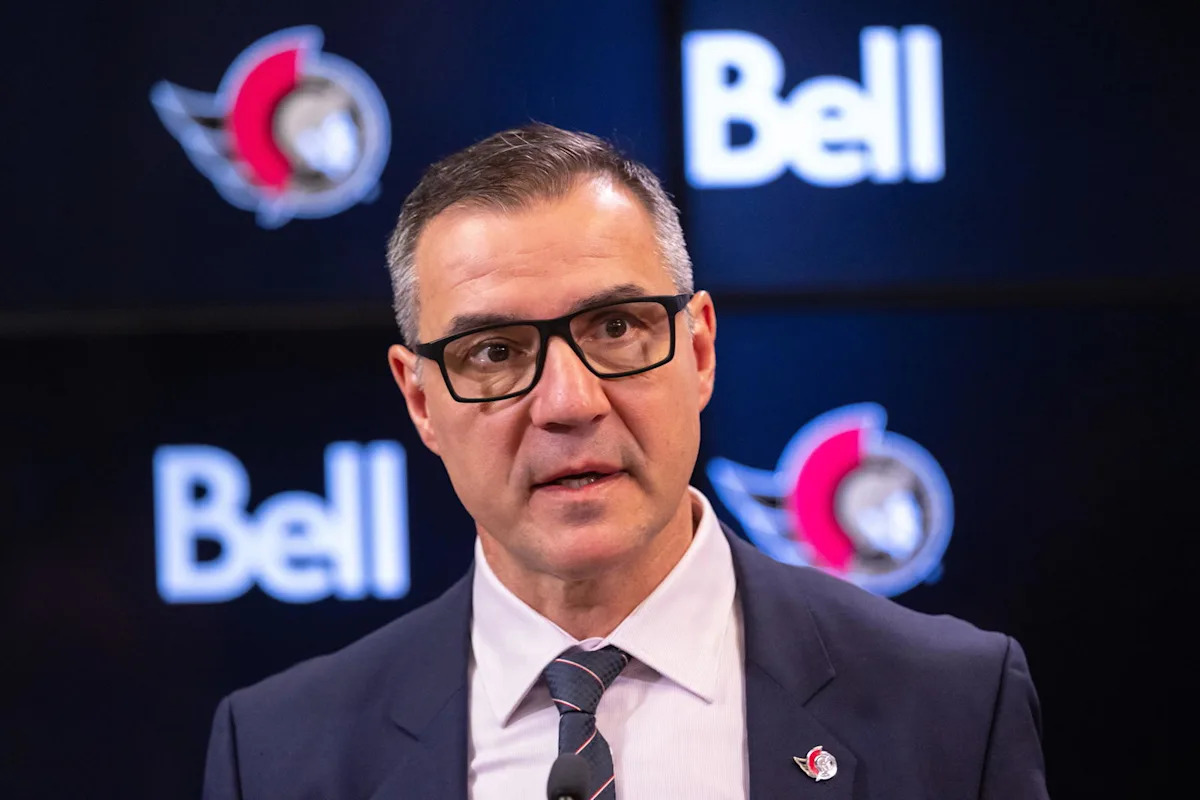
We are entering a pivotal stretch for the Ottawa Senators and general manager Steve Staios.
Back-to-back games against the divisional rival Montreal Canadiens and Detroit Red Wings this weekend highlight the remaining eight games left in January, but time is quickly running out for the Senators to close the distance on the Eastern Conference’s wild card seeds.
Advertisement
Thanks to the ever-increasing presence of three-point games around the league, it will not be easy to gain traction in a tightly contested Eastern Conference. Three points separate the Senators from the lowly 15th-place Columbus Blue Jackets, while five points are the difference between them and the second wild card.
In order for the Senators (22-19-5, .533) to get in the vicinity or surpass Boston’s points percentage (26-19-2, .574), it would necessitate winning five more consecutive games.
Putting together a seven-game winning streak certainly feels unlikely given the Senators’ struggles in goal this season, and that is what has to be frustrating for Staios.
If this team could generate a higher save rate, they would comfortably be in a playoff position.
Advertisement
Instead, the Senators’ five-on-five save percentage of 88.64 is the lowest in the league per Evolving-Hockey. Their 79.81 shorthanded save percentage is also the lowest in the NHL, but worse than that, it ranks as the lowest since modern public analytics websites began scraping and capturing data at the start of the 2007-08 season.
Similarly, if their 86.87 percent all-situations save percentage holds up for the remainder of the year, it will become the worst save percentage ever recorded in the modern stats era.
On an individual basis, only the St. Louis Blues’ Jordan Binnington has a lower goals saved above expected (GSAx) metric than Leevi Merilainen (-11.09 GSAx) and Linus Ullmark (-9.14 GSAx).
Although a young goaltender experiencing troubles in his first professional season as an NHL backup is hardly unique, the goaltending position has been further complicated by Ullmark’s unanticipated leave of absence. Prior to his absence, Ullmark was projected to play in more than 50 regular season games for the first time in his NHL career. That was noteworthy given the condensed schedule in this Olympic year, but it likely spoke volumes about the organization’s confidence in the struggling Merilainen.
Advertisement
Whether the increased volume of starts contributed to Ullmark’s struggles is up for debate, but considering his body of work and career save percentage of .914, it was reasonable to believe that his statistics would improve and begin to reflect his career norms in time. Now, everyone is wondering when Ullmark will rejoin the Senators and return to the net.
In the interim, Merilainen’s ineffectiveness and the lack of quality options at the AHL level necessitated the signing of unrestricted free agent goaltender James Reimer. The 37-year-old has not played in an NHL game since April 17, 2025, when he beat the Philadelphia Flyers. His only action this season has been the two games that he represented Canada at the Spengler Cup and the lone appearance in Belleville, where he was shellacked for six goals.
The struggles of the position have not only shone a light on the organization’s lack of quality depth, but have also drawn attention to general manager Staios’ offseason decisions.
It is clear the organization obviously felt obligated to reward Leevi Merilainen for his strong 2024-25 campaign that he split between Belleville and Ottawa. His nine-game stretch in January was principally responsible for keeping the Senators afloat and in contention for a playoff spot that they would eventually secure.
Advertisement
Despite that loyalty and being compelled to provide an opportunity for the young goaltender, the organization elected not to bring in a veteran goaltender with NHL experience as a contingency plan to guard against the possibility of Ullmark missing games or Merilainen’s ineffectiveness.
Now, the Senators are experiencing both.
Given how poorly Ullmark and Merilainen have played, the hope is that they will bounce back and that their numbers will regress toward their career norms over time. It is worth noting that Merilainen has looked capable in his last two starts, but there is a specific timetable for Ullmark’s return.
It puts Staios in a difficult position because their goaltending is unreliable. They cannot bank on it getting markedly better, and because of that, it should, in theory, impact what the Senators’ general manager can or is willing to do.
Advertisement
The organization’s pipeline of prospects is widely panned for lacking quality prospects.
Poor amateur scouting and the trading of valued draft picks in shortsighted deals that never required revisionism by Staios’ predecessor simultaneously emptied the system while shortchanging the Senators’ rebuild. It has created a situation in which, as good and impressive as the Senators’ young core is, there should be more young talent in Ottawa’s system that they could either graduate to the parent roster to insulate their core or use as capital to acquire the players they need to push this roster forward.
Without it, the Senators are closer to resembling a middle-of-the-pack team than a true Cup contender.
The dreaded murky middle can be a difficult place to navigate for a general manager. Often, your team is too good to be bad or at least bad enough to have lost seasons be rewarded with high draft picks. They are also not good enough to sustainably compete with the league’s elite.
Advertisement
There is also the added pressure of trying to maximize this group’s prime.
Modern NHL research has proven that a player’s offensive prime years often occur between 22 and 27 years of age, which happens to coincide with where Ottawa’s core is right now. With Drake Batherson representing the first of Ottawa’s core to potentially reach unrestricted free agency at the end of the 2026-27 season, with Brady Tkachuk and Thomas Chabot to follow the year after that, the reality is that the Senators’ window of contention is already upon us.
The uncertainty around the Senators’ goaltenders’ effectiveness is compounded by the fact that there simply aren’t a ton of desirable trade chips within their system. Perhaps things would be different if the Senators had not lost their 2026 first-round pick for their gross incompetence (or willful ignorance) in the Evgenii Dadonov trade scandal, but without any guarantees that they will eventually be able to recoup that pick, they do not have a ton of assets to move without touching the parent roster.
The situation essentially limits what Staios can do.
Advertisement
This group needs an infusion of higher-end talent to help take this core to the next level, but it lacks the high draft picks or trade chips the organization needs to easily acquire it.
Without it, it’s likely Staios will continue to make the moves that have characterized his stewardship of this franchise – modest moves that improve the margins in hopes that these small gains will be enough to progressively move this team forward.
Graeme Nichols
The Hockey News Ottawa
This story is from The Hockey News Ottawa. You can visit the site here or click on one of their latest articles below:
Senators Put Up First Eight-Goal Performance Of Season
Why The Senators’ 2020 NHL Draft Lottery Heartbreak Became A Blessing
Former Senators Head Coach Takes Over Bench In Columbus
Senators Handled Social Media Controversy The Best Way They Could
What’s Going On With Sens Captain Brady Tkachuk?
