CHICAGO — As the architect of the “Greatest Show on Turf” offense that fueled the St. Louis Rams’ Super Bowl title 26 years ago, Mike Martz was an in-demand speaker when he retired from the NFL in 2011. For years he worked the lecturing circuit, but there was one visit that made a lasting impression.
It was 2018, and Martz had been invited to the Miami Dolphins training camp by former head coach Adam Gase. Dolphins’ wide receivers coach, Ben Johnson, made sure not to waste the opportunity.
The signature pass play from Martz’s offense was called the Zampese Play — an ode to one of football’s most innovative minds, the late Ernie Zampese. The Zampese Play was run 124 different ways in the Rams’ high-octane attack, and Johnson wanted to know about every variation and how to teach it to his position group.
“I’ve had people ask me about [the Zampese play] a million times,” Martz told ESPN Thursday. “He’s the only one that asked me what exactly is the quarterback doing with this and what makes him do that?
“Everybody else just kind of skims through, and then they go run it and can’t figure out why it’s not successful because they don’t know how to adjust it. He wanted all the adjustments — how do you do this and why? We talked for an hour just on that pass play.”
As other Dolphins coaches trickled out of Johnson’s office, Martz and Johnson spent the rest of the afternoon dissecting the intricacies of the scheme. There was so much to discuss that the conversation extended to dinner in a nearby strip mall.
“I’ve met him a couple times, and I’ve got a ton of respect for the guy,” Johnson said. “He could just talk for hours, and you were just a sponge soaking it all in.”
The results speak for themselves. Johnson is in his first year as head coach of the Chicago Bears, who will host the Los Angeles Rams in a divisional-round playoff game on Sunday (6:30 p.m. ET, NBC/Peacock). The Bears earned their first playoff win in 15 years last week with a 31-27 victory over the Green Bay Packers.
The Bears feature one of the NFL’s most explosive offenses. Chicago generated 127 explosive plays (classified as a rush of at least 10 yards or a completion of at least 20) in the regular season. That was the second-most in the NFL behind the Buffalo Bills (129).
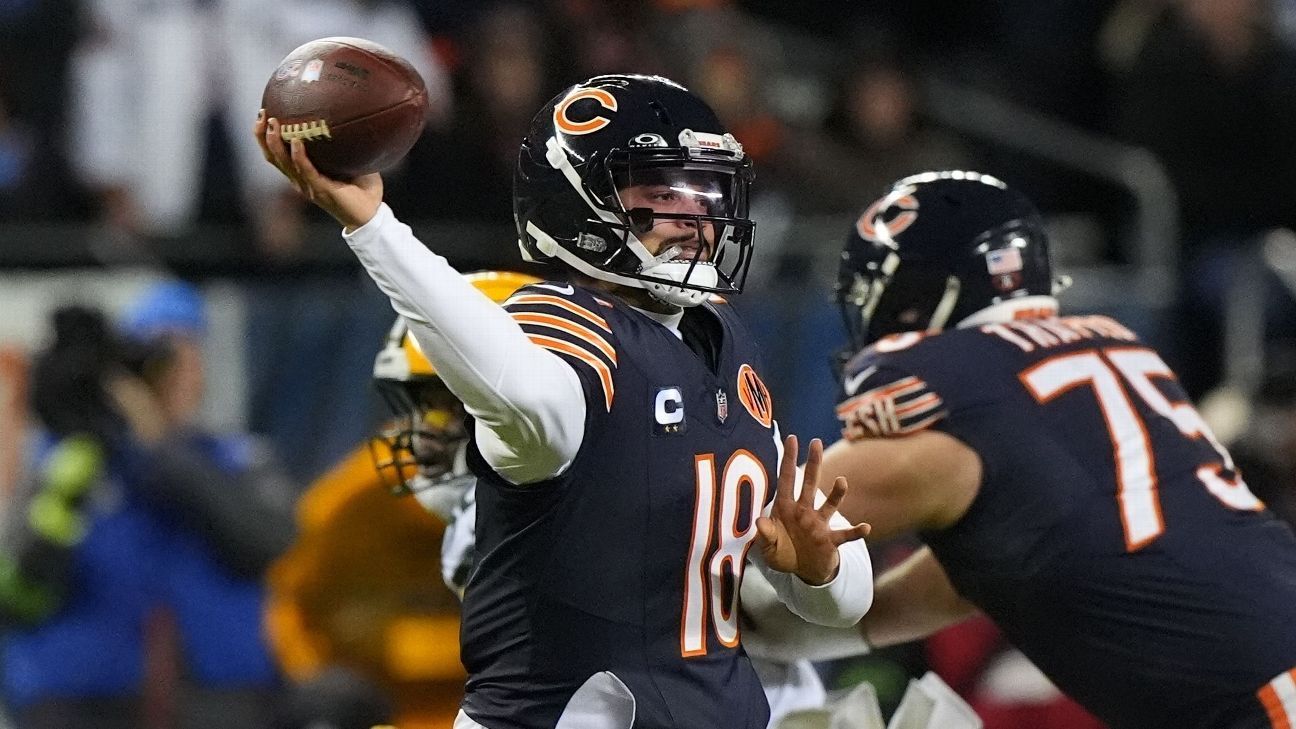
Chicago set a franchise record in yards gained (6,282) while second-year quarterback Caleb Williams set the team’s single-season passing record (3,942 yards).
Williams’ development into what the Bears hope is their first franchise QB in decades has been just part of the equation. After general manager Ryan Poles and Johnson rebuilt the interior offensive line and drafted pass-catching weapons, the Bears offense shattered expectations.
“They got it right,” Martz said. “It’s the best head coach they’ve ever had and the best quarterback they’ve ever had, clearly.”
JUST OVER A month after the Bears hired him in January, 2025, Johnson and the front office were working to build out the roster. The offensive line — notably both guard spots and center — was the weakest link and priority No. 1.
At the combine in February, Johnson was asked how realistic it would be to flip the interior of the offensive line in one offseason. He seemed to appreciate the challenge.
Caleb’s smooth on the run 🎶 @ChicagoBears pic.twitter.com/RS4CnCZHmm
— Inside the NFL (@insidetheNFL) January 13, 2026
Within a 24 hour stretch in March, the Bears traded for left guard Joe Thuney and right guard Jonah Jackson then turned their attention to spending big on center Drew Dalman. Johnson not only delivered on his promise, the Bears checked the biggest item off their to-do list in a five-day span.
“When you looked at Caleb’s rookie season, the number of times he got sacked (a league-high 68), that’s a hard way to live,” Johnson said. “That’s a hard way to be efficient on offense …
“Getting the offensive line right was a big part of our vision of how we wanted to build the football team this year and going forward.”
The Bears had 71 plays that went for 20+ yards (sixth-most) compared to the 2024 season when they had 47 (28th in the league). Notably, the run game has become much more explosive with 67 rushing attempts that went for 10+ yards (third-most). Last season that number was 42 (tied for 25th).
Johnson inherited an offense with wide receivers DJ Moore and Rome Odunze, tight end Cole Kmet and running back D’Andre Swift. He and Poles saw roles for all four players while wanting to use the draft to continue loading up on offense.
Chicago used the 10th overall pick on Michigan tight end Colston Loveland and came back early on Day 2 to select Missouri WR Luther Burden III with the 39th overall pick. That marked the first time in the Common Draft Era (since 1967) that the Bears drafted two pass catchers with their first two picks.
The Bears added left tackle Ozzy Trapilo in the second round and used their last pick in the seventh round on running back Kyle Monangai.
The results paid off immediately with Loveland emerging as the Bears’ leading receiver (58 catches, 713 yards, 6 TDs). In the wild-card win over Green Bay, Loveland became the second rookie tight end since 1970 with 100 receiving yards in a playoff game. According to Next Gen Stats, Loveland averaged 8.9 air yards per target this season, the fourth-highest mark among tight ends with at least 35 targets.
“We got a home run with him, and that’s something Coach said the other day to me,” Williams said. “We were sitting in his office and everybody goes back to draft night. Why did we get Colston Loveland and why did we do this and why did we do that? It’s Colston Loveland, you know what I mean? That’s who he is.”
The same can be said for Burden, who is fourth on the team in receiving yards with 652. His ability as a big-play threat (13.9 yards per reception) paved the way for him to become a significant part of the passing game.
“He’s a guy that as you give him more, he takes advantage of those opportunities and then makes you want to give him more opportunities to show that off,” offensive coordinator Declan Doyle said. “We’ve loved having him as a huge part of the offense.”
WILLIAMS NICKNAMED HIS offensive line “The Avengers,” a team of superheroes whose power is forged in its combined strength.
That group helped cut Williams’ sack total down from 68 as a rookie to 24 in 2025 while allowing him the time to find his receivers down field. Chicago ranked No. 1 in pass block win-rate (74%) and fifth in run block win-rate (74%).
A key part of the OL’s success was allowing Williams to learn the position in Johnson’s offense. Williams was predominantly a shotgun quarterback in high school, college and during his rookie season.
In 2024, Williams and the Bears offense went under center 29% of the time (16th). That figure spiked to 49% of snaps (5th) in 2025. Williams’ increased play-action dropbacks (19% as a rookie, 32% in 2025) is the catalyst behind the Bears’ passing attack that had the sixth-highest explosive play rate (15.0%) with 112.
“I think early on [Johnson] really tried to force Caleb to get out of his comfort zone,” Bears pass game coordinator Press Taylor said. “I would imagine Caleb had less than a hundred snaps under center before he got to the NFL.
“We were going to expose him to all this and get him as good as we possibly can. If that’s something he never latched onto, we would have pivoted and gotten somewhere else with it. But that’s a credit to Caleb’s work and what he’s done and how he’s gotten himself to really be very comfortable with what we’re asking him to do in this situation.”
Williams had 28 completions of 20+ yards (tied for fifth) after generating 20 of those pass plays as a rookie (T-14th). Of Williams’ 27 touchdowns this season, 11 were 20+ air yards, the most in the NFL. As a rookie, only five of Williams’ passing touchdowns went for 20+ air yards.
The explosive plays in the passing game showed up in the biggest moment of the season. Against Green Bay in the playoffs, the Bears totaled eight explosive passes in the fourth quarter, the most of any team in any game this season. No other team had more than six in any playoff game since at least 2016.
The 2025 team is a departure from Bears teams of old. Johnson can rely on his quarterback to win games (as evidenced by Williams’ seven game-winning drives, including the playoffs). No longer are Chicago offenses winning despite the play at quarterback.
But the root of being explosive starts with the run game. Chicago had the second-highest explosive run rate this season (13.3%) with the tandem of Swift (who reached a single-season high 1,087 yards and 9 TDs) and Monangai.
“Coach Johnson has done a heck of a job of stressing the run game since day one,” running backs coach Eric Bieniemy said. “That was one of the main points of emphasis that we wanted to make sure of, that we can run the ball, especially in an atmosphere [frigid temps] like we’re going to be facing this weekend.”
Under Johnson, the Bears have developed an attacking mindset on offense. That’s a departure from the way it’s been.
“They wanted to grow the grass in the stadium really long, run the ball and play great defense,” said Martz, who was the Bears’ OC from 2010-11. “That was their mantra since they started playing. That’s how it was when I was there. But they lifted that when they hired Ben.
“Now it’s wide open. Anything is possible.”
