International Trio Has Brought Scene-Shifting Influence to NCAA Women’s Swimming
In the current era of college swimming, the dominant men’s programs blend domestic and international talent to assemble their rosters. Last season, seven out of 13 individual titles at the NCAA Championships went to swimmers who represent other countries in global competition. Fourteen out of 15 top-three relay teams featured one or more foreign swimmers, and in the 400 medley relay, an American-record-setting performance from N.C. State resulted in a ninth-place finish.
The women’s side has been the total opposite. Virginia’s five consecutive national-title-winning teams have been fueled by U.S. swimmers, with the only foreign representation coming from Aimee Canny and Jasmine Nocentini. Stanford and Texas, the programs consistently joining the Cavaliers in the top-three, have been exclusively American. At last year’s national meet, American women won every individual swimming event, and only five non-U.S. swimmers had individual top-three finishes – Cal’s Lea Polonsky, Michigan’s Stephanie Balduccini, Tennessee’s Mona McSharry and Indiana teammates Miranda Grana and Ching Gan. Five further women contributed to top-three relays.
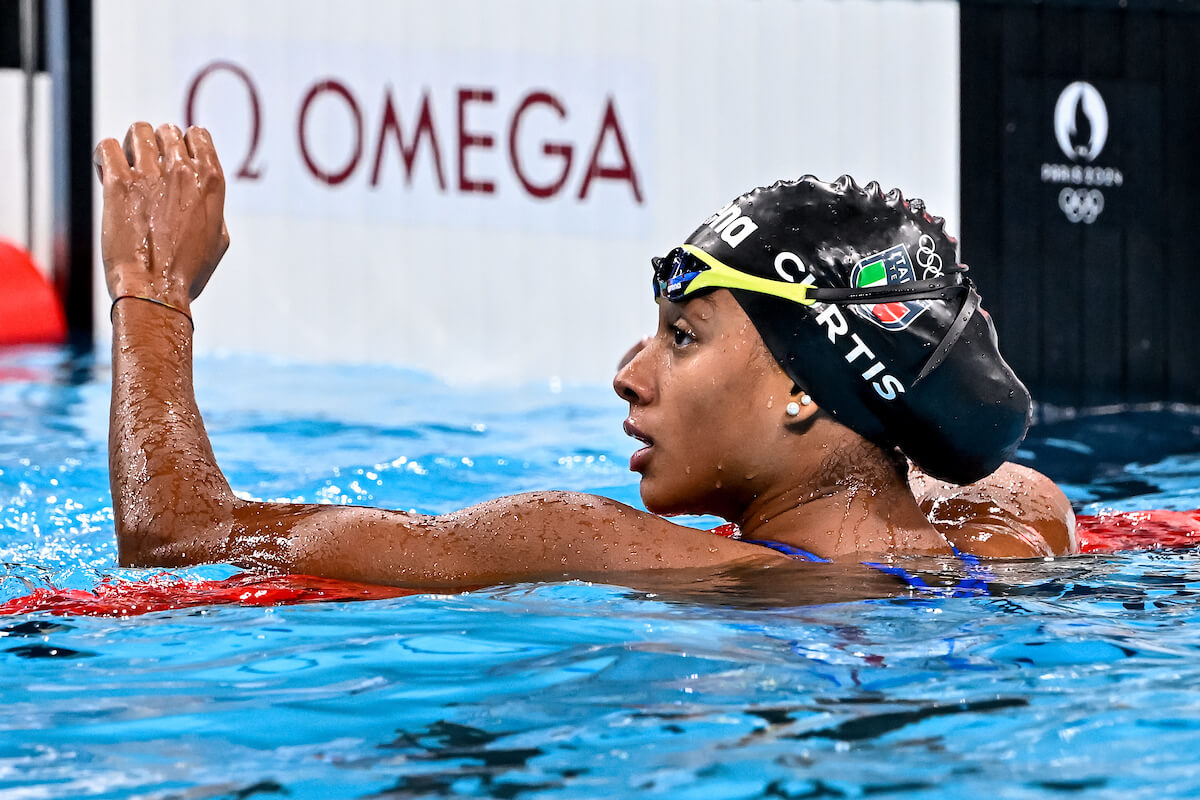
Expect a different pattern this spring as three internationally-acclaimed swimmers have matriculated at contending universities: Italian sprinter Sara Curtis has become a central player for this year’s Virginia team while Great Britain’s Eva Okaro is already the quickest in the short freestyle events for Texas. Additionally, Estonian Eneli Jefimova is already one of the top sprint breaststrokers in the country as she begins her career at N.C. State.
Curtis arrived in Charlottesville, Va., fresh off a World Championships finals appearance in the 100 freestyle in Singapore, where she took eighth. She also reached the semifinal round of the 50 free at that meet, and previously, she won a short course world title with Team Italy’s mixed 200 medley relay in December 2024. But her finest international effort came after she began working under Virginia coach Todd DeSorbo and his staff.
At the recent European Short Course Championships in Lublin, Curtis captured seven medals, three of them gold. She clocked 25.49 for gold in the 50 backstroke, at the time a European record and good enough to make her the fifth-fastest woman in history. Curtis helped Italy to gold medals in both mixed 200-meter relays. She also tied for silver in the 50 free and took bronze in the 100 free while helping the Italian women to two further relay medals.
In yards competition, Curtis currently ranks second in the country in the 50 free at 21.18, with only Torri Huske having been quicker, and the mark sits 12th on the all-time list. Curtis is also fifth in the 100 free (46.62) and seventh in the 100 back (50.56), and her top 50 back time of 22.83 is quicker than any swimmer went at last year’s NCAA Championships. It would be unfair to compare Curtis to Gretchen Walsh, but she will play a major role in making up for the points lost with Walsh’s graduation as Virginia pursues another crown. She is a lock for both sprint freestyle relays, and her presence as the backstroker in medley relay action would allow Claire Curzan to handle butterfly and Anna Moesch to anchor.
Okaro, meanwhile, fills a huge need for a Texas program that has never dominated the sprint events like its primary rivals. The 19-year-old made her Olympic debut in Paris with a relay final appearance, and she won a silver medal with the British team’s 400 medley relay at the 2024 Short Course World Championships. In 2025, Okaro won British titles in the 50 free and 50 fly, and she placed 11th in the 50 free at the Singapore Worlds.
In Austin, she is already the No. 1 option for the sprint events, having become the first Texas swimmer to ever split under 21 seconds for the 50 free. Individually, her 100 free top time of 46.49 ranks third in the country behind only Moesch and Huske, with her 100 fly time of 50.82 fourth and 50 free mark of 21.53 tied for ninth. In the Longhorns’ five-year streak of top-three finishes at the NCAA Championships, the team has had exactly one scoring swim in either the 50 or 100 free (Grace Cooper placed ninth in 2024), making Okaro’s emergence a potentially game-changing one. As for the 100 fly, Texas has graduated Emma Sticklen, Kelly Pash and Olivia Bray within the past two seasons, so Okaro could make up those points while also taking over an important relay position.
But of the European freshmen to arrive in women’s college swimming this year, the one with the best shot at an individual national crown is Jefimova, also 19. Her record of senior-level international accomplishments is already stacked, with a long course European title in the 100 breast in 2024 and a bronze medal in the event at the Short Course World Championships that same year. She is already among the best long course 50 breaststrokers in the world, her time of 29.83 finishing the year as the second quickest in the world for 2025.
At the World Championships in Singapore, she finished sixth in the 50 breast and 10th in the 100. Further, she has captured back-to-back European short course crowns in the 50 and 100 breast. Last December in Lublin, Jefimova swam times of 28.81 in the 50 and 1:02.82 in the 100, both meet records and vaulting her to No. 5 all-time in both events.
In college swimming, European swimmers have been more successful in the 100 breast than any other event, with Nocentini winning the title in 2024 and McSharry scoring numerous top-three finishes alongside her Olympic bronze medal in the 100-meter event in Paris. For this season, Italian-native Anita Bottazzo has the country’s top time for the Florida Gators at 56.87 with Jefimova second at 57.67. Moreover, Jefimova turns the weakest leg of NC State’s medley relays into a strength. Combining with versatile sophomores Leah Shackley and Erika Pelaez plus backstroker Kennedy Noble and sprinter Olivia Nel, the Wolfpack could contend for top-three finishes on the national level.
When swimmers arrive in the United States to begin competing in college, they sometimes face a learning curve as they compete in short course yards for the first time. Clearly, that will not be the case for this trio. Based on their early-season returns plus their trajectories of improvement while representing their respective countries, Curtis, Okaro and Jefimova are all strong bets for individual top-three finishes at this year’s NCAA Championships.
