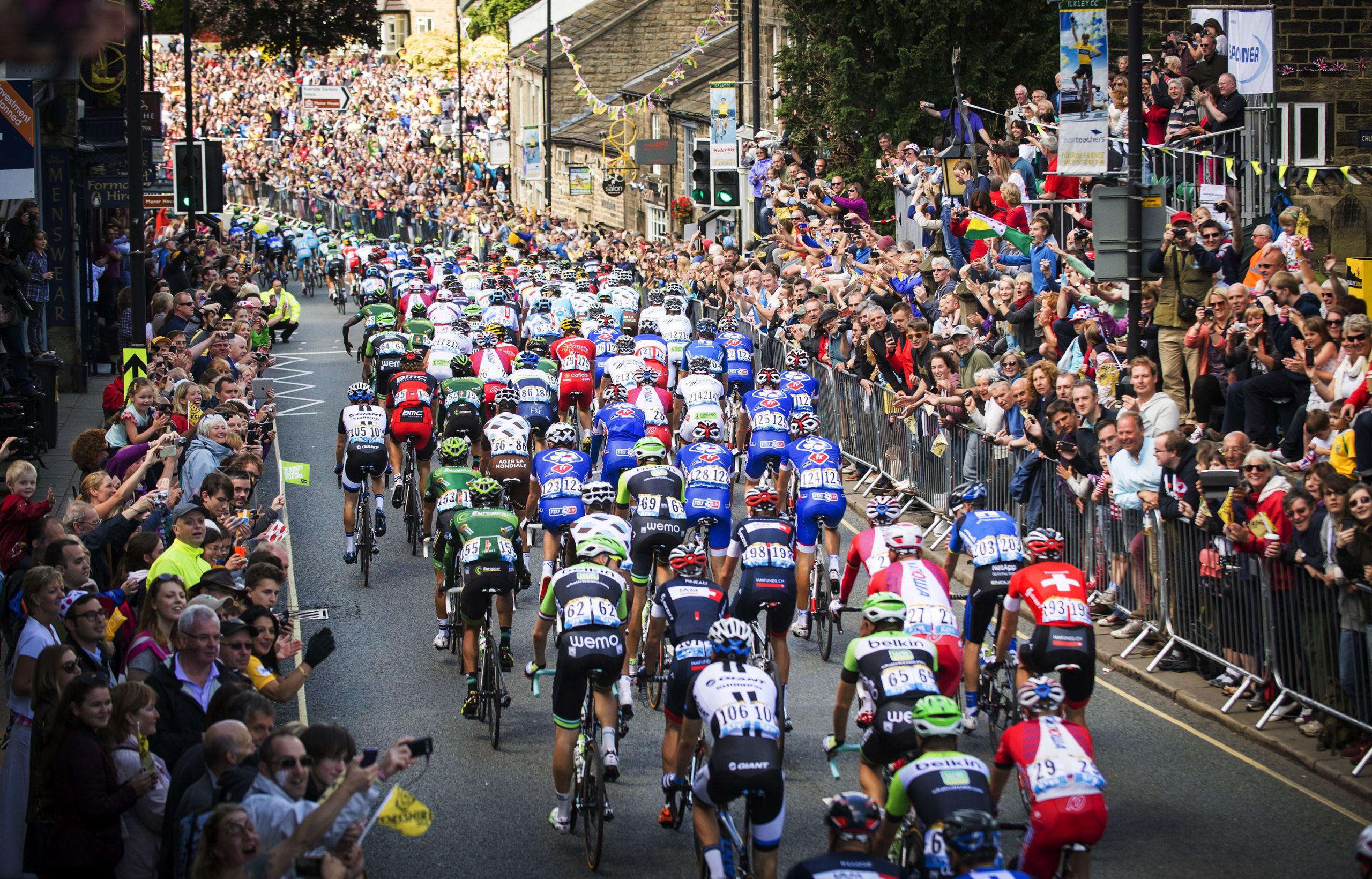
As he sat down to address the media in Leeds on Thursday, Tour de France race director Christian Prudhomme used a phrase he’d perhaps never said before. “Ee bah gum,” he said with a smile, rousing a chuckle from the local Yorkshire reporters. The moment signalled Prudhomme was in a playful mood. He knew, after all, that what he was about to announce would please people.
And not just the locals. Oh no. The 2027 Tour de France and Tour de France Femmes avec Zwift will not be contained within these county walls. Across six days next summer, they’ll span the length of Great Britain, visiting Scotland, England and Wales, stopping in big cities like Edinburgh, Manchester and London, but also smaller towns like Welshpool in north Wales, and the Lake District’s Keswick, where barely 5,000 people live.
Tom Davidson
Present at the grand unveiling in Leeds, Tom is wishing July 2027 was here already.
Prudhomme, “emotional” to be back in Leeds after the success of the 2014 Grand Départ, let his excitement run free. He had already been out to drive stretches of the men’s route, which he described in a string of gushing synonyms: “beautiful landscape”, “outstanding scenery”, “stunning backdrop”. He then distilled it all into one adjective. “All three stages will be gorgeous,” he said, and pointed to a photographer in the front row. “Just for you, they’ll be gorgeous.”
Women’s race director Marion Rousse echoed the same when her turn came to speak. She remembered being “glued to the sofa” in 2014, struck by the “fervour” of the British fans at the roadside. Her race will start on the same Yorkshire roads next year. “It’s an absolute honour that the women will now experience the same thing,” she said.

Christian Prudhomme (left) with Marion Rousse and British Cycling CEO Jon Dutton
(Image credit: Simon Wilkinson/SWpix)
When the event organisers first announced the UK’s successful Tour bid last year, they promised “the grandest of Grands Départs”. The plans they shared on Thursday further cemented that. Scenery? Tick. Masses of fans? Guaranteed. And the routes? Will the racing be any good? Prudhomme and Rousse are sure of it. And they have good reason to be.
The men’s race will open with a stage nailed on for the sprinters (cough, Matthew Brennan yellow jersey, cough), through the Scottish borders and into Cumbria. The TV cameras will then marvel in the beauty of stage two, when the peloton will skirt Lake Windermere and Morecambe Bay, before arriving at Liverpool’s docks. That day will stretch 223km – 14km more than the route’s longest stage last year – a distance that will repeat itself on stage three in the tricky Welsh hills.
Do not underestimate stage three; it counts eight categorised climbs, six of which come in the last 80km, and a total elevation nearing 3,000m. With a transfer day to follow, it’s a stage for the most daring breakaway thrill-seekers. Perhaps even early GC blows.
Rousse confirmed more thorough details are still to come about the three women’s stages, which will start in Leeds on 30 July. What we do know, though, is that stage one will close with an expected sprint near the velodrome in Manchester; the riders will need to find early climbing legs over the ‘Côte de Snake Pass’ in the Peak District to Sheffield on day two; and stage three has London calling. It’s similar, though not exactly, to the men’s Grand Départ in 2014. If it ain’t broke…
A lot will be said about the legacy of these Grands Départs, as was the case 12 years ago. 2027 will mark the first time both races start in the same place outside France, and a big budget has been drawn up for the occasion; Cycling Weekly understands it to be around £65 million, paid for mostly by the UK, Scottish and Welsh governments. It’s a lot of money, but it falls in the shadow of the £150 million the governments expect the race to bring to the economy.
The lasting memory, of course, will concern much more than numbers on balance sheets. Around five million Brits lined the roadside in 2014. Next summer’s Grands Départs will count twice as many stages – twice as many opportunities to watch, applaud and cheer – stretching further and wider, carrying their inspiration through more than 10 counties. Road bikes will, hopefully, top every child’s birthday list.

(Image credit: Simon Wilkinson/SWpix)
A sign of the scale of the route announcement came in Leeds’s Millennium Square on Thursday evening. There, yellow beams lit up the Civic Hall, onto which a highlight reel began to play. Lizzie Deignan‘s voiceover told of the century-old history of the Tour, its champions through the ages, and the places in the UK that will experience its magic in 2027. People in suits glanced up on their walks home from work, and stopped to watch. At the end, a ripple of applause filled the air.
The display finished with two 15-metre-tall Tour de France logos shining from the building. The date below them – 2027 – may feel far away, but it will come sooner than you think.
“Somebody asked me this morning, ‘Why the UK?’,” Prudhomme told the press. “It’s because we found in the UK a passion for cycling, and a love for the Tour.” He then looked to next summer, and as if telling a fact rather than a belief, said: “It will be unforgettable.”
Explore More
