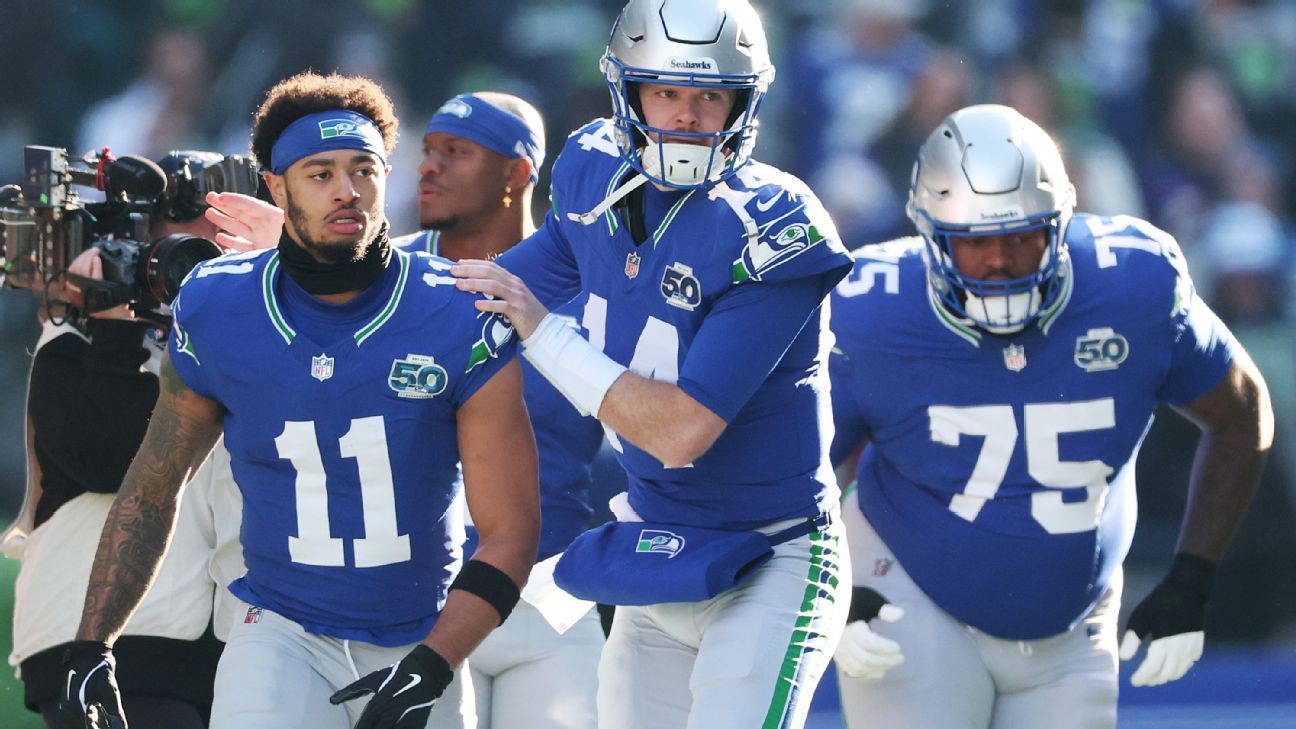
GO AHEAD, CALL the Seattle Seahawks boring. They’ll thank you for it. The God-given right to a drama-free existence is the first article of their constitution. They are deeply, magnetically dull. Mike Macdonald, the head coach, speaks as if he pre-scans every sentence through an algorithm that removes any trace of personality. Macdonald’s motto, enthusiastically adopted on T-shirts throughout the locker room, is M.O.B. — Mission Over Bulls—. The B.S. part precludes any player from saying anything that even approximates controversy. Every mouth travels with its own chaperone.
The quarterback, Sam Darnold, is so aggressively bland that it’s become endearing. Before his weekly news conference the Thursday before the Seahawks’ final regular-season game against the San Francisco 49ers, Darnold stopped at backup quarterback Drew Lock‘s locker and asked if he would help him choose that week’s game balls “after I get through with this media deal.” Darnold proceeded to answer questions pleasantly and without elucidation for 10 minutes before moving on to the fun work of choosing between presumably identical footballs. The mission, indeed.
The concerted effort to exude a lack of excitement is everywhere. It’s like they all signed an NDA. But seven or so times per game, something happens that peels back the layers and exposes the weakness at the heart of the Seahawks’ quest for a bland, mission-driven existence.
On those seven or so moments in every game, Darnold throws the ball to the best receiver in the NFL, and whatever happens next is out of their control.
JAXON SMITH-NJIGBA carries himself with the ease and nonchalance reserved for those of supreme talent. His personality nests perfectly within the Seahawks’ ethos; an antidote to the stereotypical diva hood of many star receivers, Smith-Njigba comports himself without the aid of sideline histrionics, or public spats, or hours spent inhaling from the glue bag of social media.
It seems to have grown organically. Throughout a storied high school career in Rockwall, Texas, Smith-Njigba played wide receiver, was the Wildcat quarterback, played defensive back in long-yardage situations and served as the holder for field goals and extra points. His high school coach, Rodney Webb, jokes with Smith-Njigba that he “walks like he has blisters on his feet,” and yet when the ball is snapped and Smith-Njigba accelerates off the line, it’s more of a glide than a run. “He looks like a hockey player,” Seahawks tight end AJ Barner says. “He’s in and out of his breaks like he’s on ice. So effortless.”
Speed is the glory hound, soaking up all the attention at the scouting combine and the draft, but what if football’s stealth superpower is the ability to stop? Watch Smith-Njigba run a simple out route, the cornerback backpedaling as if staring at an oncoming tsunami. Suddenly, Smith-Njigba stops, like a cartoon roadrunner, and turns to catch a pass from Darnold. The cornerback — no doubt a man whose physical skills fall within the top 0.2% of the world’s population — is still 10 yards away. There’s something unique about the movements, the ability to go from full speed to full stop and then full speed all over again. The man they call JSN might have the best brakes in the NFL. “It’s all about the power of illusion,” he says. “It’s a chess match out there. I’m putting it into the DB’s mind that I’m going fast even when I’m not. I can stop on a dime. I can change speed. Keep ’em guessing.”
I asked Rashid Shaheed, the Seahawks’ second-leading receiver, to recall a play or a moment that explains why, in his opinion, JSN became the first player in NFL history to lead the league in receiving yards for the team that passes the least. Within seconds, he points me to a 63-yard touchdown catch Smith-Njigba made on a pylon route in Week 12 against Tennessee.
“Watch that one,” he says. “You’ll see.”
The play starts with JSN going in motion from wide left to slot right. When the ball is snapped, he hits the seam as fast as a thought. Down the field, he wins a hand fight with safety Amani Hooker at the 22-yard line and hauls in a perfect Darnold pass at the 19. Hooker goes down and watches Smith-Njigba sidestep into the end zone. It’s a solid play, but it doesn’t have the look of the best play in a 119-catch, 1,793-yard, 10-touchdown season. But that’s the beauty of it, Shaheed says: the way JSN’s arms stay free of Hooker’s body while their hands bicker; the way JSN’s eyes remain fixed on the ball no matter what else is happening; and the way JSN separates from Hooker at precisely the right moment. It’s the utter and complete lack of tension at the tensest moments.
“It’s how deceptive he is in his routes, and his ball skills when the ball is in the air,” Shaheed says. “He might have the best ball skills I’ve ever seen. The ability to not panic when a DB is on him — he’s the best I’ve ever seen at that. Oh, and what separates him is his ability to get open when the defense knows we’re going to him.”
It seems Smith-Njigba is a connoisseur’s version of an All-Pro receiver, someone whose greatness arrives by whisper and requires a jeweler’s eye. Late in the third quarter against the Niners, he ran a shallow cross and caught a pass that was thrown a bit behind him. The play is not memorable on the first watch. He reaches back to catch the ball, runs for a few extra yards and is tackled. “Not an easy play to make,” Troy Aikman says on the broadcast. First down, move the chains. You see it all the time.
But wait. There’s something about it that demands a closer look. The throw from Darnold is close to two feet behind Smith-Njigba. It is a bullet, thrown hard and high. Watch it again, from the end zone camera: JSN catches the ball over his right shoulder and allows the ball to take his body with it. Instead of making the catch and clumsily reclaiming his path, he creates a new one that necessitates a 180-degree pivot. It’s difficult to see live, or even after a replay, but what he does is snatch the ball out of the air the way a bird in flight might snag a bug and proceed on its way to somewhere more important. He’s not so much defying the laws of physics as creating new ones.
“It’s not one miraculous play,” wide receiver Cooper Kupp says, “it’s the body of work he’s put in this year.”
IF YOU STUDY something hard enough, eventually it will appear to come naturally. Darnold and Smith-Njigba began studying each other’s skill sets and tendencies during minicamps in April after Geno Smith was traded to the Las Vegas Raiders and Darnold signed with Seattle. They talked in the cafeteria — some football, more life — and began forming a connection that became the best in the NFL.
How did it happen so quickly? “It’s just Sam being around a lot of ball,” Lock says. “He’s been in a few different offenses, a few different teams, trying to figure out Justin Jefferson [in Minnesota], the guys with the Jets and now here. I think it’s a skill he’s developed over time. Plus, it helps to have a really good receiver like Jax. Jax knows how to speed up the chemistry process. Sam knows how to speed up the chemistry process. It worked.”
Smith-Njigba was standing in the visitors locker room in Santa Clara inside a cloud of cigar smoke so thick and acrid that only happiness could overcome it. The Seahawks were celebrating the No. 1 seed in the NFC, home-field advantage and, maybe most of all, a week off. The music was loud enough to turn everybody’s ribs into tuning forks. Darnold, fresh off another pleasantly non-illuminating trip to the podium, was going about the real work of quarterbacking by stopping at every smoke-filled locker and shaking the hand of the man creating plumes in front of it.
Smith-Njigba nodded toward Darnold and said, “It’s been a long time since I’ve been able to turn my head and the ball is right there. I’ve been missing that for some years. For us to be on the same page for him to trust that I’m going to be in my spot and he can throw without me even looking at him, that’s the elite-level ball.”
The word most commonly employed to describe Darnold — resilient — can be interpreted as a backhanded compliment. It’s an acknowledgment that he’s had some stuff to overcome, some B.S. that overrode the mission.
Darnold’s B.S. came clothed in Jets green. He struggled on a team that struggled, and for some that was proof that he would never escape it, that his blood would forever circulate his past. Most famously, Darnold was caught on a sideline microphone telling Jets coaches, “I’m seeing ghosts” in the first half of a loss to the New England Patriots in 2019. It became the one thing people who knew nothing about Sam Darnold suddenly knew; he was the guy who saw ghosts. The fact that he was quarterbacking the Jets — a team that specializes in conjuring all manner of unclean spirits — became secondary. For a certain segment of the sporting public, he would remain ossified in that moment, on that bench, his red hair poofing a bit and his expression one of pure, innocent confusion.
One of the few people who remained faithful throughout three rough seasons with the Jets and two roughish campaigns with the Panthers was Darnold himself, maybe the only person who mattered. He took what amounted to a redshirt year with the 49ers, every quarterback’s favorite rehab clinic, and has won 14 games, thrown for 4,000 yards and made the Pro Bowl in each of the past two seasons, with the Vikings and now the Seahawks. Once the wick gets lit, provided it remains dry, who knows?
“When I got drafted in New York,” Darnold says,” I thought of myself as a guy who could potentially change the franchise, and win games, win playoff games. When that didn’t happen, a little doubt can creep in. But I think it was great to lean on my family, my close friends from back home and the teammates I’ve grown with over the years. As a quarterback, it can seem lonely at times, but it’s a team sport.”
Lock calls the hyperfocus on the quarterback position “a fetish — that’s a good word for it.” And Darnold says, “It can eat you up if you let it.” He says this with a shrug, standing amid that smoky celebration in Santa Clara.
“The system and the people you’re surrounded by plays such a huge role,” Kupp says. “And I think Sam is better now than he was, but what happens if Sam starts here, or with the Niners, or in Minnesota? If he starts in a place where the system fits him and teaches him the things he needs to learn, what happens to his career then? How do we talk about Sam now? It’s a difficult thing, because guys get eaten up and told, ‘Well, you can’t do it.’ He’s proven he can.”
Hurdles remain. Darnold the Viking played the first playoff game of his eight-year career last year and was sacked nine times while compiling a QBR of 12 in a blowout loss to the lower-seeded Rams in the wild-card round. Ghosts can be exorcised to make room for new ones.
“I want to do it for Sam, to prove to all the doubters,” Smith-Njigba says. “My job is to make his life easier. He’s taught me how to be a professional. How to overcome. How to stay even. How to lead these guys. How not to give up. Don’t care what people say, just keep going. I know in my heart he’s a winner.”
SOMETIMES THE ABILITY to summon a proper grievance, to unearth motivation from the darkest depths, is its own talent. A cursory run through Smith-Njigba’s résumé doesn’t indicate much in the way of outside disrespect: a storied high school career at 6A Rockwall High School outside of Dallas; a three-year stay at Ohio State that ended with an almost comical 347-yard receiving game in the Rose Bowl; chosen in the first round (20th) by the Seahawks in the 2023 draft; a 1,000-yard receiver in two of his first three seasons, including nearly 1,800 yards this season.
But Webb, the Rockwall coach who predicted JSN would be an NFL player the first week of summer workouts before his freshman year, says there were always mini dramas within the broader narrative. “In his case, it’s well-founded,” Webb says. “There have been legitimate questions about how good he’s been since high school.”
Texas and Texas A&M weren’t interested in Smith-Njigba — something about his unimposing size or lack of speed — until receiver-rich Ohio State made an offer and caused everyone else to see him in a different light. JSN believed he should have been drafted higher than 20th after his showing in that Rose Bowl game, when he got his first chance to be the No. 1 receiver after fellow first-rounders Garrett Wilson and Chris Olave opted out.
“Coming out of the draft, I’ll put my hand up: I didn’t think he was going to be as good as he is,” Niners defensive coordinator Robert Saleh said before the teams met in the regular-season finale. “I mean, he’s freaking unbelievable. Super talented kid, great body control, great strength at the catch point, can go up and get it.”
Saleh’s words would seem to indicate that JSN’s personal mission — “make them respect me,” he says — has been at least partly achieved. “There are always questions,” Smith-Njigba says. “I’ve had high hopes for myself, and I’ve seen it all come crashing down. Trials and tribulations: That’s partly why Sam and I click.”
EVERYONE KNOWS WHAT home-field advantage looks like for the Seahawks: 68,000 crazed fans wearing No. 12 jerseys, perhaps the only fan base that can’t be convinced it’s not on the roster. Lumen Field under steel-wool skies, throbbing like a 30-acre toothache, a wall of noise from beginning to end.
Even though the Seahawks have been statistically better on the road in each of Macdonald’s seasons in charge, and even though just two of the six home teams won over wild-card weekend, the Seahawks are perceived to hold a massive home-field advantage.
It’s mainly a style thing. The Seahawks are the masters of grinding a game, mortar and pestle, into a fine paste. The defense plays with a keen level of acceleration and violence, even by the standards of its fast and violent peers. The Seahawks can make a 13-3 win feel like a blowout, as they did in Week 18 against the Niners, and they’ll get a chance to do it again Saturday, against a rapidly thinning Niners’ roster in front of all the beholders who see nothing but beauty.
They’ll go about their business believing all that matters is this play, and then the next play, and then the play after that. Every team pretends to believe in this stuff, but these guys seem convinced of its divine provenance. And so Macdonald will continue to proclaim Wednesday as “Football Thursday” because the game is on Saturday and not Sunday, and he will say it in a way that makes it sound important. He will apologize every few sentences, as if obeying an internal alarm, for the quality of his answers. He’ll emphasize that nothing matters but preparation and attention to detail, and everyone in the locker room will wear an M.O.B. tee unironically.
But no matter how hard the Seahawks try, they remain vexed by an insoluble problem: Anywhere from seven to 10 to 12 times a game — seriously, the more the better — they have no choice but to ditch their boring ways. The mission demands it.
