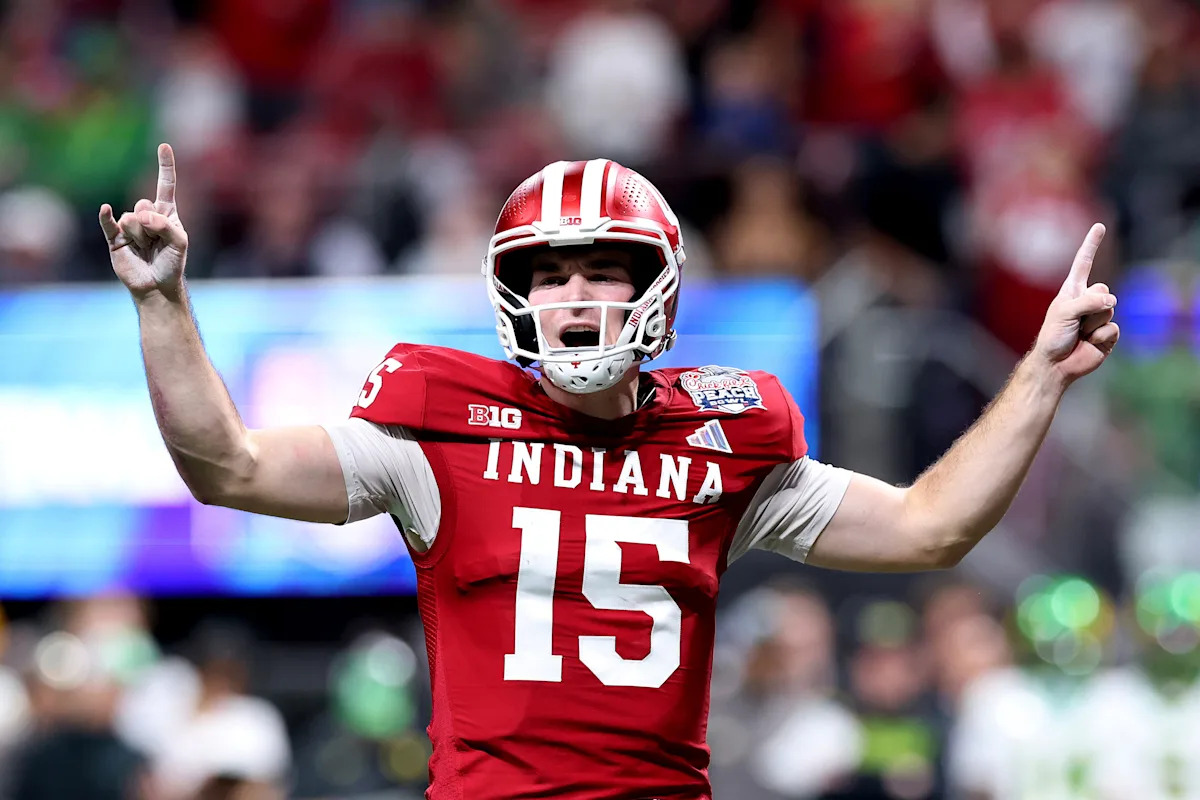
FORT LAUDERDALE, Fla. — In June 2021, at the University of Alabama’s football camp in Tuscaloosa, Ala., Alex Mortensen was struck by the fluid form and accurate arm of a quarterback he didn’t know. As an Alabama offensive analyst, Mortensen studied plenty of top high school arms — many, in fact, were invitees to this very camp.
But who was this kid?
Advertisement
“I remember thinking, ‘Is this my imagination? This guy’s really good,’ ” Mortensen remembered.
The name written on the back of the player’s helmet — Mendoza — didn’t mean anything to Mortensen. But by the end of that camp he was so smitten by this rising high school senior from Miami, Fernando Mendoza, that the coach asked which colleges were recruiting him.
“He said, ‘(Florida International) is talking to me, and I’m thinking of walking on in the Ivy League,’ ” Mortensen said. “I’m thinking: ‘This is the best quarterback in our camp, and no big school is recruiting him?’ That didn’t change, too.‘’
How did this happen? Why was Indiana’s Mendoza lost in plain sight in the recruiting hotbed of South Florida? How could he slip through the cracks, as you’ll see, all the way until he put up a season to win the Heisman Trophy and direct the Hoosiers into Monday’s College Football Playoff national title game against his hometown Miami team?
Advertisement
Back in that summer of 2021, Alabama had signed five-star recruit Tyler Simpson and wasn’t in the market for a quarterback. But Mortensen wanted to help. He phoned David Lee, a longtime NFL quarterbacks coach living in South Florida working with young quarterbacks.
“I’ve got a guy you need to work with,’’ Mortensen told Lee.
Thus began Mendoza’s odd and winding road from unknown camp name to Heisman Trophy winner. Lee declined to talk for this story. But others in South Florida football circles said Lee began to work out Fernando and his younger brother, Alberto, at their Coral Gables home or in watching Columbus High practices.
Mendoza’s throwing became more refined that senior season. The recruiting didn’t pick up, though. Mendoza was hurt by COVID limiting scouts’ attendance during his great junior season. He tried to showcase his game with a camp-a-palooza tour before his senior year, like the one at Alabama — “something like 18 camps in 25 days to show what he could do,’’ said his high school coach, Dave Dunn.
Advertisement
Any interest beyond Mortensen?
“Nothing,’’ Dunn said. “He went to the camp of one ACC school outside the state of Florida, and the quarterback coach walked up to him and only said, ‘Have a good flight home.’ ”
Dunn sent a video package of Mendoza to every major program — “every Power 5 school,’’ he said.
Still no interest.
“The only feedback we got is that his body wasn’t filled out,’’ Dunn said. “So, he wasn’t the runner in high school he can be now. He was skinnier then.”
The list of rejections piled up. Florida Atlantic wasn’t interested. Miami was in the recruiting cycle before coach Mario Cristobal arrived, and Manny Diaz’s staff didn’t invite Mendoza as a walk-on. Calls were made, like the one to Cal quarterbacks coach Bill Musgrave from his old friend, Lee, but Cal already signed a quarterback.
Advertisement
“It was beyond frustrating,’’ Dunn said.
Alabama, thanks to Mortensen, offered him a chance to walk on.
“I couldn’t believe we had a chance at getting him, but as the months passed I thought we might,’’ said Mortensen, who is now the head coach at University of Alabama at Birmingham.
FIU became the only Division I school to offer Mendoza a scholarship. But the Mendozas and Dunn had another gameplan by then if a Power 5 school didn’t step up: the Ivy League.
Mendoza’s father, Fernando, attended Brown on his way to becoming a doctor. Dunn coached at Harvard earlier in his career, just before quarterback Ryan Fitzpatrick played there. So, he’d seen Ivy League talent graduate to the NFL. Yale became the idea, even at a cost of $78,000 a year.
Advertisement
That was about set when, after Mendoza’s senior season, Cal’s Musgrave received another call from Lee just checking if he knew of anyone looking for a quarterback. Cal had just lost its quarterback recruit. He told Lee to send over Mendoza’s video. A few minutes later, Musgrave called Lee.
“What’s wrong him?” he asked Lee.
“What do you mean?’’ Lee said.
“I’ve seen the video; why isn’t anyone recruiting him?” he asked.
Musgrave was told Mendoza had Ivy League-caliber grades, was class president and a member of the Fellowship of Christian Athletes. He then called Dunn with the same too-good-to-be-true concern.
Advertisement
“I’ve seen his film, so what’s wrong with him?” Musgrave asked.
“Come and meet him,’’ Dunn said.
Musgrave flew to South Florida and worked out Mendoza. That was that. Mortensen remembers receiving a text from Mendoza’s father in January 2022 saying, “Cal just offered him.”
“I really was happy for him,’’ Mortensen said. “I’m also thinking to myself, ‘Man, I just missed him.’ ”
Mendoza played three seasons at Cal before hitting the transfer portal last offseason. He wanted to join his brother at Indiana. Miami, to be sure, again didn’t have interest. Its targets were Texas’ Quinn Ewers, who opted for the draft and became the Dolphins’ seventh-round pick, and Carson Beck, who the Hurricanes signed.
Advertisement
Mendoza, more than anyone, recognizes Monday’s game as, “a very full-circle moment for myself,” as he said this week. “If you open Google Maps and put my address, the University of Miami campus is under a mile away. And I walked there, biked there, played basketball rec games in the offseason there.”
Meanwhile, NFL scouts have begun calling Dunn with a different line of questioning that college recruiters four years ago.
“He’s such a great personality, they want to know if he’s for real,’’ Dunn said.
He chuckled.
“I say ‘Everything about him, everything you see on and off the field — is 100 percent real.”
