Before we get into the first Ballislife Mid-Major Top 10 ranking of 2026, let us first establish what constitutes a mid-major program. For the purposes of this exercise, we’re using the original definition of mid-major, which is specifically tailored to include all Division 1 basketball programs that aren’t currently included in a presently constructed Power 4 conference. That means Gonzaga, the WCC, A10, and Mountain West are all fair game despite their respective exclusion from other outlets’ rankings.
From familiar faces to programs having their brightest moment, the Ballislife Mid-Major Top 10 breaks down which non-powers you should look out for in March.
1. Gonzaga (17-1, 5-0 WCC)
While their current status in the West Coast Conference makes them a mid-major by definition, Gonzaga has always been a power conference program in mid-major clothing. Led by a veteran-laden lineup featuring stars Graham Ike and Tyon Grant-Foster, the Zags largely did what they were supposed to do in their non-conference slate, with their lone slip-up being a 43-point setback against Michigan at the Players Era Championship in Las Vegas.
Aside from that embarrassing night on the Strip, which many of us Vegas folks have experienced ourselves in some manner or another, the Zags earned decisive non-con victories over Creighton, Alabama, Kentucky and UCLA. Last Thursday, Gonzaga moved to 5-0 in WCC play so far this season with a 12-point win over a Santa Clara team that we’ll get to a little further down the line.
On Thursday evening, we learned 6-foot-10 junior Braden Huff is out 4-8 weeks with a knee injury. His injury doesn’t really affect the Zags standing amongst other mid-major teams, just their viability as a potential NCAA title contender.
2. Utah State (16-1, 6-0 Mountain West)
We’re only a few seasons removed from the Mountain West being the pinnacle of mid-major hoops and a true competitor against at least one Power 4 conference. In 2025, however, the Mountain is just trying to send more than a single team to the NCAA Tournament in the final year of its most successful iteration. The one team Mountain West fans don’t have to worry about being left out of the bracket is the Aggies of Utah State, who have quietly emerged over San Diego State as the conference’s top power in the last few seasons.
The Aggies’ best win of the season was an 80-77 triumph at VCU in their first Division I game on Nov. 7, setting the tone for their current 16-1 start that has them ranked No. 23 in the country in the most recent AP Poll. Utah State did lose a Dec. 4 non-conference game to South Florida by 13 points on the road, but the fact the Aggies have won their first six games in Mountain West play by an average of 23 points certainly makes up for that setback.
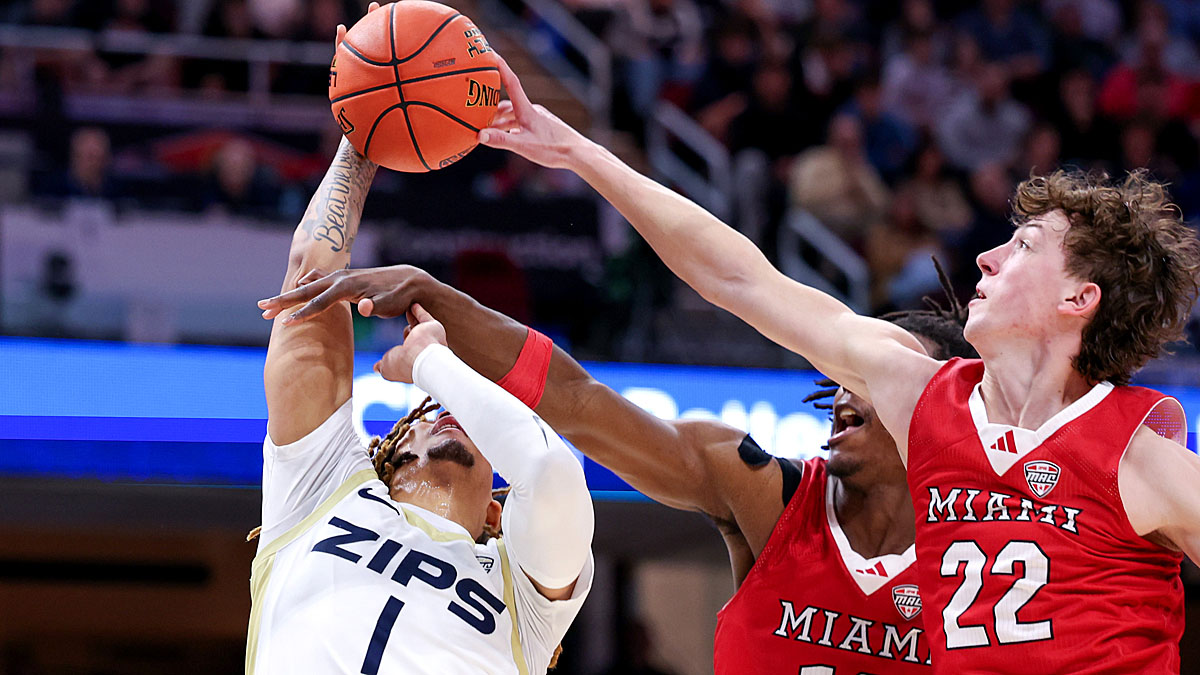
3. Miami (OH) (18-0, 6-0 MAC)
It’s certainly true that there’s a handful of mid-major programs with better wins on their resume than the Miami (OH) Redhawks, but what’s also true is that every single one of those programs has lost a game this season. You know who hasn’t? The original Miami University, the one in Oxford, Ohio that was established before Florida even reached statehood.
Despite the fact some of the advanced stats don’t love the Redhawks in comparison to some of their other elite mid-major counterparts, they are one of the nation’s most efficient teams on offense. Miami (OH) has the third-highest effective field goal percentage in the entire country and they rank in the top 15 nationally in both 2-point and 3-point field goal percentage. And if you’re skeptical about whether Miami (OH) can keep winning, keep in mind that only two of their wins this season have come by less than 10 points.
4. Saint Louis (16-1, 6-0 Atlantic 10)
Aside from a one-point loss to Stanford at the buzzer during Feast Week, fan favorite Robbie Avila and the Saint Louis Billikens have been riding high through their first 17 games. The Billikens exerted dominance over a trio of established WCC foes in the non-conference portion of their schedule, earning impressive wins over Santa Clara, Loyola Marymount and San Francisco. Even more impressive is the Billikens’ 6-0 start in Atlantic 10 play, highlighted by a 72-61 win at VCU on Jan. 7.
Avila’s presence has made Saint Louis arguably the most effective inside scoring team in the nation, as the Billikens rank second nationally in effective field goal percentage (60.2 percent), fifth in 2-point field-goal percentage (61.3), and first in average 2-point field goal attempt distance (3.7 feet).
5. New Mexico (14-3, 5-1 Mountain West)
The Mountain West’s best hope at becoming a two-bid league is for New Mexico to win its second Mountain West Conference Tournament in three seasons in March, but the good news for Gloria Narvaez and company is that the Lobos have a very good shot at doing so. The Eric Olen era has gotten off to a mostly fast start in Albuquerque, albeit with a few poorly aging losses against New Mexico State and Boise State.
On the other hand, you’d be hard-pressed to find a mid-major program outside of Gonzaga that played as unforgiving a non-conference schedule as the Lobos, and they escaped with impressive wins against Mississippi State, Santa Clara and VCU. If the Lobos can limit their setbacks in Mountain West play, they could play themselves into at-large territory.
6. George Mason (17-1, 5-0 Atlantic 10)
George Mason, like Miami (OH), has benefited from playing a schedule full of teams that aren’t as good as they are. The advanced metrics and respected statisticians are unanimously wary of the Patriots’ fast start on account of who they’ve played, but my number one philosophy when making any sort of power rankings is that on-the-court results must be paramount.
When you consider this team hasn’t lost to any of their (albeit lesser) opponents, that their one loss came against an ACC foe in Virginia Tech, and that they have the same best win as Saint Louis and New Mexico (VCU), maybe it’s time to give the boys from Fairfax the benefit of the doubt until they drop a game they aren’t supposed to. Because it hasn’t happened yet. There are teams that may look more attractive when you look at the metrics, but those teams have crumbled in moments where George Mason has been at its best.
7. Saint Mary’s (17-2, 6-0)
Saint Mary’s will likely climb up the rankings a bit once it gets a few of those good WCC wins on their resume, but its two losses in non-conference play gave an initial cause for pause. The Gaels’ first loss to Vanderbilt was a concerning 25-point trouncing during Feast Week, though it has come to age quite well since considering Vanderbilt’s recently-broken winning streak. The other, however, a one-point loss to Boise State, has aged like a cigarette smoker in the desert after the Broncos have started 1-5 in Mountain West play.
Still, the Gaels boast one of the most well-rounded teams in the country. Mid-major or otherwise. The Gaels rank in the top 30 in both KenPom and Torvik’s offensive efficiency ratings and in the top 50 in each of their respective defensive efficiency ratings. Like Gonzaga, Saint Mary’s metrics are more aptly comparable to power conference teams than any mid-major, yet their resume is never even close to as ironclad.
8. Dayton (13-4, 6-2 Atlantic 10)
Like New Mexico, Dayton is a team that has gone through the wringer early in the season and has largely emerged as a better team on the other side. Of their four losses, two came against teams that were ranked in KenPom’s top 15 (BYU and Virginia) and another Power 4 opponent in Cincinnati. Dayton doesn’t yet have a signature win, but the defensive metrics show the Flyers will be a force to be reckoned with throughout Atlantic 10 play. They rank fifth nationally in turnover percentage, eighth in steal percentage, and 14th in 2-point percentage allowed
9. Belmont (16-3, 6-2 Missouri Valley)
Belmont’s current resume doesn’t exactly jump off the page when looking at wins and losses, but the Bruins’ offense will be a force to be reckoned with for any team they cross paths with this season. Belmont leads the entire country in effective field goal percentage at 60.6 percent, ranking second nationally in 2-point field goal percentage and 10th in 3-point field goal percentage.
Beyond that, Belmont is an extremely formidable defensive force. The Bruins rank 12th nationally in 2-point field goal percentage allowed and 55th in total effective field goal percentage allowed. If they can survive a gauntlet in the Missouri Valley Conference tournament, Belmont is a team you’ll want your power conference alma mater to avoid in March.
10. Tulsa (14-3, 2-2 American)
If this ranking came out a few weeks earlier, the Golden Hurricanes probably would have debuted a few slots higher after their 13-1 start. Two losses in four American Conference games have knocked them down a peg, but they still have an offense that compares favorably to most in the country. They lead the nation in effective field goal percentage and rank 20th in 3-point percentage, although we’ll have to see whether or not they can keep their heads afloat in conference.
They get some benefit of the doubt playing in an American Conference that’s teetering on the edge of high-major, and thus, they get more benefit of the doubt than some of their other mid-major counterparts.
Editor’s Pick
The post Ballislife's Mid-Major Top 10 Rankings (Jan. 15) appeared first on Ballislife.com.
