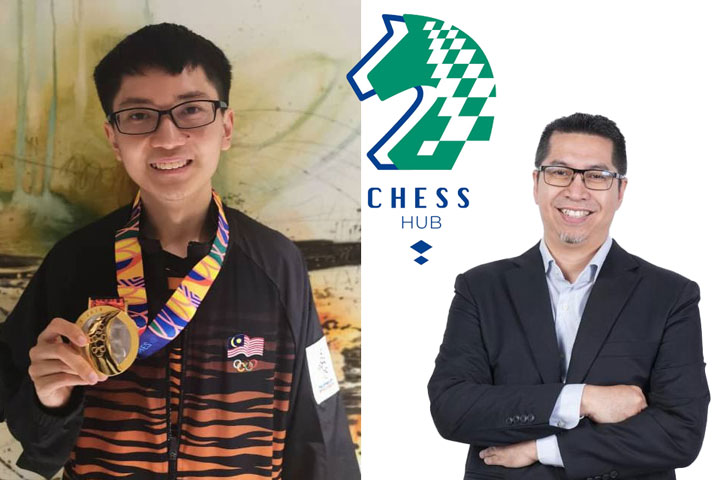
Abdullah Hidayat Mohamad and Chess Hub
By Edwin Lam Choong Wai – All photos provided by Chess Hub
On the 3rd of August 2025 the then International Master Yeoh Li Tian won the last round of the Chess Hub MCF 1st GM/IM Invitational Chess Championship and fulfilled his third and final GM norm – to finally complete the dream outlined by the late Malaysian chess philanthropist, Dato’ Tan Chin Nam (traditional Chinese: 陳振南, pinyin: Chén Zhèn Nán; born 18 March 1926, picture right from Alchetron)
The rejoicing at this decades old dream went beyond the chess community as newspapers and social media pages were filled with headlines of GM Yeoh’s success. Even the Malaysian Prime Minister himself, Anwar Ibrahim, gave a call to the new GM right after his historic triumph.
This watershed moment should be attributed in large parts to the catalytic financial support of Chess Hub to the Malaysian Chess Federation (MCF). Around end December 2025, I had the opportunity to meet Abdullah Hidayat Mohamad, the man behind Chess Hub. This is the first time he had ever spoken extensively to the media about what inspired him to ‘start-up’ Chess Hub, his vision for Malaysian chess and also his plans for 2026 and beyond.
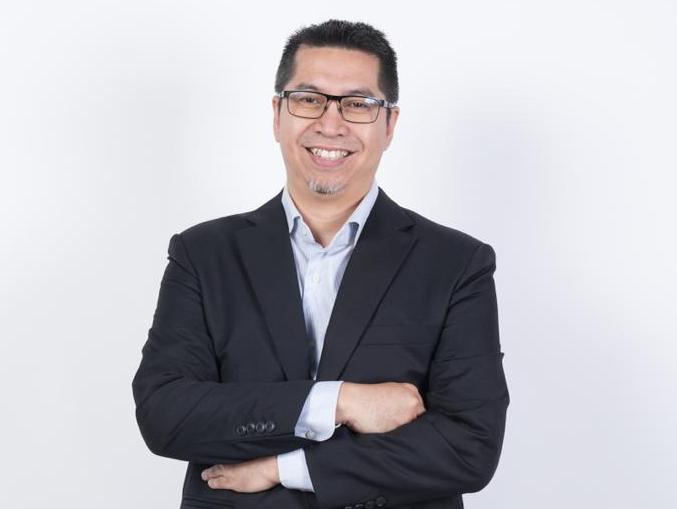
Getting to know the man himself
Abdullah Hidayat is a venture capitalist. He is the Managing Partner and co-founder of Ficus Venture Capital. They manage Shariah-compliant funds aiming to invest in start-ups that have the potential for growth and are rightly placed to deliver social impact to the community. One of the largest funds managed by them is the US$ 13.6 million Ficus SEA Fund.
The 42-year-old Hidayat was born and bred in Kedah, the northern state of Malaysia that is also known as the Rice Bowl of the nation. He had taken up the game in the year 1995 when he was twelve years old and in quick succession, he managed a 12th placed finish in the Kubang Pasu district championship.
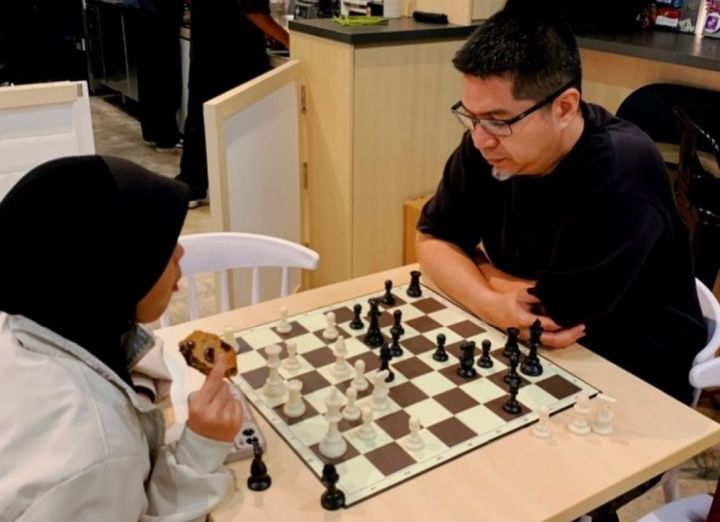
Hidayat playing a casual game of chess in the neighbouring café to Chess Hub
Not bad for a total beginner in the game. But, his obsession for chess was short-lived. It became merely a one-year wonder as his entrance into boarding school the following year dampened the ecosystem for growth in the game.
It would be years later when Hidayat undertook his university education in Edinburgh that he would again be exposed to the cultured presence of chess, via chess clubs there. It was there that he would witness the vibrant social aspects of the game with community members gathered in clubs to play, have fun and chill. The best part of it as he recalled to me, “Clubs there freely welcome anybody in the community to join in.”
Despite the welcoming chess community in Edinburgh, his passion for the game again did not become a full-blown affair. Maybe he was up to too much mischief and prank at university or possibly that the footballer in him was too attracted to The Beautiful Game that Caissa was simply overlooked.
Another few decades passed by before Hidayat, in the year 2023, by then a married man running a VC fund and being a dad with a 12-year-old daughter and an 8-year-old son, would again cross path with chess.
“I had taught my kids the basics of the game and my daughter wanted to play in a tournament at KL Gateway. She was keen to compete in order to get the certificate of participation from the tournament. My son joined in as well to accompany the sister,” he recalled.
His daughter did less well, while his son had a decent run. And, this led to another tournament for the boy soon after where he was placed third for his age-group. Soon after, Hidayat hired Adam Jafri as his son’s coach and chess became serious work for the boy. Hidayat became the typical chess parent in Malaysia – bringing his son to tournaments around the Klang Valley, staying overnight in hotels for multi-day events and even venturing all the way to Johor Bahru, a 4-hour drive from their home.
What led to the setting up of Chess Hub?
Once in end 2024 while waiting for his son to compete in a tournament held at MCF’s office, he had a chance discussion with the arbiter then, Wong Qi Hao, about the facts, data and figures behind chess. Being the actuary that he is, he started digging some statistics online on his phone and the more he dug, the more it intrigued him.
“Looking at the data out there on FIDE’s website, chess results and others, there is room for business given the small population playing the game anywhere across Asia versus the untapped market out there,” he said before adding that, “The potential is even bigger if the tournament venue is located in a vibrant place with greater accessibility by the community.”
 It was around that time that he was looking for an office space for his VC business and also his other commercial entity that offers training and development. “A bell rang in my head – why can’t we have a space that is an office and training facility on weekdays that can also become a chess meet-up point on weekends? It was then that I asked Adam to join me to set up Chess Hub,” he shared.
But Chess Hub is much more than just a co-shared space for different entities – which some other chess coaches and academies have already been doing for years. There is so much more to the vision of Chess Hub that goes beyond the exercise in asset maximisation.
Chess Hub: Beyond philanthropy
When Chess Hub announced its financial sponsorship for MCF and Malaysian chess around March 2025, the upfront commitment from the VC-backed chess venture amounted to a total of over Ringgit Malaysia (RM) 1 million from the year 2025 to 2029.
“We have pledged a guaranteed sum of RM 229,000 annually for the next five years. This sum will be used to host the annual Chess Hub – MCF’s GM/IM Invitational Championship as well as host of other major events locally as well as cover some of MCF’s administrative expenses,” Hidayat shared.
This is aside from the RM 30,000 annual sponsorship given to each talented chess teenager in Malaysia to allow them to find their GM coaches and to fund and financially aid their travels for tournaments abroad.
“Getting the right type of competitive exposure is essential for the player’s growth. One of our Chess Hub sponsored player, 11-year-old CM Chow Yi Chen, had only just competed in his first ever international event at the FIDE World Cadet in September 2025 and finished a very strong 13th place! Imagine what might have been if he had gotten a lot more exposure of competing globally!” he opined.
But Hidayat is not being charitable with his sponsorship support. Instead, he sees the need to ensure that financial support for chess must go beyond philanthropy. “I am a VC and I always look for Returns on Investment,” he quipped.
He had shared that the current Chess Hub model operates in wanting to create an ecosystem whereby it plays the role of a united chess development entity that can go in a scalable way to raise corporate monetary support as well as to gain any in-kind sponsorship i.e. air tickets, train tickets and accommodation support for top GMs coming to play here.
He also shared that any monetary support that exceeds the commitment agreed with MCF will then be split between the two entities – allowing for Chess Hub to retain a sustained kitty of finances that can be further used for chess development in the months and years ahead. This ensures that there remains a sustained effort in chess development that is backed by sound finances beyond philanthropic means.
Hidayat’s three-pillared Vision for Chess in Malaysia
According to him, “Chess Hub has set a target to enable Malaysia to become a chess powerhouse of being ranked in the top 50 bracket by the year 2030.”
To do so, he has laid out three action plan pillars that need to happen in the near term.
“I bring in VC and corporate management expertise into the picture. In the early days of me being a chess parent going around tournaments and observing how tournaments are run, what types are being organised, who plays in them and where these are held, I sensed some gaps. For one, there is the competitive nature of every other chess industry player, which I believe is the barrier why we can’t unite and work together. I then went and spoke to Najib Wahab, the Secretary General of MCF and I asked him: What’s stopping Malaysia from having its first GM?” he said.
Najib outlined the lack of good quality classical tournaments as well as the issue of ‘access’ to GM coaching. A key stumbling block to both points above is monetary.
“I then asked Najib to tell me how much does it cost to organise a strong, international-level classical event? He gave me the low-down for the costs in the five areas of venue, equipment, manpower, logistics for overseas players as well as appearance fees for GMs. I did the Math and then based on the calculation, I said I can commit to support it,” recalled Hidayat.
“Logically, accessibility is greater and total costs is lower to organise a strong event locally and get GMs to come here versus sending talented juniors to Europe for similar strength events,” he added.
This sparked Hidayat’s thinking to outline the three pillars of his chess vision for Malaysia. The first pillar – of which much had been outlined in the preceding paragraphs – is the organisations of high-quality international classical tournaments.
Second of all is the need for structured and planned player development sponsorships.
“All our Chess Hub sponsored teenagers who are 18 years old or younger have to meet their rating KPI target for the year. They are given a sponsorship total of RM 30,000 per year for them to hire GM coaches and to help cover their expenses when travelling for tournaments. They are also welcomed to play in all Chess Hub tournaments for free,” he explained.
At the moment, Chess Hub has under its wings eight talented juniors in this program, namely FM Kavin Mohan, FM Genivan Genkeswaran, CM Chow Yi Chen, AIM Aqil Allaudin Abdul Aziz, WFM Ainul Mardhiah, CM Shen Ree Herng, ACM Ashwiny Kumaran and Uzair Shahar.
“We might add on another one or two more players under this program, but we will most likely want to see some tangible results first from this initial batch before moving ahead. We want to prove a workable model first,” he added as he waxed lyrical about the tremendous results of FM Kavin, CM Chow and Uzair this year.
For perspective, FM Kavin – in this debut FIDE World Cup 2025 – fought bravely to tie the classical games against the highly-rated and experienced GM Robert Hovhannisyan. FM Kavin went down only in the tie-breaks – running a great race. CM Chow finished 13th in the World Cadet while Uzair won the Malaysian Masters ahead of his more illustrious opponents.
The third pillar in Hidayay’s mind is the need to instil a strong chess culture in Malaysia through regular and sustained community engagement programs.
“This is the hardest nut to crack, but I recognise that this is also the most important as this will help unlock the future pipeline of chess talents for Malaysia. We have done some work on this area in 2025, but there are so much more to be done beyond this in 2026,” he shared.
What’s in store for 2026?
In the new year, Hidayat said that Chess Hub is about to launch an online platform that will unite all key services of chess under ‘one-roof’.
“It will enable chess players to get information, engage with and financially transact on any chess related services and activities. We also want this platform – which is a sort of an online chess hub – to also be informative and engaging. We will launch this around end January 2026, so stay tuned!” he shared.
There are also firmed plans for Chess Hub to work with 9 different state chess associations to organise a circuit of classical chess events all over Malaysia. Chess Hub aims to guarantee the participation of at least 10 Grandmasters in each event.
“This idea, with this circuit is to enable us to scale the chess activities so that we can better gather support from corporate sponsors. As for the travelling GMs, this circuit provides them with the option to extend their stay here across multiple tournaments and be able to make a living, professionally. We also want talented teenagers and kids in Malaysia to have the chance to play regularly against strong opponents as this would help them grow,” he concluded.
All these as well as the committed plan to have the annual GM/IM Invitational Tournament as well as the continued sponsorship of talented kids will lead Malaysian chess to an even brighter future before the end of this decade.

