American Women Positioned for 400 Freestyle Relay Breakthrough
The premise here should sound familiar. Over the summer, the U.S. women were in prime position to capture a world title in the 400 freestyle relay and end an eight-year gold-medal drought in the event. The team has never failed to reach the podium at a major meet during that stretch, but Australian teams led by sisters Cate and Bronte Campbell, Emma McKeon and Mollie O’Callaghan were too much to overcome.
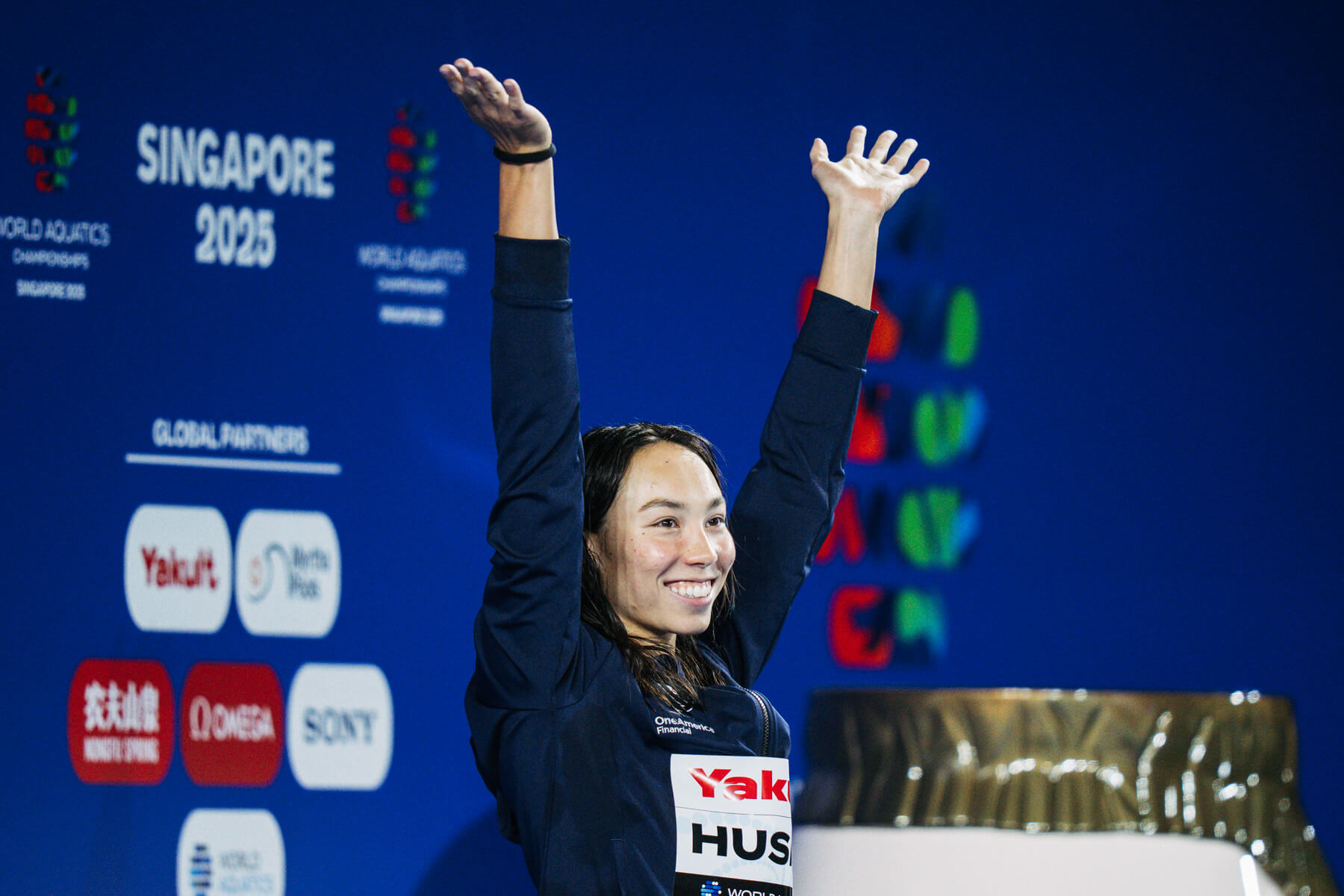
The 2025 showdown figured to be different after three U.S. women dipped under 53 in the 100 free final at U.S. Nationals. Torri Huske led the way with the world’s fastest time, with Gretchen Walsh and Simone Manuel not far behind. Kate Douglass had been sub-53 in topping the U.S. qualifying fields each of the previous two years. All of those swimmers had accumulated significant international experience — none more than Manuel, the 2016 Olympic co-champion in the 100 free — and a composite analysis of 2025 best times put the American team one-and-a-half seconds ahead of Australia.
Of course, that was before most members of the American team began suffering symptoms of gastrointestinal illness a week before the start of the World Championships, which featured the 400 free relay on day one. The American team had to shuffle lineups throughout the meet based on health, beginning with Huske’s withdrawal from the 100 butterfly that same day. The relay team appeared to be intact that evening, but then Walsh’s condition worsened after the 100 fly semis, and Erin Gemmell was inserted in her place in the lineup.
Kate Douglass — Photo Courtesy: Peter H. Bick
Despite the last-minute setbacks, the U.S. team came close. Douglass in particular was brilliant, splitting 51.90 on the second leg. Only the Netherlands’ Marrit Steenbergen and Australia’s Meg Harris were quicker, and both won sprint freestyle world titles later in the meet. Gemmell went 53.17 on the third leg, much quicker than her flat-start best time. On the anchor leg, Huske blasted out from the beginning to take the lead, but she had nothing left on the way home. Australia ended up getting the win by a half-second.
With the benefit of hindsight, it seems clear that a fully-healthy U.S. roster would have won that race. Simply replace the splits from Gemmell and Huske in her compromised state with the flat-start times that Huske (52.43) and Walsh (52.78) swam at Nationals, and the Americans’ time would be 3:30.20, four tenths quicker than Australia’s actual gold-medal time. With relay starts, the margin could have been even greater.
Various results posted since the conclusion of the Singapore meet lend further credence to the notion that the U.S. will take gold the next time these teams face off, expected to be at the Pan Pacific Championships in August. The Americans will welcome teenager Rylee Erisman to the senior national team for the first time after her star performance at the World Junior Championships: eight medals, five of them gold, with individual wins in the 50 and 100 free.
The two-lap race saw Erisman finish in 52.79, which would have been quick enough to win bronze at Worlds. That gives the Americans a full squad of sub-53-second performers while no other country had more than one swimmer under 53 for the year.
Douglass would not be included in the hypothetical best foursome based on 2025 flat-start times, but she fired off a pair of statement swims during the World Cup circuit. She lowered the world record for the short course meters 100 free on two occasions. In Toronto, she became the first woman to ever break 50 in the event.
That gives the Americans five stellar options while Australia still has questions behind O’Callaghan and Harris. Olivia Wunsch performed well in her first finals relay in Singapore, coming back on Huske with a 53.05 closing split, and Milla Jansen went sub-53. Alex Perkins is another veteran option, and so is Shayna Jack, but she missed the Worlds team this year while swimming well off her best times. There are several options in the 53-high range, but those times will not measure up against a full slate of 52-capable swimmers.
However, Australia is on a winning streak, with no intentions of going down quietly. O’Callaghan and Harris, the bridge to the previous generation, proved that in Singapore. Still, moving into the middle year of this still quad, the talent and flat-start times point toward the United States.
