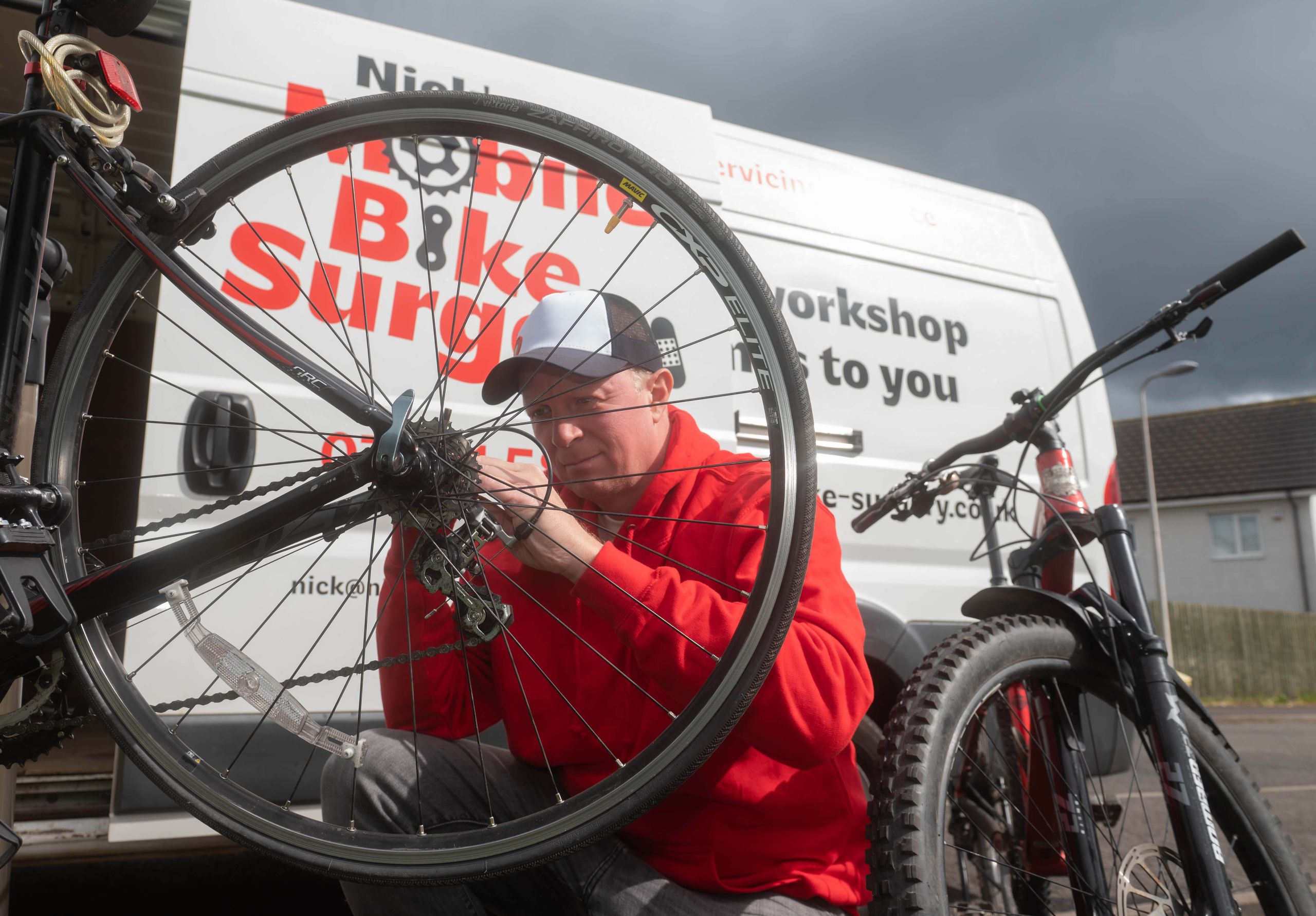
Nick Sharpe was terrified. He might have been a high-flying communications director, used to facing down interrogations from MPs and TV news anchors, but right now, he just could not do it. Having been signed off work for six months due to stress-related anxiety, he was attempting to return to his job at Scottish Renewables in Glasgow, and it wasn’t going well.
“It was a constant terror,” he tells Cycling Weekly. “The commute was just cold sweat and panic and just awful. It’s otherworldly – a very, very strange feeling.”
It was the brutal culmination of two decades spent on a roller-coaster of caffeine-fuelled stress, thrills and trauma – and one that ultimately led him to step off the hamster wheel and into life as a mobile cycle mechanic.
His job also took him to the Eyjafjallajökull volcano in Iceland in 2010. And just as airspace around Europe was about to be closed, Sharpe was flying into the eruption: “There were rocks the size of cars, on fire, flying past the helicopter window,” he says.
Sharpe left his newspaper job 14 years ago after having a family, to work in communications. It was a job he enjoyed, but as time went on and he was given greater and greater responsibility, it only became more arduous.
“I love being out on the road, meeting people… then Covid happened, and nobody wants to meet you for coffee anymore. All the good stuff about the job seemed to disappear,” he says. “I worked from home during Covid, and we were actually busier than ever. We had to try and keep the industry running… That was really stressful, too.”
And the anxiety had not gone away. “People would think I was knocking it out of the park, but I remember sometimes being almost paralysed with nerves and even gagging over the toilet before big moments. I was like a swan – appearing graceful on the surface but frantically paddling away under the water.”
Things came to a head after he took six months off with anxiety in 2023. “I spent a lot of money on expensive therapy, which was great, and I learned an awful lot about how to manage my anxiety,” he says. “But I was just terrified the whole time of going back to work, absolutely terrified. I couldn’t even think about it. If I saw a wind turbine [his area of work], I went into panic mode.”
Sharpe’s boss tried to persuade him to return – even telling him he could write his own job description. And while he tried a downscaled role for a while, the anxiety would not abate. In the end, he says, after talking with his therapist, he went home and spoke to his wife about a new life: “I think I need to do something else… something that’s not behind a desk, because I can’t sit behind a desk anymore. I’m just too crippled by it.
“It was a huge thing to take what was probably a 70, 75% pay cut… And then, can we keep the house? How are we going to feed the kids, and all that stuff? But I couldn’t carry on,” he says.
His initial idea had been to work as a supermarket delivery driver, but after applying for a dozen jobs in the sector without even a call back, recalling a newspaper article about a local mobile bike mechanic in the next village sparked his interest. A lifelong mountain biker, Sharpe has spent as much time as the rest of us fixing bikes – probably a fair bit more, in fact: during lockdown he offered his services free on Facebook, repairing and servicing bikes for locals.
“We live in a village of 1,000 people and I just knew that there were, you know, 500 sheds in that village with bikes with two flat tyres, but probably just needed a couple of inner tubes to get going again,” Sharpe says. “I had to subscribe to a project management tool online to keep track of all the appointments. But people loved it, and it was great.”
After a “really positive” conversation with Ian, the mobile mechanic from the newspaper article, the decision was made. Sharpe spent two weeks in South Wales on a Cycle Tech mechanics course – itself no easy task thanks to his latent anxiety – and spent time on building a website, social media channels and establishing distributor channels. Finally, last June, Nick’s Mobile Bike Surgery was up and running.
The ‘standard’ bikes he works on are the Carrera Vengeance mountain bike and the Genesis Croix de Fer gravel / tourer, he says. He’s Bosch qualified and although around 25% of his jobs are on ebikes, most of those are standard mechanical issues.
Fitting new chains (and often cassettes) is the most common job he does, Sharpe says, along with replacing brake pads. “About 60/40, disc brakes to V-brakes,” he says. “There’s still a lot of V-brakes out there… I go through big boxes of V-brake pads.”
The most rewarding fix he does is to get brakes working just so, he says, or perhaps silencing a raucous squeal that is driving the owner to distraction.
Very much a people person, Sharpe enjoys getting out to meet customers in his west central Scotland base – as well as those who just want to stop and chat, he says: “If I’m on the street for an hour with the bike in the stand, two people will stop and want to talk about cycling or take a business card. It could be school kids, all the way up to a guy of 96 who stopped and told me how he used to race time trials.”
There are a lot of aspects of his new vocation that Sharpe enjoys, but perhaps the biggest is having control of his life again. “That’s the important thing for me, is I’ve got control back,” he says. “The control is, it turns out, is massively important for controlling my anxiety.”
In speaking to the media, Sharpe is keen to promote his new business, of course. But he is also keen to get the message out there that if you’re miserable in your job, you don’t have to stick it out.
“What I’ve been trying to get out to people through this is telling people they’re not trapped,” he says. “I think that’s what that terrible fear was for those six months when I was off and when I tried to go back, that I was trapped,” he says, “like I can’t do anything else.”
The old anxiety threatens to raise its head from time to time, he says, but now he is in a position to recognise it and to back off. “I’ve got to remember why I’m doing it,” he says. “I’m not trying to pack my day with jobs and turn into machine,” he says. And, being his own boss, these days he doesn’t have to.
