It’s easy to find yourself buying into the tenets of aero doctrine governing the bicycle industry, and while much of what is preached is true, the speeds required to unlock these watt savings are not always achievable for the average rider. For the most part, aero road bikes are heavier than the climbing equivalent, and while they do devour roads – particularly rolling terrain – at a much faster rate than lightweight bikes, there’s a sense of purity and feel that is lacking.
Scott is one of the brands bucking the aero trend and still offers a genuine climbing bike in its portfolio, the Addict RC. The Addict RC has long been considered one of the best lightweight bikes, a fact underscored by the original 2008 model. For the latest iteration, Scott set out to rekindle the original’s values, and the result is a lightweight thoroughbred designed to mince climbs and rail descents while still holding its own on the flats.
We set out to assess how the Addict RC Pro would perform across varied terrain and surfaces, amassing over 1,100km of testing to deliver a definitive verdict.
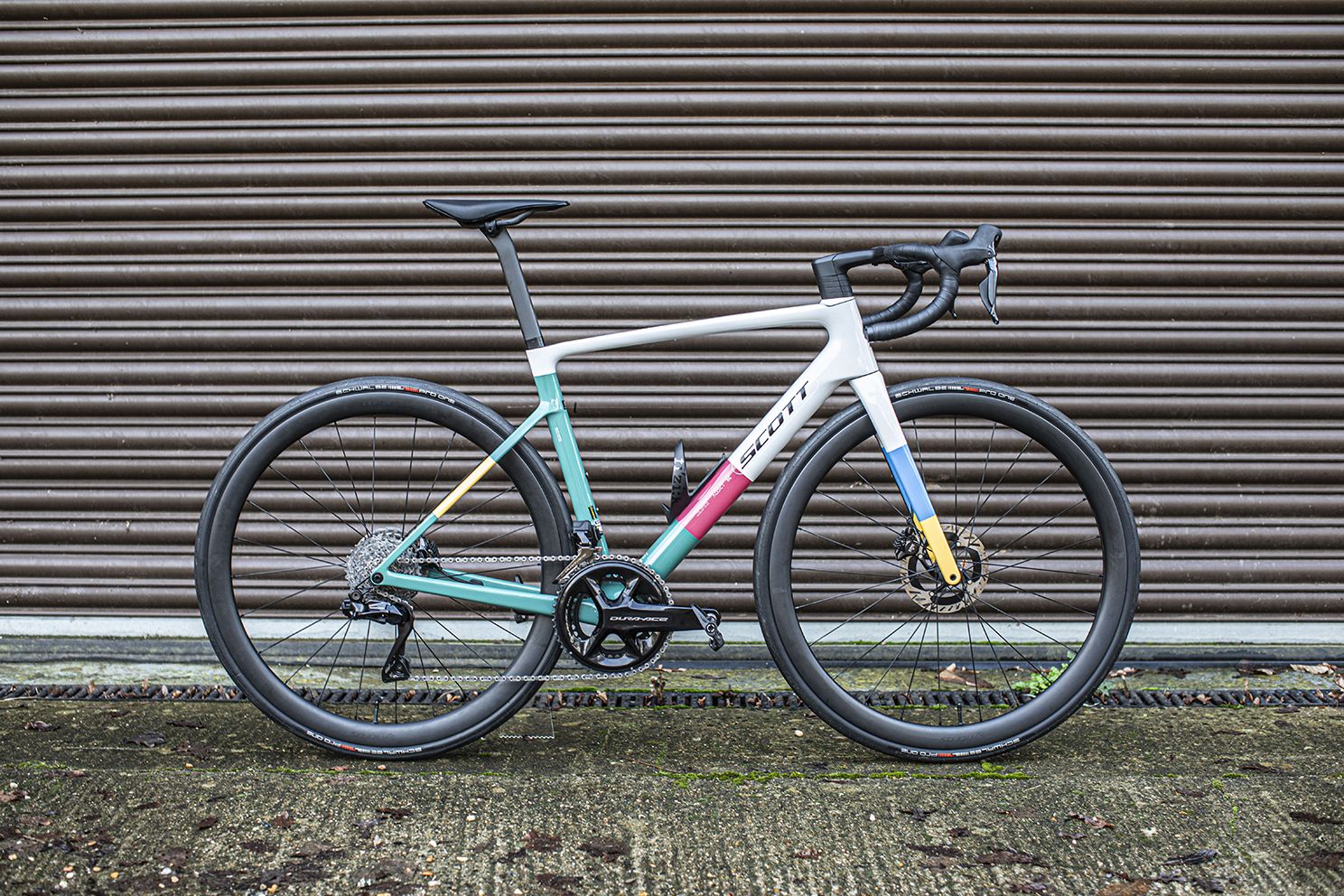
The harlequin-style beluga grey/seashore green colourway might not be to everyone’s taste, but I particularly like the mix of white and bright, blocked colours.
(Image credit: Aaron Borrill)
Design details
The Addict RC Pro conforms to the classic modern climbing bike template, with dropped seatstays and near-parallel head and seat tube angles of 72.8- and 73.6-degrees respectively on my medium test bike – these angles become almost perfectly parallel on the large frame. It’s set up on the racier side of the geometry spectrum, with a slightly lower, stretched-out front end than some of its rivals in the same size. The reach and stack numbers are rated at 395.2mm and 543.3mm, which is more aggressive than all-rounders such as the Cannondale SuperSix Evo and Specialized Tarmac SL8 platforms, not to mention the Specialized Aethos 2, the Addict’s chief adversary. The 410mm chainstay length is spot on for this category, hinting at playful, responsive handling.
It’s available in seven sizes and two colourways: black and white, and the harlequin-style beluga grey/seashore green pictured here. It might not be to everyone’s taste, but I particularly like the mix of white and bright, blocked colours. With so much white on offer, though, it will be difficult to keep clean throughout a northern hemisphere winter, so I suspect most prospective buyers will choose the black-and-white colourway over this one.

The frame is constructed from HMX high-modulus carbon layup and is claimed to weigh 780g.
(Image credit: Aaron Borrill)
The Addict RC frame is constructed from the brand’s HMX high-modulus carbon layup and is claimed to weigh a feathery 780g. In fact, the entire Addict RC range utilises the HMX layup, save for the range-topping Addict Ultimate, which uses a lighter HMX SL layup, weighing 140g less at 640g. In terms of complete system weight, the Addict RC Pro weighs 6.49kg (without pedals) for a size medium, which is impressively light and well below the UCI’s 6.8kg weight limit. If that’s not light enough for you, the range-topping Addict Ultimate is some 500g lighter, claimed to come in below 6kg for a full build, thanks to the 1,170g Syncros Capital SL wheels, HMX SL carbon recipe and SRAM Red AXS groupset.
Despite utilising a few aerodynamic touches from the Foil aero bike, the Addict’s modus operandi is focused more on mass reduction than on watt savings. The frontal area has been reduced by roughly 10 per cent compared to its predecessor, with a narrower head tube and sleeker fork and rear stay profiles. Tyre clearance is rated at a maximum of 34mm, which is par for the course and ample to futureproof the setup and accommodate larger rubber come winter.

Syncros Capital 1.0S wheels measure 40mm deep and come wrapped in 30mm Schwalbe Pro One TFE tyres.
(Image credit: Aaron Borrill)
Specifications
As the second model in the range, the Addict RC Pro is equipped with a full Shimano Dura-Ace Di2 12-speed groupset, including 52/36T, 11-34T, and 170mm cranks. Unfortunately, this build doesn’t include a power meter, which is disappointing given that all SRAM-equipped Addict RC bikes come with power meters as standard, including the £6,899 Addict RC Team Bike, which sits below the RC Pro in the lineup.

An integrated Syncros IC-R100-SL Carbon cockpit complete measures 38cm wide and comes with a 110mm stem.
(Image credit: Aaron Borrill)
The balance of the build is handled by Scott’s in-house component arm, Syncros. As such, it gets an integrated Syncros IC-R100-SL Carbon cockpit complete with a 110mm stem and 38cm bar width – a nice balance when it comes to comfort and aerodynamic efficiency. There’s also a handy Syncros iS multi-tool located in the right-hand drop of the handlebar.
The Syncros Capital 1.0S wheels, while not as light as the Capital SLs, are still impressive, measuring 40mm and wrapped in 30mm Schwalbe Pro One TFE tyres. Other than that, there’s a Syncros SP-R100-SL seatpost topped off with a Belcarra Regular 1.0 saddle.
Image 1 of 10


Performance
There’s no two ways about it, the Addict RC Pro is happiest when the road turns skywards. It’s a pleasure to pedal uphill, regardless of whether you want to cruise or feel the red mist descending. The frame is beautifully constructed and manages to balance stiffness, weight and compliance – a difficult task to pull off successfully, but Scott has nailed it. As a result, the RC Pro accelerates with ease and responds instantly to pedal inputs, a feature often lacking on aero and climbing bikes alike. For all its anti-gravity intentions, it’s still a rapid machine on the flats, though – it’s only on rolling-style terrain where I foresee an aero bike gaining a clear advantage, as you’ll need to keep on the pedals more owing to the paucity of deeper tubing and taller wheels.
The ride quality is exceptional for such a light frameset, and the 30mm Schwalbe Pro One tyres and 40mm Syncros wheels are to thank for it. Not only is the grip and rolling efficiency of the wheelsystem impressive, but lowering your tyre pressure (regardless of which format you run) will add a level of comfort that was always lacking on rim-brake-style climbing bikes a decade ago. I chose to keep the inner-tube format set at 60psi front/rear for the entirety of my 1,100km test and was left impressed by the all-round performance it afforded me – no punctures or harshness, just oodles of purchase in the corners.

As a top-spec model, the Addict RC Pro is outfitted in Shimano’s best groupset, Dura-Ace Di2.
(Image credit: Aaron Borrill)
While I’ve raved over its climbing ability and straight-line performance, it’s actually on the technical descents where the Addict RC Pro excels – and it’s in this type of terrain (technical ups and downs) that it will leave an aero bike for dead. The level of communication coming through the front end borders on telephatic, allowing you to instinctively adjust your weight bias across both axles to maintain confidence and make the best line choice. As much as I tried to unsettle it down the steep and slippery lanes in and around the Surrey Hills, the Addict Pro was flattering, allowing me to change direction with ease and make up ground faster than usual, without any spincter-clenching moments.
With an assortment of bikes to choose from, including options from the aero and gravel variety, I found myself turning to the Addict RC Pro most of the time, given its playful nature and easy-to-ride-anywhere demeanour. If I were to nitpick, though, I’d probably change the saddle to something more familiar and also ditch the Syncros iS multi-tool, as it would sometimes rattle inside the bar on rougher tarmac – it might also save you a couple of grams.
Value
The Scott Addict RC Pro is a fun and fast bike to ride, regardless of the terrain. While it’s far more comfortable on the climbs than the flats, it can more than hold its own against an aero bike on flat terrain, making it one of the best road bikes available. While the aero agenda is being pushed hard at WorldTour level and filtering down into consumer rhetoric, too, it’s good to see brands still making bikes for dedicated situations, as the climbing bike undoubtedly remains on the endangered species list.
Compared to its rivals, direct and indirect, the Addict RC Pro is an appreciably capable machine. While it has an aggressive riding position that won’t appeal to all, it’s an absolute pleasure to pedal uphill and a veritable scything tool on the downs, carving and dissecting technical descents with a sense of unfettered clarity that is all too often missing from some modern all-round road bikes.
While it ticks all the boxes in terms of entertainment and performance, this particular model is far from affordable at £8,399. A little dig into the range unearths the Addict RC Team Bike, which is £1,500 cheaper at £6,899 and basically the same weight at 6.5kg. It gets the same components (wheels, handlebar arrangement, and saddle), losing out only as far as its second-tier SRAM Force AXS groupset goes – it’s clearly the value performance proposition here. However, if that price point is too dear, the £4,899 Addict RC 30 might pique your interest. It gets a Shimano 105 Di2 groupset, carbon wheels, and a mix of carbon/alloy Syncros parts, weighing 7.7kg for a full build.

Different perspective: a closer look at the chainline.
(Image credit: Aaron Borrill)
Looking at its rivals, the Specialized S-Works Aethos 2 in Dura-Ace Di2 configuration is its closest threat. With a quoted weight of 6kg in size 56, it’s notably lighter but also £3,100 dearer for the same parts, and, dear I say, less aerodynamic. It also gets a 4iiii Precision Pro dual-sided power meter as standard and 35mm tyre clearance. Undercutting the Addict RC Pro on price is the Canyon Ultimate CFR Di2, which gets the same Dura-Ace build (and a power meter), resulting in around 6.7kg at a £7,448 sticker price but with slightly less tyre clearance. There’s not much in it on spec, weight, and clearance, but a lot balancing on price – the choice is yours.
That said, if you’re dead set on the Scott Addict RC platform and want something that represents a sweet spot in terms of price, weight, and performance, I’d recommend the £6,899 Addict RC Team Bike.
Tech spec
- Price: £8,399 / $8,999.99 / €8,699
- Brand: Scott
- Frame: Addict RC, HMX carbon construction
- Fork: Addict RC, HMX carbon construction
- Weight: 6.49kg tested (54cm)
- Sizes: XXS, XS, S, M, L, XL, XXL
- Headset: Acros AIF-1317S
- Levers: Shimano Dura-Ace ST-R9270
- Brakes: Shimano Dura-ace hydraulic, 160/140mm rotors
- Rear derailleur: Shimano Dura-Ace RD-R9250
- Front derailleur: Shimano Dura-Ace FD-R9250
- Crankset: Shimano Dura-Ace FC-R9200, 52-36T
- Bottom bracket: Shimano SM-BB92-41B, press-fit
- Cassette: Shimano Dura-Ace, 11-34T
- Chain: Shimano Dura-Ace CN-M9100-12
- Wheels: Syncros Capital 1.0S 40mm
- Tyres: Schwalbe Pro One Microskin TLE 30mm
- Bar/stem: Syncros IC-R100-SL Carbon combo
- Seatpost: Syncros SP-R100-SL
- Saddle: Syncros Belcarra Regular 1.0
