It was a good year for Phillies on the Hall of Fame ballot.
As expected, Chase Utley did not get elected in this, his third year on the ballot. Neither did Jimmy Rollins, Bobby Abreu, or newcomer Cole Hamels. Again, no surprises there. However, Utley’s stock increased greatly in 2026, seeing a 19.3% increase from last year’s vote, up to 59.1% (75% is needed for induction). He appears to be on a glide path to eventual enshrinement.
Advertisement
Hamels received a surprisingly encouraging 23.8% in his inaugural appearance on the ballot, a good sign for his future candidacy. Rollins improved to 25.4%, up from 18% a year ago, and Abreu bumped up from 19.5% last year to 30.8% in ‘26. It’s likely Rollins and Abreu will garner enough support to stay on the ballot all 10 seasons, but their induction is far less certain that Utley’s at this point.
All in all, a solid showing, especially for Utley and Hamels, the two most important pieces of the 2008 world champions, and it got me thinking how many of this generation’s Phillies could eventually be Hall of Famers.
How many all-time greats are we watching right now? I believe there are six contenders:
Sure, players like Cristopher Sanchez and Jhoan Duran are among the very best at their respective positions at the moment, but they’re too early in their careers to even discuss the possibility, so let’s focus on the six veterans who have built up a body of work that allows us to compare them to previous inductees and project what their accomplishments may ultimately look like.
Advertisement
Bryce Harper
Harper may not finish with some of the counting numbers that usually guarantee induction, but as one of the game’s marquee stars and recognized best players for the entirety of his 14-year career, and the fact he’s still just 33 years old, he seems like a shoo-in.
So far, he has compiled 54.0 WAR, ranking him 29th among all-time outfielders. Granted, Harper will play the rest of his career at first base, so a position-to-position comparison won’t really apply for him moving forward. Still, his WAR total is not far behind Vladimir Guerreros’ 59.5 or Ichiro Suzuki’s 60.0, both of whom are already in, and he will surpass those totals over the next two seasons if he averages 3.0 WAR.
In terms of counting stats, Harper is at 1,801 hits, 401 career doubles and 363 homers. He is 137 away from 500, so if he averages 27 bombs a season over the next five seasons, he’ll hit that magic milestone, ensuring enshrinement. Even still, with two MVP Awards, a Rookie of the Year, eight All-Star Game appearances, four Silver Slugger Awards and numerous postseason moments to remember, Harper is the most obvious current Hall of Fame candidate on the roster, provided his career doesn’t collapse in on itself as he hits his mid-30s.
Advertisement
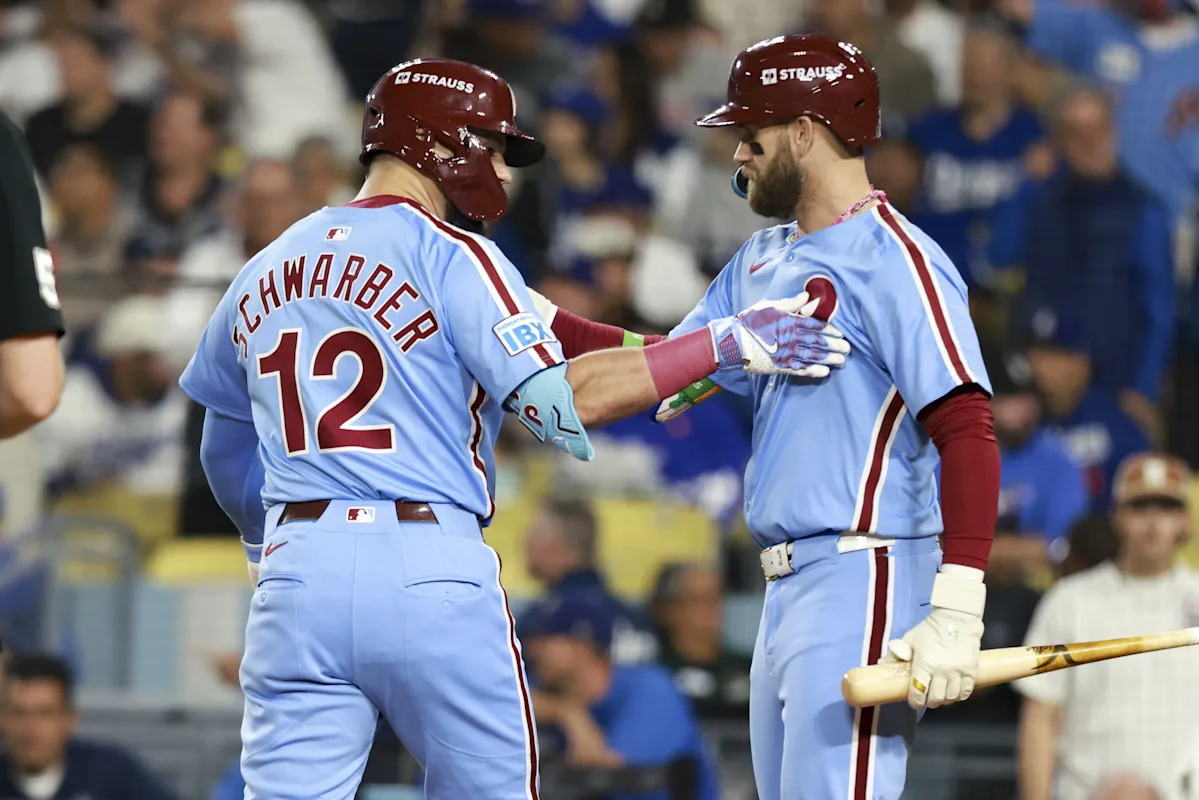
Kyle Schwarber
While Harper put some of his best seasons together in his early-to-mid 20s, Schwarber seems to be saving his best for his 30s. Since joining the Phillies for his age-29 season in 2022, he has slugged a ridiculous 187 homers in four seasons, twice leading the National League in that category, and finishing as the NL MVP runner-up in 2025. He’s only made three All Star Games and last season was the first time he’d cracked the top 15 in MVP voting, but with a career-best 4.7 WAR a season ago, Schwarber’s ability to hit left-handers has turned him into the most feared slugger in baseball.
Schwarber enters his age-33 season with 340 career bombs. With a new five-year contract under his belt, Schwarber is 160 dingers away from 500. He would need to average 32 home runs a season over the life of his contract to get to 500, a task that seems very doable given he’s averaged 46.7 homers a season as a Phillie. Even if his production drops a bit, 32 homers per year feels like a lock.
It’s simple. If he gets to 500 home runs, he’s a lock. If he falls short, he’ll have to have some other kinds of data to warrant inclusion. I’d say the odds are better than not he gets in, based on his recent trajectory.
Advertisement
J.T. Realmuto
With the ink still drying on his new 3-year deal with the Phils, Realmuto can no longer make the claim of being the BCIB (Best Catcher In Baseball) anymore. But for a long stretch, he was.
From 2017 (his penultimate season in Miami) to 2022, Realmuto was worth 24.8 WAR, the most, by far, of any catcher in baseball. Willson Contreras was second (18.8), with Salvador Perez third (14.8). He was named to three All Star teams and took home three Silver Sluggers over that stretch. While catchers have been largely underrepresented in the Hall because they don’t pile up the counting stats the way other position players do, Realmuto’s career 38.7 WAR ranks 27th among all-time catchers. He’ll never reach the heights of the upper-tier catchers in the Hall (Johnny Bench, Gary Carter, Ivan Rodriguez, Carlton Fisk, Mike Piazza and Yogi Berra), but it isn’t crazy to think he could be productive enough over these final three seasons in Philadelphia to warrant real consideration.
Compare his numbers to long-time Cardinals backstop Yadier Molina, who most believe will one day be enshrined. Molina has a career 41.7 WAR, just 3.0 WAR more than Realmuto. J.T. will probably pass him in 2027, if not this year. He’s just 4.0 WAR behind Jorge Posada (who is not in the Hall) and 6.3 WAR behind Buster Posey, who will be on the ballot for the first time in 2027 and is seen as a likely inductee.
Advertisement
Right now, I’d put the odds at 50/50 he becomes a Hall of Famer, but it’s a real conversation that will become even more realistic if he can get his WAR total into the upper 40s with another few 2-3-win seasons in Philadelphia. It’ll be close.
Trea Turner
First, the pros. At 33, Turner is coming off his best season since 2021 with the Nationals and Dodgers, posting a 5+ win season (5.4 WAR) for the first time in four years. He won his second career batting title (albeit hitting just .304), and finished 5th in the MVP voting. He has three All Star nods, two top-five MVP finishes and a Silver Slugger (2022) in his back pocket, 1,531 career hits, 282 doubles, 48 triples and 315 stolen bases. In 11 seasons, he’s been worth 41.9 WAR, for a 162-game average of 5.4 WAR per season.
He’s been a really, really good shortstop for the majority of his career.
Advertisement
Now, the cons. Like with Utley, Turner didn’t play more than 100 games in a season until his age-25 season with the Nationals in 2018. So, he got a late start. He also plays a position in which the demand for greatness is tremendous. His 41.9 WAR ranks just 44th all-time among shortstops, currently 0.1 WAR behind Xander Bogaerts and 1.9 behind Corey Seager, the player who beat him out for NL Rookie of the Year in 2016. Rollins, who piled up 47.9 WAR in his career, is eight full wins better than Turner at this point.
The average WAR for Hall of Fame shortstops is 67.7. Can Turner span the 25.8 WAR needed to hit that number over the final eight years of his contract? He would need to average 3.2 WAR per season through his age-40 season in 2033, likely with some bigger WAR numbers over the next couple seasons to compensate for what will almost certainly be a notable drop as he moves through his 30s.
There are a slew of Hall of Famers who managed to earn enshrinement as much for longevity as a tremendous peak. If Turner averages 184 hits per season over his final eight years, he’ll get to 3,000 and guarantee inclusion. If he averages 121 hits, he’ll reach 2,500. Would that be enough?
Zack Wheeler
The case for starting pitchers is in the process of recalibrating itself before our very eyes. Starters are no longer throwing 250-300 innings a season, they’re not staying in games long enough to earn “wins” and teams are no longer going with four-man rotations, all of which was routine through the 1980s.
Advertisement
Clayton Kershaw, Justin Verlander and Max Scherzer are the last of a dying breed. Pitchers are now likely to be based on shorter peaks of greatness rather than a 20+ year career of throwing 220 innings and piling up counting stats. That’s why Felix Hernandez, Cole Hamels, Mark Buehrle and others are finding Hall voters more receptive to their candidacies over the last couple years.
That said, despite being perhaps the most effective starting pitcher since his arrival in Philly in 2020, he likely got too late of a start.
His first good season was in 2014 for the Mets, when he made 32 starts and put up a 3.54 ERA. He then missed all of 2015 and 2016 with Tommy John surgery and pitched in just 17 games in 2017. That ate up his age 25, 26 and 27 seasons. Finally, in 2018, he emerged as a 3-win starting pitcher with New York, earning him a five-year free agent deal with the Phils.
Obviously, he’s blossomed with the Phillies, finishing runner-up in the Cy Young voting twice and earning three All Star nods. He led the NL in WAR in ‘21 (7.5), has three 200+ strikeout seasons and would have had a fourth last year if he hadn’t suffered thoracic outlet syndrome. He’s already turned himself into one of the best starters in franchise history, with a 2.91 ERA in six years and is one of the greatest postseason pitchers in baseball history.
Advertisement
He’s been phenomenal, but unless voters are swayed by his 2020-2025 peak, his 113 career wins and 1,820 strikeouts probably isn’t enough, even with his postseason accolades and Cy Young runners-up finishes. If he’d won both of those awards, we may be singing a different tune.
There’s obviously still a chance for Wheeler to add to his legacy over the next few years, but entering his age-36 season and coming off a concerning injury, he doesn’t have a lot of time left.
Aaron Nola
Unlike Wheeler, the 33-year-old Nola has never been as dominant a starter. He had one season (2018) in which he was an All Star, leading the league with an insane 9.7 WAR and finishing third in the NL Cy Young voting, but he’s never led the league in strikeouts or, really, any pitching category. He has one other top-five Cy Young season (4th in 2022), and is coming off the worst season of his career, an injury plagued 17-start campaign that saw him post a 6.01 ERA and -0.3 WAR.
Advertisement
His 35.3 career WAR is far below where it needs to be, especially when compared to Hamels, who sits at 59.0. He’s signed for another five years, through his age-37 season, and the only way Nola makes Cooperstown is if he somehow finds the form to make a few more All Star teams and increase his strikeout total, which currently sits at 1,876. He’d need to average 225 strikeouts a season over his final five seasons to get to 3,000, a number he routinely reached in his prime but it unlikely to see again in his mid-to-late 30s. A number around 2,500 is more likely.
Nola is a first-ballot Phillies Wall of Famer, but it’s difficult to see how he can pile up enough counting stats on the back end of his career to make a push for Cooperstown.
