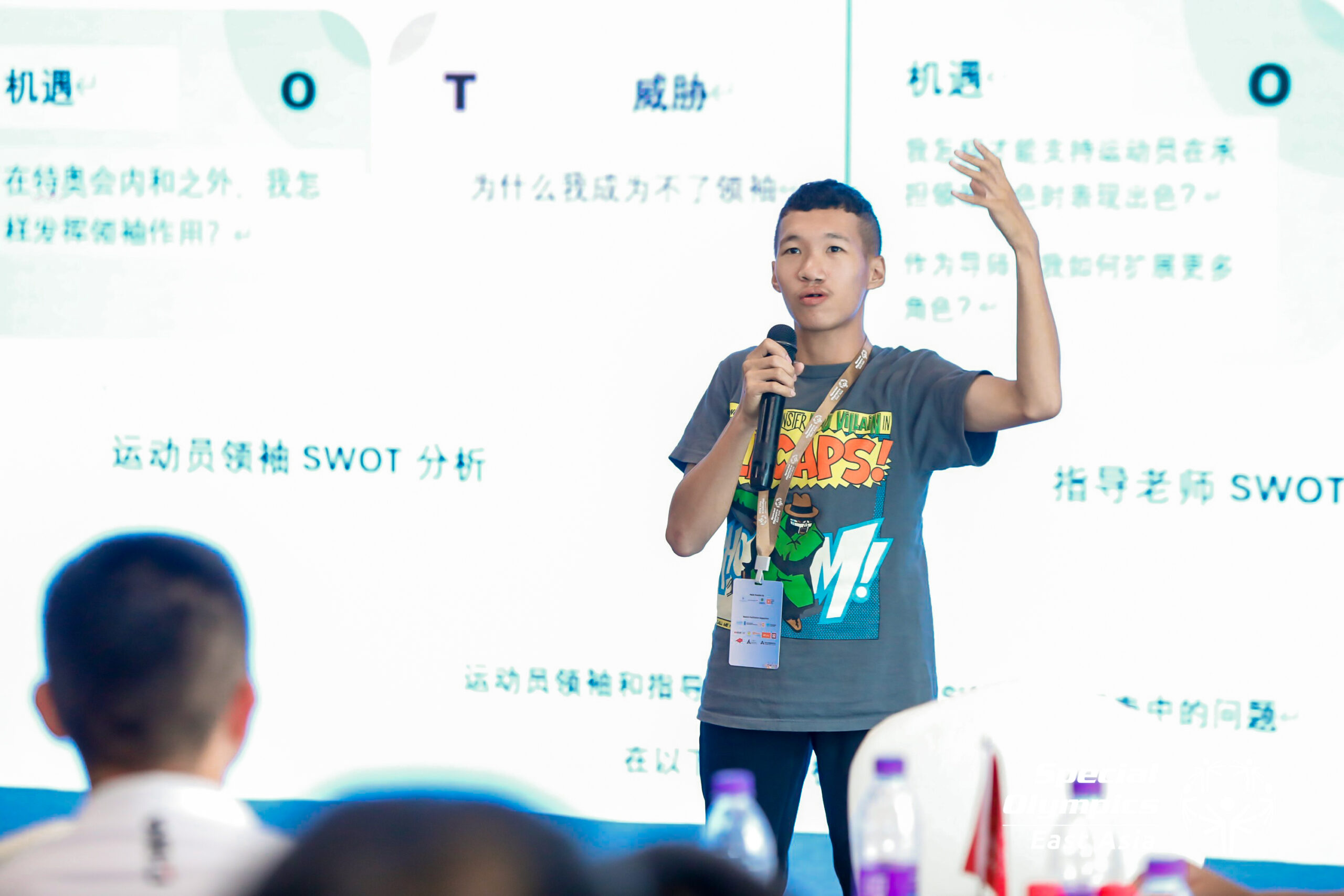
When Wenli first learned about Special Olympics, it wasn’t through a school program or a family connection, it was through a simple post on social media. Something about the message caught his attention. Curious, he reached out to WeiJhen, his teacher at Kaohsiung Municipal Sanmin Vocational High School of Home Economics & Commerce, to learn more about the Movement and the sports it offered. What began as a question soon became a calling.
At first, Wenli joined for the competition. He found sports that inspired him, that made him feel strong and capable. But what he discovered along the way was something far more powerful, a connection.
Wenli describes himself as “sometimes introverted, sometimes extroverted,” someone who used to hesitate before speaking up or meeting new people. Through sports, he began to find his voice. Competing helped him step outside his comfort zone. Interacting with teammates and volunteers helped him practice communication and confidence, skills he later realized were essential not just on the playing field, but in life.
His transformation didn’t stop at athletics. Wenli soon became drawn to leadership, taking part in youth summits, athlete leadership training, and regional events. These experiences opened his world. He began meeting athletes from other Programs, learning new ideas and best practices, and seeing how the spirit of inclusion could shape communities everywhere.
“Special Olympics is not only about sports. It’s about personal growth, passion, and pushing your own limits to do better.”
Now an Athlete Leader for Special Olympics Chinese Taipei, Wenli uses every opportunity to inspire others. One of his proudest achievements is launching a project focused on empowering female athletes. The project is creating leadership opportunities, supporting their health and well-being, and breaking down gender stereotypes in sport.
In his community, he’s challenging long-held beliefs about what men and women can do. Wenli has worked to increase female participation in mixed-gender sports and, just as importantly, to encourage more men to try traditionally female-dominated sports like table tennis and badminton.
“We can’t keep those old ideas that only boys play certain sports or only girls do certain things. Inclusion means everyone has the chance to try, to learn, and to lead.”
With limited resources, Wenli and WeiJhen started their project from scratch. Yet their impact is growing. They’ve already trained several female athletes to take on leadership roles, including one who now works as a social worker in a nursing home, someone using her patience and care to support older women’s health and dignity.
For Wenli, these stories are proof that inclusion creates ripple effects. When athletes lead, they not only gain confidence, but they also lift others with them.
He dreams of expanding this work even further, reaching children from kindergarten through university, and inspiring families to join in building a culture of equality and empathy.
There’s an old Chinese saying Wenli likes to share: “There’s always a challenge to overcome, one by one.” He smiles when he says it, acknowledging that the translation can’t capture its full beauty. But in his journey, from shy athlete to outspoken leader, Wenli embodies that meaning every day.
He continues to push past barriers, not just for himself, but for a generation of athletes who will see that leadership and courage know no limits, on and off the field.
