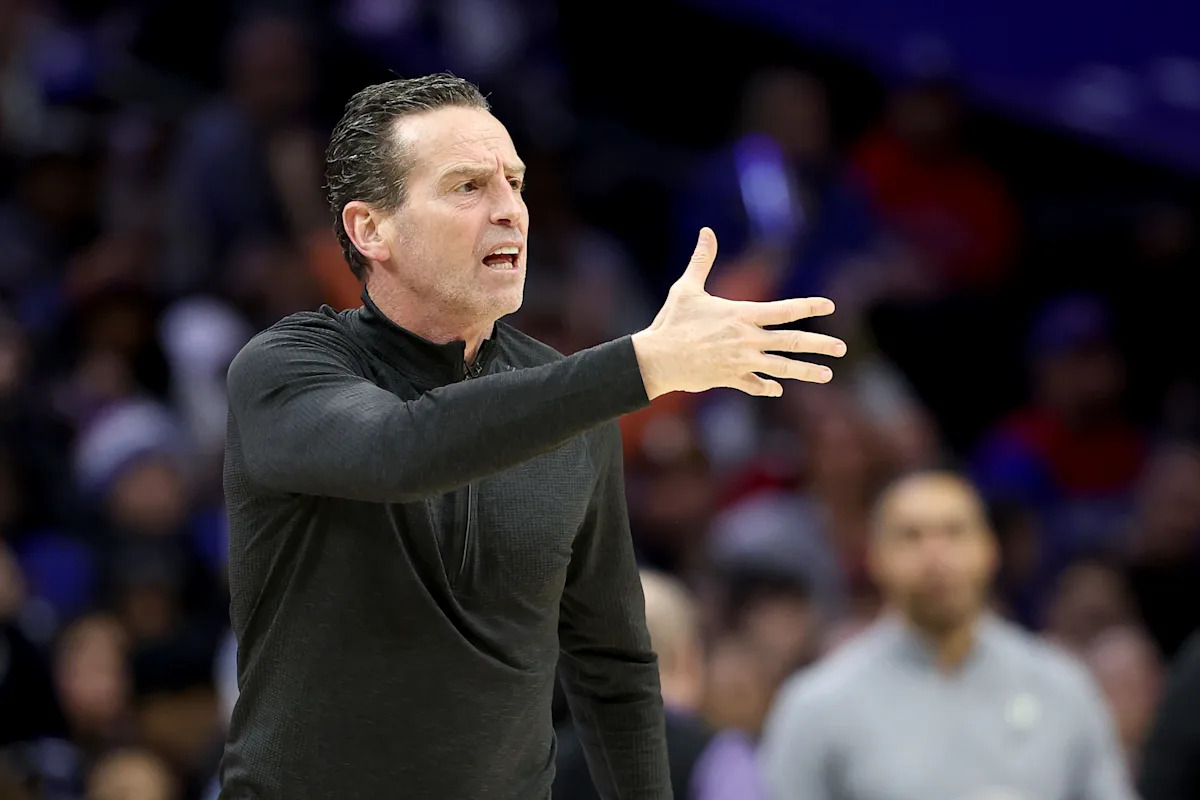
CLEVELAND — The Cleveland Cavaliers haven’t found their usual consistency on the defensive end this season. When asked about why that’s been the case before Friday’s game against the Sacramento Kings, head coach Kenny Atkinson pointed to one thing: Three-point defense.
“We’re number one in taking away [shots at] the rim in the last 15 [games]… we got two elite shot blockers,” Atkinson said. “[We have to] somehow bring their (three-point) percentages down.
Advertisement
“I’m taking suggestions.”
Three-point defense has been one of the main problems for the Cavs. They rank last in opponent three-point percentage this season, as teams are converting 38.2% of their outside shots against them. Atkinson is trying to figure out what has led to this.
“We’re looking at all things,” Atkinson said. “What’s their shot quality? How can you get their shot quality down? How can we contest better? How can our jump height be better at the contest? What hand are we putting up?”
Support us and Let ‘Em Know with Homage!
Anything bought from the links helps support Fear the Sword. You can buy the Spida shirt HERE. You can also shop all of Homage’s Cavs gear HERE.
Advertisement
Opponent three-point shooting is complicated. Good defense doesn’t always get rewarded, while bad defensive possessions can be bailed out by a lucky miss. Atkinson alluded to their recent win against the Charlotte Hornets as a situation where their opponent just missed shots. The numbers would seem to suggest this.
Charlotte went just 8-47 from three (17%). Of those 47 outside attempts, 30 of them came with no defender within six feet at the time of the shot, and they only hit five of them (16.7%), according to the NBA’s tracking data. On the season, the Hornets are connecting on 40.1% of their wide-open three-point shots, which is good for the sixth-best percentage in the league. Wednesday’s game was an outlier.
“There’s a lot of pieces to that,” Kings head coach Doug Christie said when asked about what leads to a team being good at defending the three-ball. He then listed three things that could make this an issue. All are things that apply to the Cavs’ current situation.
First, it can be a reflection on point-of-attack defense.
Advertisement
“It could be from getting beat off the dribble, and now you can get the ball out [for an open three],” Christie said. “Basketball is about creating advantages. Once the advantage is created, you want to keep that advantage, so now you swing the ball out.”
Cleveland has struggled in this area.
Isaac Okoro spent much of the last few seasons defending their opponent’s best scoring guard. No one has been able to step up and take that assignment in his absence. Additionally, Darius Garland has struggled with mobility, and the effort from the remaining guards just hasn’t been what it needs to be to have a good perimeter defense.
Then, there’s running opponents off the line.
Advertisement
“It could also be the ability to close out in space,” Christie said. “Are you running them off the line? Are you arriving late? Do they feel you? A lot of times, if you just run out at this level, guys just don’t see. They’re programmed to rise up, see their target, and shoot the basketball. So you have to arrive early, and that means multiple efforts.”
The Cavs are struggling to do this as well. Opponents are attempting more threes against them this season than they ever have in the core four era. Cleveland is giving up the 15th most three-point attempts. Each of the last four seasons, the Cavs were allowing the eighth fewest three-point attempts or better. Part of that is from failing to run opponents off the line and then rotating to the open man.
“I know we can do a better job of bringing three-point attempts down,” Atkinson said. “That’s what you control more than the makes and misses, believe it or not. I know everybody freaks out when people say that, but that has been established.”
Lastly, it could be from prioritizing protecting the rim.
Advertisement
“If you’re trying to protect the paint, you see a downhill drive, and all of a sudden you get in the gap, and you protect the paint,” Christie said. “That means you left your man. He’s standing there, so someone has to stunt, and that stunt has to be hard enough that they feel you not want to shoot the basketball that allows you to get back to your man. And that’s called second and third, multiple efforts. On a night-to-night basis, in our league, the really elite teams that are down about that, they give that effort up.”
Cleveland has done an excellent job of protecting the rim this season. That, more than anything, is the most important part of having a good defense. They have the second-best opponent field-goal percentage at the rim, but the defensive effort shouldn’t stop at just preventing shots at the basket.
“The rim is, in our philosophy, the number one priority,” Atkinson said, “In an ideal world, you’re taking away the rim, and you’re limiting threes. That’s the perfect defense.”
The Cavs are still looking for the perfect defense. They’re doing some things right, but until the perimeter defense consistently does better at the point of attack, shows more effort rotating, and is clear on how the rotations should happen, they’ll continue to struggle with this. Fortunately, they still have time to get these issues ironed out.
“We’re on the details, but the fact of the matter is, we’re going to try and bring the percentages down,” Atkinson said. “Our defense will get better.”
