
Painful to watch
Round six of the Tata Steel Chess Tournament saw Nodirbek Abdusattorov move into sole first place after defeating world champion Gukesh Dommaraju with the white pieces. The game appeared to be drifting towards a draw in a balanced major-piece endgame when it ended abruptly. On move 36, Gukesh played the inexplicable 36…Rg5??, a one-move blunder that immediately lost a rook.
Abdusattorov played 37.Qxf6+ without hesitation (38.Qxg5 would follow), and Gukesh resigned straight away. The suddenness of the error made the moment particularly striking.
Grandmaster Harshit Raja, India’s 69th GM, has created a practical and powerful 1.e4 repertoire – perfect for players who want to play aggressively without drowning in opening theory. Whether you’re playing online or over-the-board, this course gives you solid attacking weapons that are easy to learn, fun to play, and difficult for opponents to face.
Free sample video: Introduction
Free sample video: Scandinavian Defence
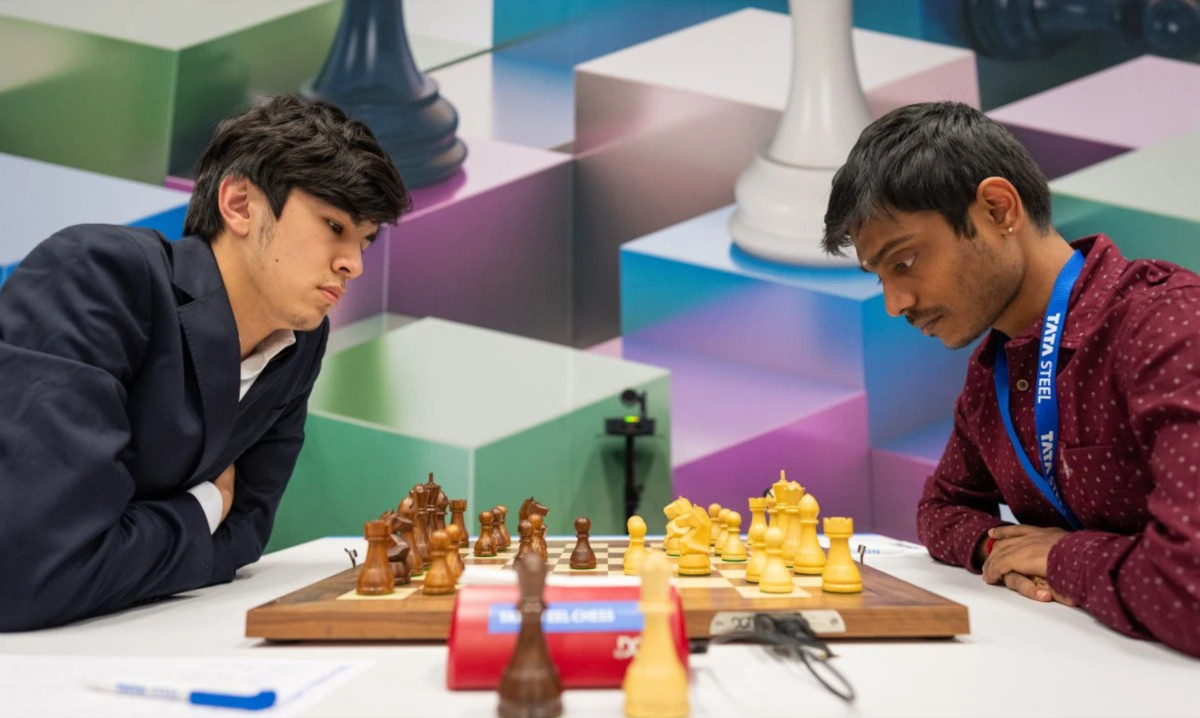
Gukesh notices he has blundered his rook right after pressing the clock
The incident inevitably recalled an earlier and highly consequential encounter between the same two players at the 2022 Chess Olympiad in Chennai. In that match, a then 16-year-old Gukesh, playing board one for India 2, faced a 17-year-old Abdusattorov in a critical clash against tournament leaders Uzbekistan.
With Praggnanandhaa Rameshbabu seemingly on course to defeat Javokhir Sindarov on board three, a draw by Gukesh would have sufficed for match victory. However, he blundered with 72.Nf3??, allowing the decisive 72…Qb7+, attacking the knight while giving check.
While the Wijk aan Zee game did not carry comparable team implications, committing a similarly inexplicable one-move error against the same opponent is undoubtedly difficult to absorb, particularly for a player of Gukesh’s stature.
Sindarov, who had entered the round tied for first place, drew his game with the black pieces against Aravindh Chithambaram after failing to find the correct continuation to make the most of a clear advantage on move 40.
Black is completely winning here. But with 22 seconds on the clock, Sindarov blundered with 40…a2??, allowing 41.Qg6 and White escapes with a perpetual check.
Instead, 40…Qxc5 is winning. If White goes for the same idea as in the game with 41.Qg6, Black can improve his queen’s position via checks starting with 41…Qc8+, as White can never place his king on the g-file because of …Rf8-g8, winning the queen.
A sample line is 41…Qc8+ 42.Kh4 Qc4+ 43.Kh3 Qf1+ 44.Kh4 Qf2+, with an easy win.
The result left him in sole second place after Abdusattorov’s win, meaning that the two Uzbek participants now occupy the top two positions in the standings as we approach the halfway mark of the tournament.
The King’s Indian Defence has been one of the most dynamic and popular responses to 1.d4 for decades. Legends such as Garry Kasparov, Bobby Fischer, and Hikaru Nakamura have employed it at the highest level – and it continues to fascinate today, as it offers Black not only solidity but also rich attacking and counterattacking opportunities. Its special advantage: the King’s Indian is a universal system, equally effective against 1.d4, 1.c4, and 1.Nf3. Grandmaster Felix Blohberger, multiple Austrian Champion and experienced second, presents a complete two-part repertoire for Black. His approach: practical, clear, and flexible – instead of endless theory, you’ll get straightforward concepts and strategies that are easy to learn and apply.
Free video sample: Introduction
Free video sample: London System
Javokhir Sindarov missed a huge chance in his round-six game against Aravindh Chithambaram | Photo: Tata Steel Chess / Lennart Ootes
The third co-leader at the start of the day, Hans Niemann, suffered a setback, losing to Vincent Keymer. For Keymer, the win represented an important response after mixed results earlier in the event, while Niemann dropped into a group of three players standing a full point behind Abdusattorov. This group also includes Keymer and Vladimir Fedoseev, who remain within striking distance of the lead.
The remaining decisive game of the round saw 14-year-old Yagiz Kaan Erdogmus score his first win of the tournament. Erdogmus defeated Jorden van Foreest, a notable achievement for the Turkish youngster in his Masters debut.
One of the four draws seen in the round was close to ending decisively, as Arjun Erigaisi escaped with a half point in his game with black against Matthias Bluebaum.
Round 6 results
Niemann 0-1 Keymer
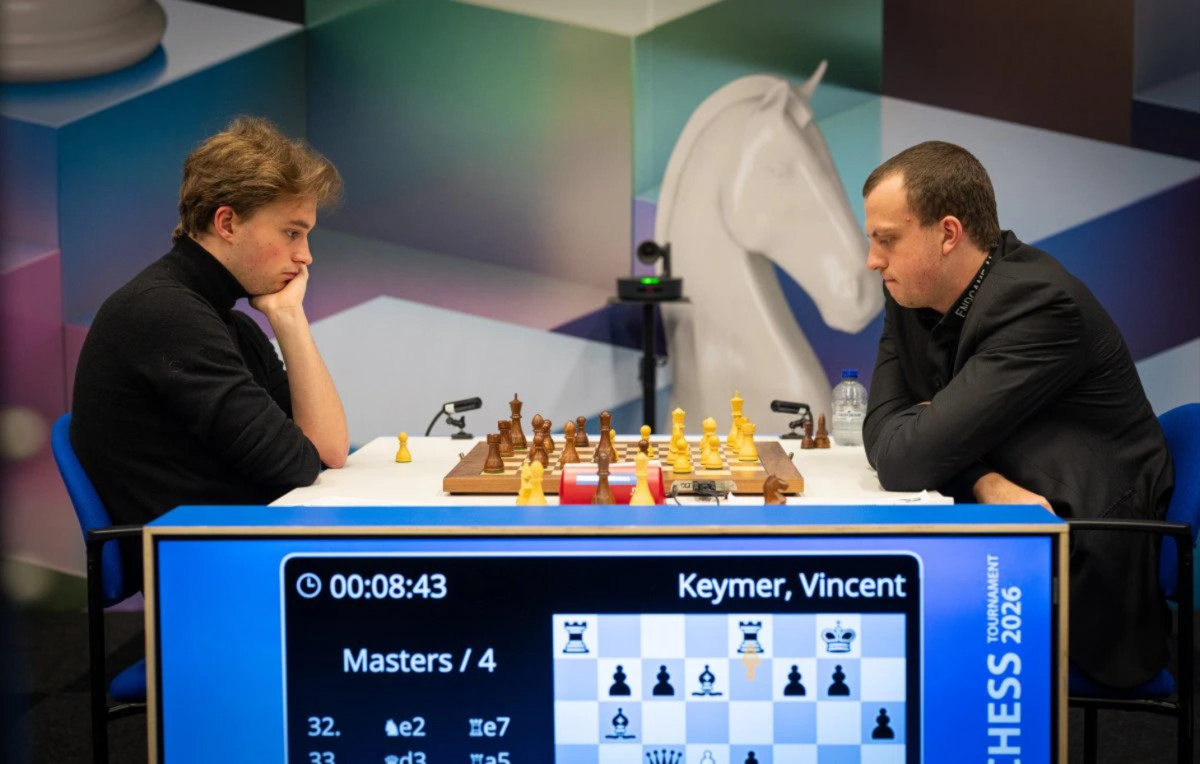
Vincent Keymer has so far scored three wins and suffered two losses | Photo: Tata Steel Chess / Lennart Ootes
Bluebaum ½-½ Erigaisi

Arjun Erigaisi | Photo: Tata Steel Chess / Lennart Ootes
Abdusattorov 1-0 Gukesh
Standings after round 6
All games
Woodward sole leader in the Challengers
Round six of the Challengers mirrored developments in the Masters, as a sole leader also emerged after an eventful round. The day began with three players tied for first place, and once again the pattern was one win, one draw and one loss for the co-leaders.
Andy Woodward climbed into clear first place after achieving a marathon, 131-move victory over Carissa Yip in an all-American encounter. The game transitioned into a materially balanced queen endgame already on move 44.
Woodward gained a pawn on move 48, but engine still evaluated the position as equal.
Naturally, Woodward continued to press relentlessly, probing for small inaccuracies. After nearly 70 further moves, he played 119…e3, fully aware that 120.Qxe3 Qxe3 121.fxe3 would lead to a winning king-and-pawn endgame.
Under sustained pressure after hours of defence, Yip finally faltered on move 129 and resigned two moves later. The win was Woodward’s fifth in a row, following his opening-round loss to Bibisara Assaubayeva, a game in which he had earlier missed a winning tactical shot.
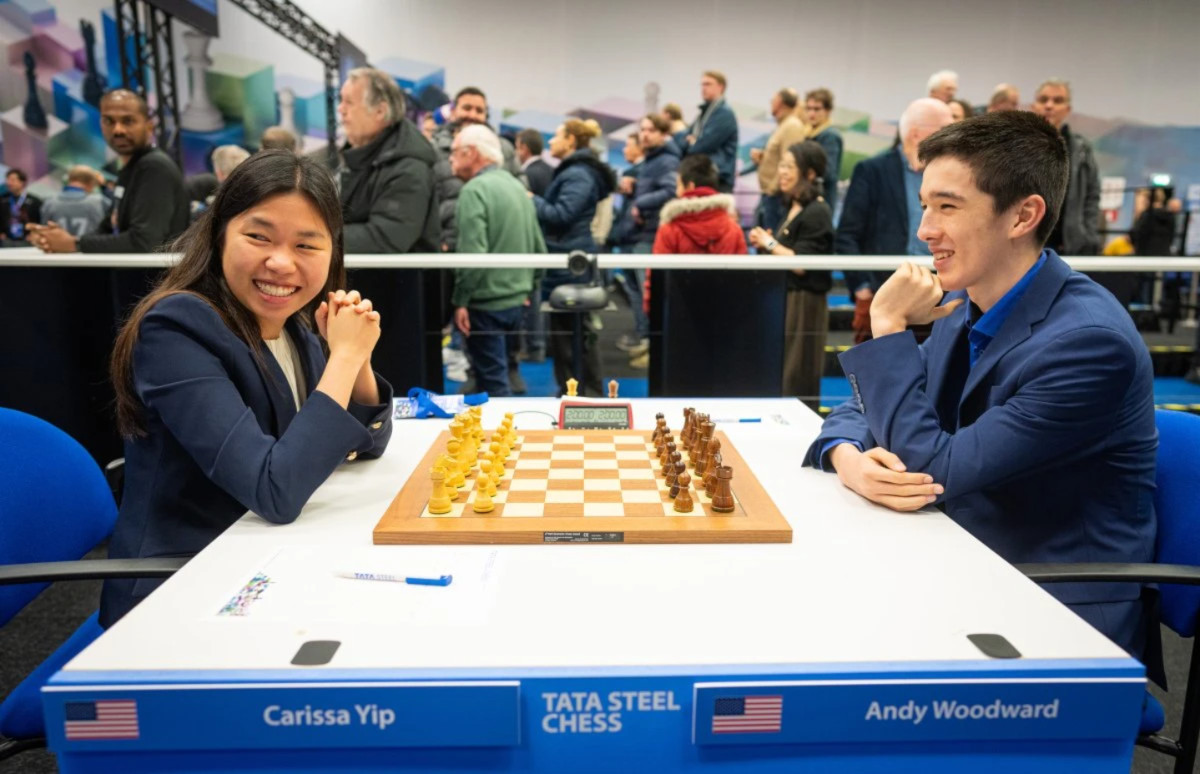
Carissa Yip and Andy Woodward in good spirits before the start of what would turn out to be a marathon battle | Photo: Tata Steel Chess / Lennart Ootes
Five additional games ended decisively in the Challengers on Friday. Velimir Ivic, Marc’Andria Maurizzi, Vasyl Ivanchuk and Daniil Yuffa all scored wins with the white pieces. Meanwhile, Max Warmerdam defeated former co-leader Faustino Oro with black. The third former co-leader, Aydin Suleymanli, drew his game with white against Vedant Panesar.
After six rounds, Woodward leads the Challengers outright. Maurizzi and Suleymanli share second place, half a point behind, while Oro now stands alone in fourth place, another half point further back.
Round seven will feature Woodward playing white against Suleymanli, while Maurizzi is set to face Eline Roebers with the black pieces.
Round 6 results
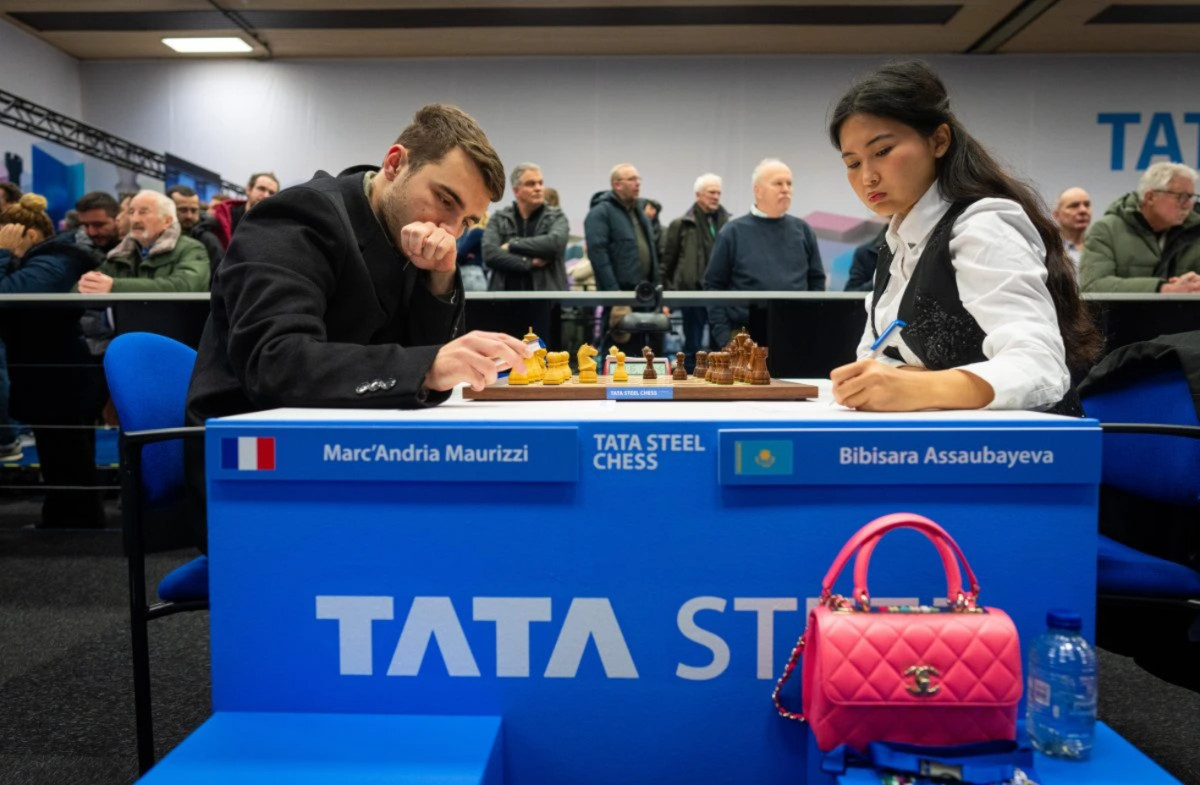
Marc’Andria Maurizzi beat Bibisara Assaubayeva | Photo: Tata Steel Chess / Lennart Ootes

Challengers’ top seed Velimir Ivic | Photo: Tata Steel Chess / Lennart Ootes
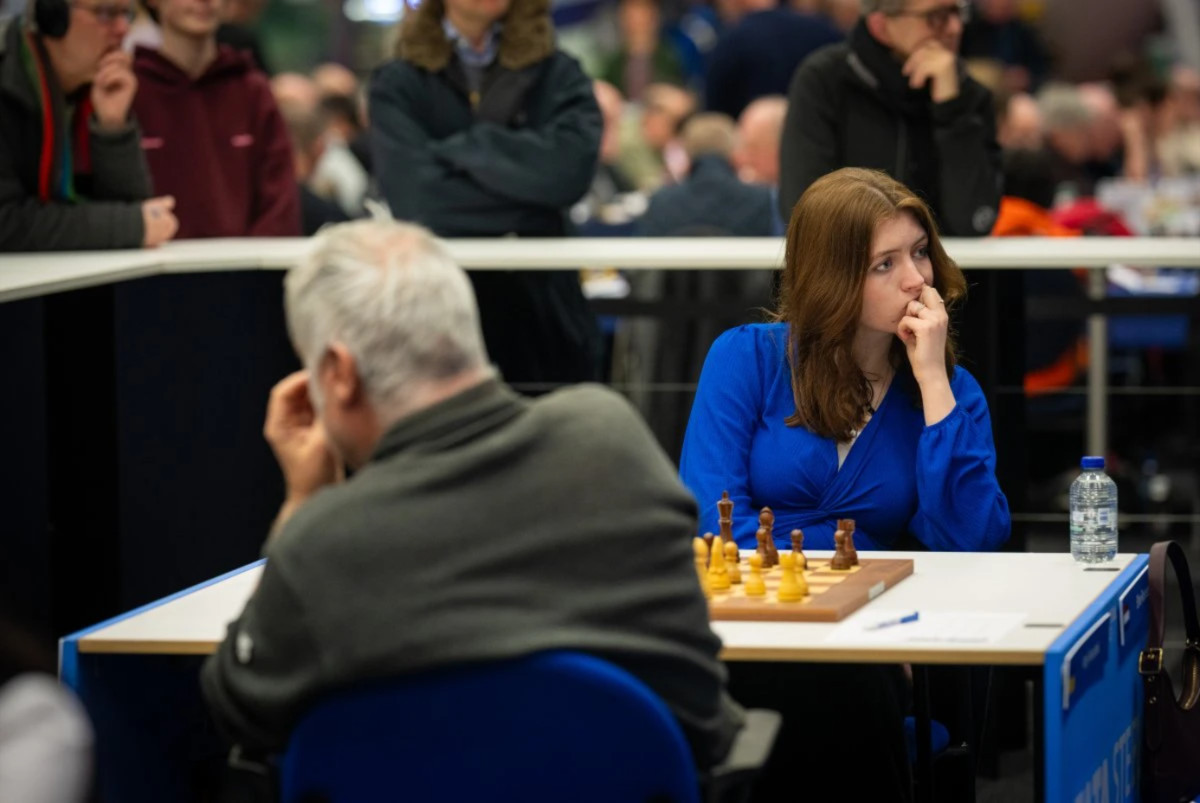
Strong players do not need to look at the board to calculate their next moves – Vasyl Ivanchuk and Eline Roebers | Photo: Tata Steel Chess / Lennart Ootes
Standings after round 6
All games
Tournament schedule
Games start daily at 14:00 CET (7:00 ET, 20:30 IST), except for round 13, which starts two hours earlier than usual.
The King’s Indian Defence has been one of the most dynamic and popular responses to 1.d4 for decades. Legends such as Garry Kasparov, Bobby Fischer, and Hikaru Nakamura have employed it at the highest level – and it continues to fascinate today, as it offers Black not only solidity but also rich attacking and counterattacking opportunities. Its special advantage: the King’s Indian is a universal system, equally effective against 1.d4, 1.c4, and 1.Nf3. Grandmaster Felix Blohberger, multiple Austrian Champion and experienced second, presents a complete two-part repertoire for Black. His approach: practical, clear, and flexible – instead of endless theory, you’ll get straightforward concepts and strategies that are easy to learn and apply.
Free video sample: Introduction
Free video sample: London System
| Date | Day | Round |
| January 17 | Saturday | Round 1 |
| January 18 | Sunday | Round 2 |
| January 19 | Monday | Round 3 |
| January 20 | Tuesday | Round 4 |
| January 21 | Wednesday | Round 5 |
| January 22 | Thursday | Rest day |
| January 23 | Friday | Round 6 |
| January 24 | Saturday | Round 7 |
| January 25 | Sunday | Round 8 |
| January 26 | Monday | Rest day |
| January 27 | Tuesday | Round 9 |
| January 28 | Wednesday | Round 10 |
| January 29 | Thursday | Rest day |
| January 30 | Friday | Round 11 |
| January 31 | Saturday | Round 12 |
| February 1 | Sunday | Round 13 |
