Every year, personal launch monitors become more accessible. Prices continue to drop, features improve and what once felt like a major purchase now is an accessory many golfers are adding to their setup.
We rigorously tested 12 personal launch monitors this year and one thing was clear: not all data is created equal.
If you’re considering a launch monitor, understanding where those differences appear can help determine which price tier makes the most sense. Here’s a look at how performance changes as cost increases.
What launch monitor price tiers delivered in our testing
| Price range | What held up well | Where differences showed up |
|---|---|---|
| $400–$700 | Ball speed accuracy often stayed within ~1–2% of reference indoors and outdoors | Indoor spin rate and launch angle showed wide variation with some models reaching 20–30% deviation |
| $1,000–$2,000 | Improved spin consistency and tighter launch angle dispersion | Some reliance on calculated outcomes especially indoors with occasional variability |
| $3,000–$5,000 | Tight clustering across spin, launch angle and carry distance | Minimal performance gaps with differences centered on precision |
If you care only about ball speed, price matters less than you think
Ball speed was the most stable metric we tested.
Across indoor and outdoor environments, most launch monitors stayed within roughly one to two percent of our reference system. Even lower-priced models performed well here which explains why budget launch monitors feel useful to so many golfers.
It’s worth noting that stability did not hold equally across all clubs. As swing speed increased, particularly with driver, differences between models became more noticeable.
If your primary goal is speed training or tracking relative changes over time, ball speed alone does not demand a high-dollar investment.
One thing to keep in mind is that ball speed does not explain launch conditions or why carry distance changes from shot to shot.
Carry distance is where differences start to appear
Carry distance accuracy varied more than ball speed, especially outdoors.
In our testing, several models approached four to five percent deviation compared to the reference. Those differences were rarely driven by ball speed alone. Instead, they were the result of small inconsistencies in launch angle and spin that compounded into larger carry gaps.
This is often where golfers begin to notice that numbers may look reasonable but do not always match real-world ball flight.
Spin rate is the biggest separator between price tiers
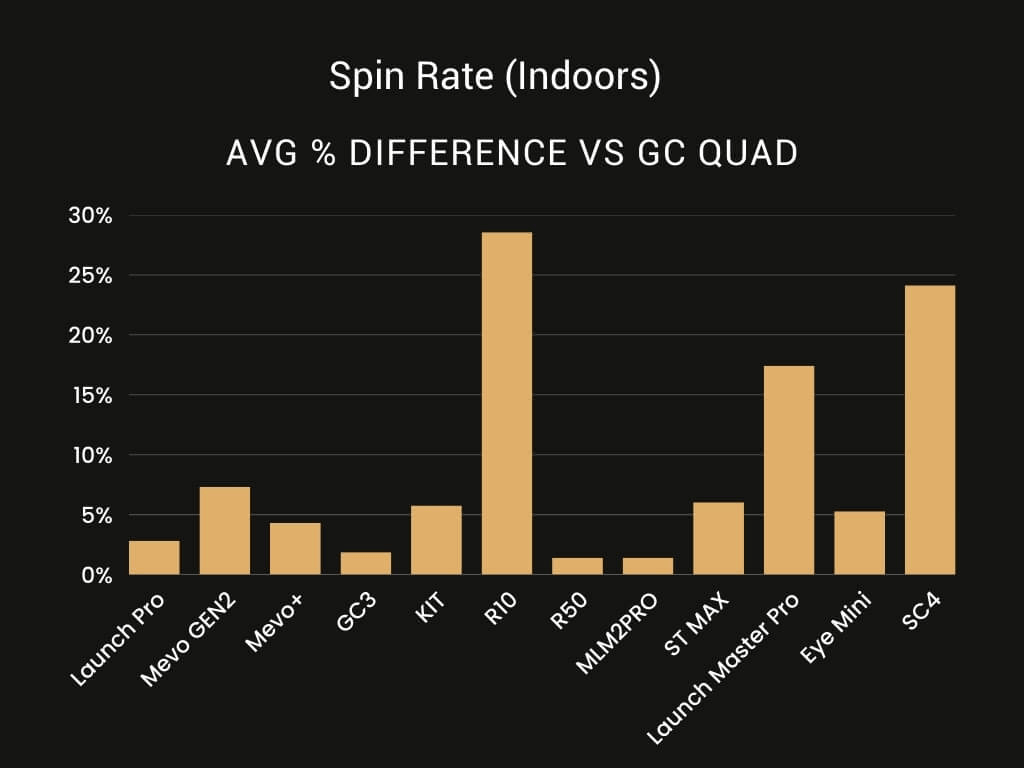
Spin rate showed the widest variation of any metric we tested.
Indoors, some lower-priced launch monitors deviated by 20 to 30 percent compared to our reference system. Higher-end units stayed much closer with tighter clustering and fewer outliers.
Spin influences launch, descent angle and carry. When spin data is unstable, it becomes harder to trust individual shots and harder to make informed changes.
For example, one of the more affordable models, the Garmin Approach R10, struggled to deliver indoor spin accuracy compared to higher-end systems like the R50 or GC3.
Launch angle quietly drives everything else
Launch angle does not get the attention it deserves when it comes to launch monitor consideration and purchase.
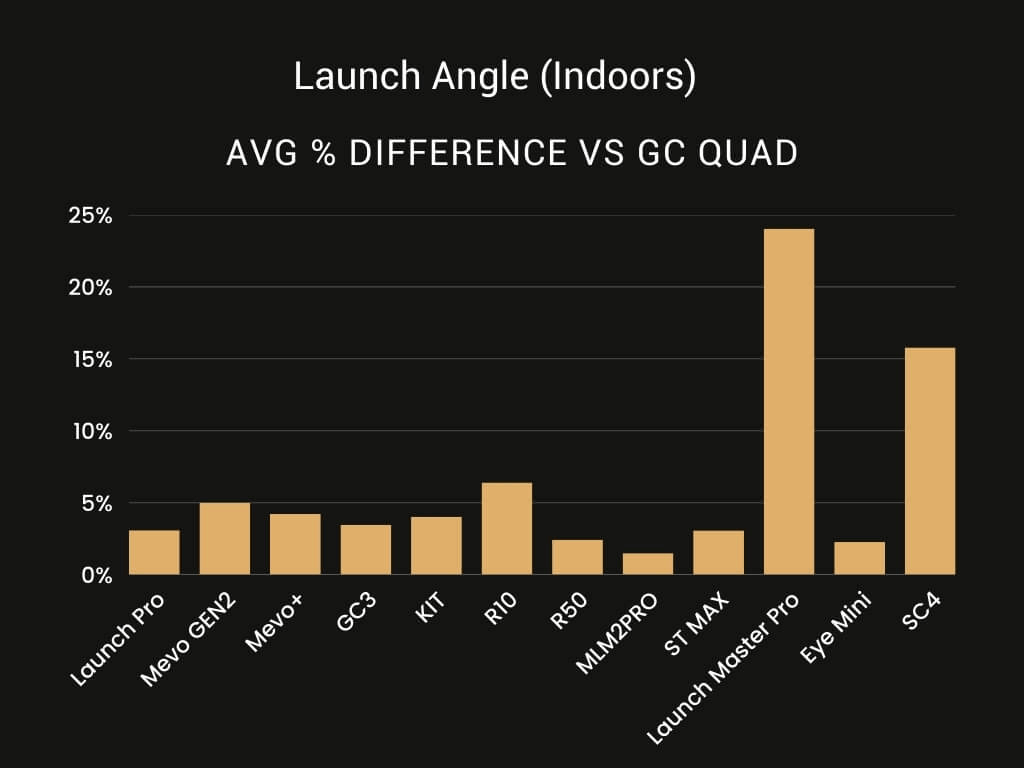
Indoors, some models showed double-digit percentage variation in launch angle which helps explain why carry distance consistency varied even when ball speed appeared accurate and consistent. Some higher-priced systems showed tighter launch angle dispersion which translated to more reliable carry and spin behavior.
What “modeling” means and why it matters
All launch monitors use algorithms. The difference is how much information they can capture directly versus how much they have to estimate.
Lower-priced launch monitors rely more on estimated outcomes, especially for spin and carry. That approach works well for general feedback but becomes more sensitive to environment and setup, particularly indoors. Higher-priced systems still use algorithms but they begin with more directly observed inputs which reduces how much estimation is required and improves consistency.
Using RCT or RPT golf balls can improve indoor spin accuracy for some models. A few lower-priced options, such as the Rapsodo MLM2PRO, combines camera and Doppler technology.
What you’re giving up and what makes sense to buy
Lower-priced launch monitors are not bad; they just have to make some tradeoffs to keep the price down. They work well for tracking trends but become more sensitive to the environment and setup, especially indoors.
Lower-priced launch monitors make sense if you:
- Care most about ball speed or speed training
- Practice mostly outdoors
- Want to track trends rather than diagnose ball flight
Mid-tier launch monitors make sense if you:
- Practice regularly with intent
- Want more stable spin and launch data
- Spend a meaningful amount of time indoors
Higher-end launch monitors make sense if you:
- Practice primarily indoors
- Need spin and launch data you don’t have to question
- Make swing or equipment decisions based on the data
Final takeaways
Ball speed is accessible at nearly every price point. Spin and launch angle are not.
The difference between a $500 and a $5,000 launch monitor is not how far the ball goes. It’s how much trust you can place in the number telling you how it got there.
For a full report of how these 12 launch monitors compared, check out the results of the test: Best Golf Launch Monitors 2025.
The post We Tested 12 Launch Monitors Ranging From $500 To $5,000. What’s The Real Difference? appeared first on MyGolfSpy.
