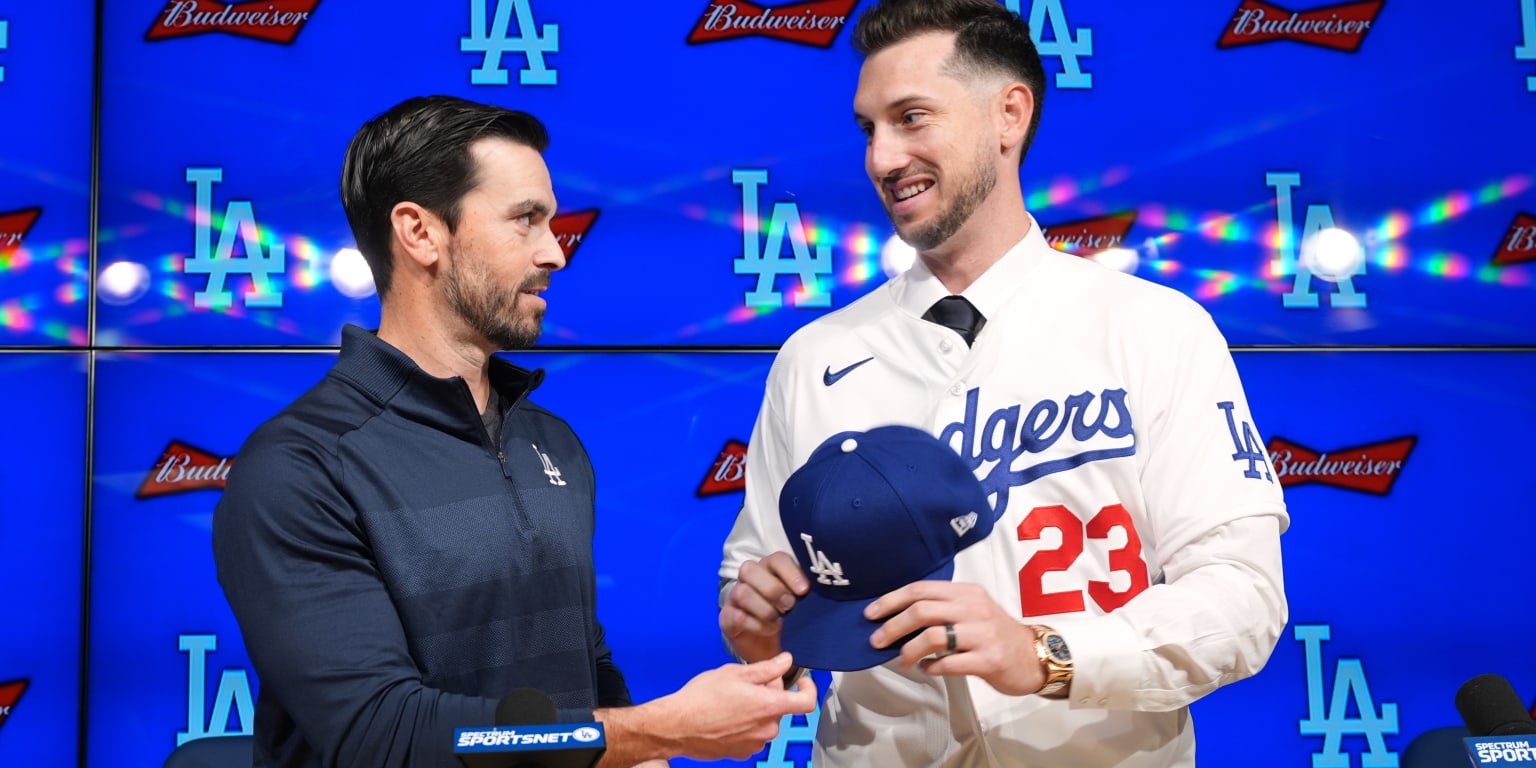
Kyle Tucker is going to hit “second or third” in the top-heavy Dodgers lineup, manager Dave Roberts said after Tucker signed. While a statement like that generally shouldn’t make any waves – only very, very good hitters get the kind of contract that Tucker just did, so of course he should hit near the top of the lineup – he’s also joining a team that famously had a few good hitters already.
If Tucker really is going to hit in the top three, then that means one of the three nearly-guaranteed-future-Hall-of-Famers won’t be. Which one? In what order? Also, don’t forget that the catcher Smith outhit Freeman, Tucker, and Betts last season, and found himself hitting second in three different World Series games, as well as moving up when Betts was injured in 2024. He’s a factor here, too.
Come with us on a fun thought experiment through the numbers, as January threatens to turn into February.
There are, to be sure, a pair of very powerful caveats to keep in mind about all of this:
Generally speaking: As long as your three weakest hitters are hitting seventh, eighth, and ninth, the rest is gravy. That didn’t always happen, in the years when the very fast runner who couldn’t actually hit was leading off. Teams are much better at this in recent times; in 2023, the second spot in the order was the most productive for the first time ever. If each lineup spot gets around 18 plate appearances more per season than the one behind it, well, have your best hitters taking those extra chances.
Still, it’s a never-ending topic of interest, and if you’re interested in making an informed argument about it, it’s worth thinking through what Roberts is working with here. As he sits down to pen his lineup, he’s staring at a likely top five – Ohtani, Betts, Tucker, Freeman and Smith, in some order – that consists of the following facts to consider.
So, working backwards, let’s assume that the final four spots in the lineup will be Hernández (.787 projected OPS), Max Muncy (.780), Andy Pages (.763) and Edman (.692), in some order (or those spotting in for them as matchups and health demand). Then let’s start to fill in the gaps, as math demands.
Strict math, using these players and their 2026 projections, would demand the following order:
Don’t forget, Tucker did steal 25 bases a year ago. But the reason for his order is simply because Ohtani is so much better a hitter than anyone here that ideally you wouldn’t want to have him hitting with the bases empty ever, really. That’s less of a concern in the modern National League, where the leadoff man isn’t following the pitcher’s spot for the rest of the game. But, either way, Tucker hitting first doesn’t seem likely on this team.
Which leaves us with this: the version of the lineup with the best combination of optimization and realistic likelihood.
2. Tucker. If the No. 2 spot is now where your best hitter lives – and it is – and Ohtani is already spoken for, then there’s a big gap between the newest Dodger and the other three. “I don’t want you guys to hold me to it right now,” said Roberts, “but [Tucker hitting] second or third seems to make sense.” It sure does.
3. Betts. Surprised? Us too, a little. The 36-year-old Freeman isn’t immune to aging, but he’s a better hitter than Betts nonetheless. Yet as Tom Tango’s “The Book” wrote years ago, your three best hitters should hit first, second, and fourth, largely because the No. 3 hitter ends up coming up with two outs and none on so often. Besides, this breaks up what would be three lefties in a row if Freeman were here, and we’re assuming that after a career of hitting in the top two, the Dodgers would prefer not to bump Betts any further down than this.
4. Freeman. The third-best hitter on the team, but also the best one remaining, hitting in the spot he spent much of last October manning anyway? Sometimes the lineups write themselves.
5. Smith. Now: Could you make a case for Betts and Smith to swap spots here? Probably, because Smith was better than Betts last year, and is projected to be slightly so again in 2026. But we’re trying to stick in the real world also, and after how good Betts was in the second half (.819 OPS over his final 55 games), plus the years he’s spent hitting first or second, means it feels unlikely they’d drop him this far. This setup also has the secondary effect of less disruption when Smith needs a day off, as catchers regularly do.
6-7-8-9. TBD. To be honest, the exact order here doesn’t matter that much. Presumably it’s Hernández and Muncy ahead of Pages and Edman, but again, once you get to this part of the lineup, it won’t make much difference.
Is that actually what we’ll see? We’re betting it’s close, because it’s hard to see Ohtani not leading off, and it’s hard to see any of the other hitters being placed above Tucker.
We’d say this is a “good problem to have” for Roberts, except it’s not even that. Really, it’s not a problem at all. Having too many good hitters is never really a problem, is it?
