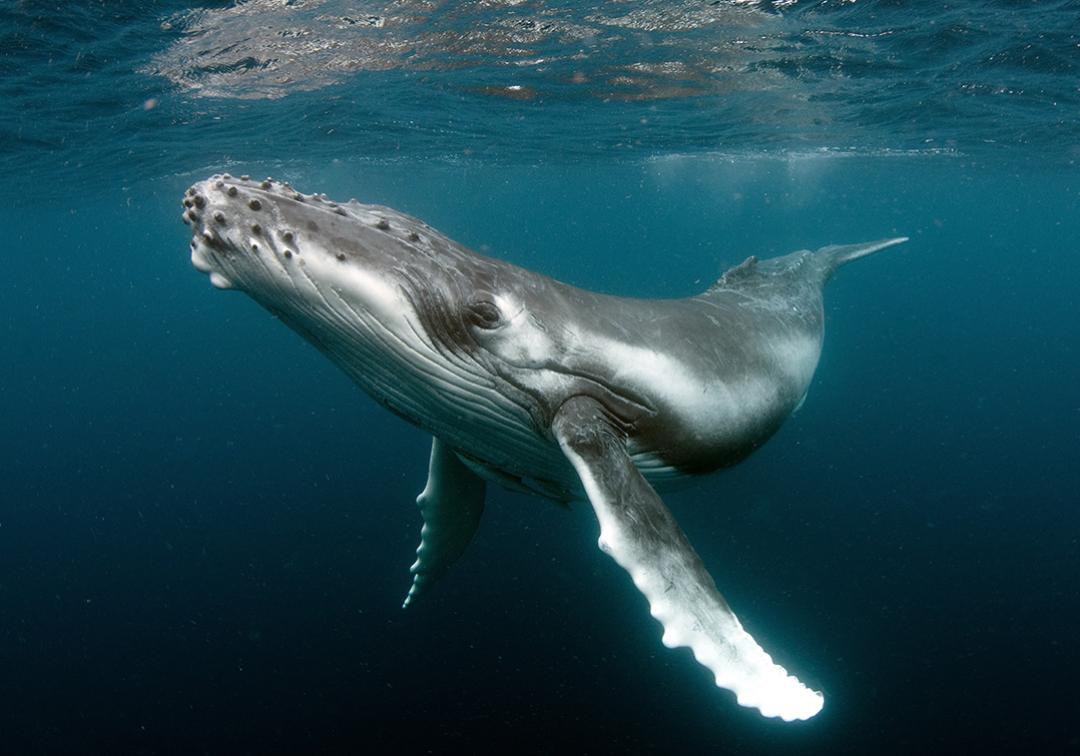
University of Queensland hearing tests conducted across kilometres of ocean off the Sunshine Coast show humpback whales react to higher frequency sounds than expected.
Associate Professor Rebecca Dunlop from UQ’s School of the Environment said the discovery has implications for the mitigation of noise-related human activity along whale migration routes.
“Until our studies, estimates of humpback hearing sensitivity were inferred based on the anatomy of their ears,” Dr Dunlop said.
“In a series of experiments, we exposed whales to upsweep sounds at a range of frequencies.
“We looked for changes such as slowing their swimming or turning towards or away from the sound as an indication they’d heard it.
“Against a background of natural noise, we confirmed that the humpbacks’ best hearing range largely overlaps with the estimates from anatomical models.
“But their responses at 22 kHz provided the first direct evidence humpbacks are highly sensitive to higher frequencies at the upper end of the human hearing range.
“They are more sensitive at these higher frequencies than the anatomical models predicted.
“This finding is significant because baleen whale species – which includes humpbacks – had previously been considered low-frequency hearing specialists.
“Our experiments also showed their ability to hear quiet signals within natural ocean noise matched data from hearing tests on captive toothed whales, indicating our study in a wild setting was able to mimic hearing experiments in a controlled environment.”
(Photo credit: The University of Queensland)
The UQ team conducted the hearing tests across 4 whale migration seasons, 2021-2024.
In a process called behavioural observation audiometry (BOA), frequency-modulated upsweeps were broadcast from a boat positioned in the path of a migrating whale group but too far away to be heard.
As the group approached and came within hearing range, observers watched for deviations in the whale’s course or a change in speed and/or dive behaviour to indicate the sound was heard.
This was repeated for 8 to 10 different groups before the frequency of the upsweeps was changed, and the whole process repeated.
“The whales typically responded by temporarily slowing down or speeding up and turning away to avoid the source vessel and this behavioural change-point was noted,” Dr Dunlop said.
“Sometimes this was followed by heading directly towards the vessel and circling it or resuming their original course, so we know the experiments were a minor but important disruption to their behaviour.”
The results have been displayed in a graph called an audiogram, which shows how sensitive the animal is to each frequency.
For these experiments, the most sensitive whale group for each frequency was used to produce the first data-driven audiogram for humpback whales. It shows their hearing range extends from at least 80 Hz at the low end to 22 kHz at the high end.
“With better understanding of humpback hearing, we can better protect them and minimise human interference on their lives,” Dr Dunlop said.
The research has been published in a research paper in Communications Biology and a research paper in Current Biology and work was conducted under relevant permits and animal ethics approvals.
