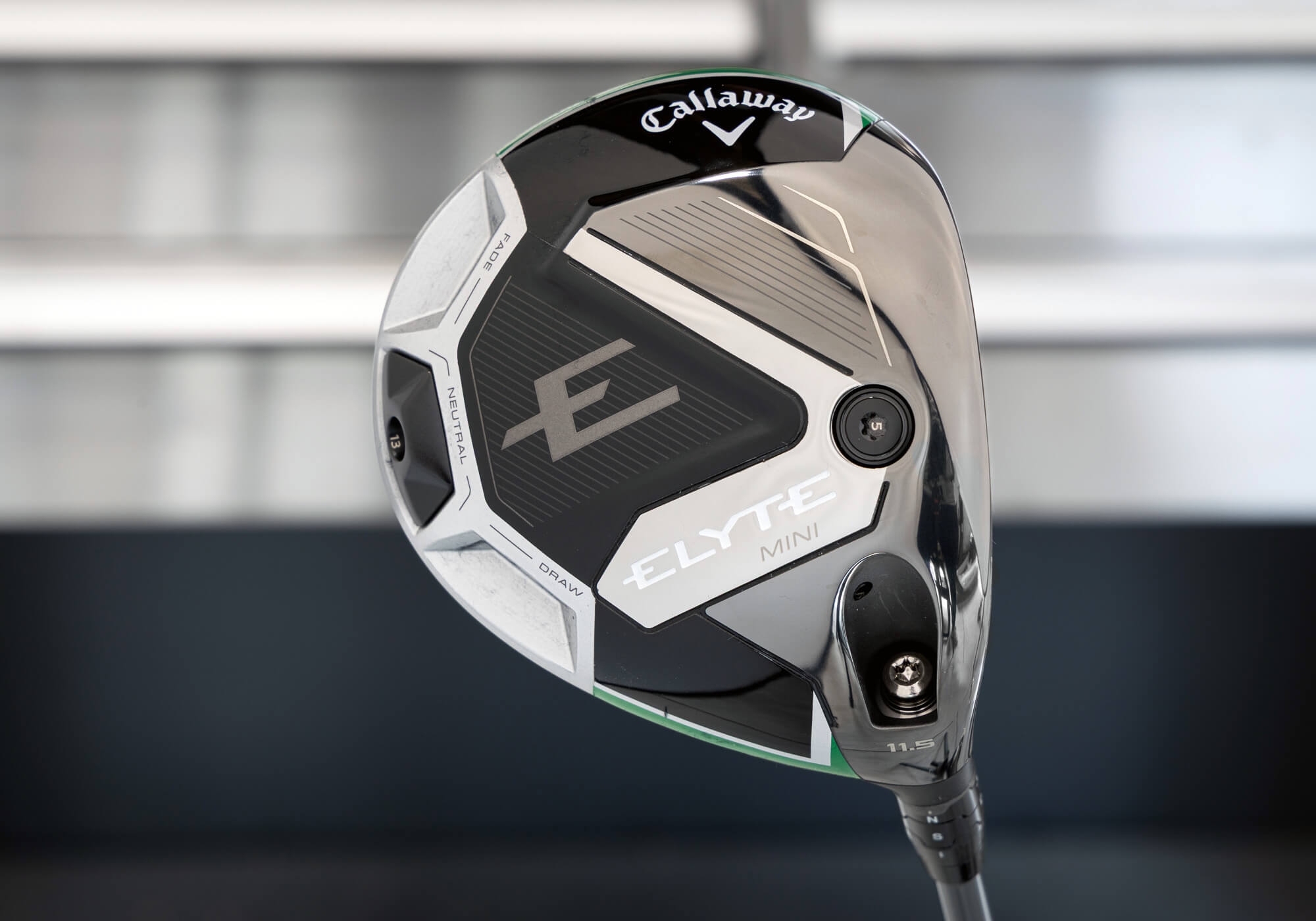
Low-spin fairway woods are often marketed as precision tools. Labels like LS, LST, Triple Diamond and Tour suggest flatter flight and tighter distance control. For the right player, that promise holds up. But many golfers try these models and quickly notice that when the strike or launch isn’t perfect, the misses feel more costly.
The 2025 fairway wood test data helps explain why and gives us an inside look into whether these low-spin fairway woods are less forgiving.
Which fairway woods we looked at
This analysis does not focus on the lowest measured spin numbers in the test. It focuses on fairway woods designed to reduce spin.
In the 2025 fairway wood test, that group includes:
- Callaway Elyte Triple Diamond
- COBRA DS-Adapt LS
- PING G440 LST
- TaylorMade Qi35 Tour
- Wilson DYNAPWR Carbon
These models share similar design intent including more forward center-of-gravity placement and flatter flight characteristics.
For context, they are compared against higher-MOI (moment of inertia) and draw-biased designs such as MAX, SFT and X-style fairway woods. Those clubs are built to provide additional height, spin and stability on misses.
Spin, height and flight: What the raw averages show
Among low-spin designs, average backspin generally falls in the 3,000 to 3,350 rpm range. Many higher-MOI and draw-biased fairway woods push closer to 3,500 to 3,800 rpm.
That difference in spin directly affects ball flight.
Low-spin fairway woods in this test typically produced:
- Peak heights in the mid-20s, most often between 24 and 27 yards
- Descent angles in the mid-to-high 30s, generally around 35 to 38 degrees
By comparison, many MAX and draw-biased models reached:
- Peak heights closer to 27 to 29 yards
- Descent angles approaching 39 to 40 degrees
Those higher peak heights and steeper descent angles act as a form of built-in forgiveness. When launch or strike quality drops slightly, the ball still stays in the air long enough to carry and stabilize. Low-spin models do less of that work for you.
Why peak height matters
Low-spin fairway woods are not designed to add height or spin. They are designed to reduce excessive amounts of those values for players who already generate enough.
If a golfer already launches the ball high and produces enough spin, lowering spin can tighten distance control and create a very playable flight window. But if a golfer struggles to reach sufficient peak height in the first place, moving into a low-spin fairway wood often makes that problem worse.
Without enough peak height, the ball does not stay airborne long enough to maximize carry. Shots flatten, fall out of the sky earlier and become far more sensitive to strike location. This is a mismatch between player and design not a problem with the club.
Dispersion: Where the trade-off shows up
Dispersion is measured as shot area in square yards (yd²).
- Low-spin fairway woods in this test generally produced shot areas in the high-2,000s to low-3,000s yd².
- Higher-MOI and draw-biased fairway woods clustered lower, most often in the 2,000 to 2,400 yd² range.
What changes from lower-spin models to higher-spin is how much protection the club provides when the strike or delivery varies.
How the MyGolfSpy forgiveness scores fit in
Forgiveness scores confirm what the performance data already suggests. Low-spin models consistently score lower for forgiveness than MAX and draw-biased designs.
That gap reflects differences in:
- Ball speed retention on off-center strikes
- Carry distance consistency
- Spin stability
- Dispersion control
Who do low-spin fairway woods work for? (And who they don’t)
| More Likely a Good Fit | More Likely a Poor Fit |
|---|---|
| Naturally launch fairway woods high | Struggle to get fairway woods airborne |
| Already generate adequate spin | Already fight low spin or low peak height |
| Consistent strike location | Miss high/low on the face frequently |
| Prefer flatter, controlled ball flight | Rely on height to maximize carry |
| Want tighter distance control | Need added MOI to protect misses |
The bottom line
Low-spin fairway woods are built for a specific type of golfer, one who already generates height and spin and benefits from reducing it.
For players who meet that profile, low-spin fairway woods can deliver excellent distance control and predictable flight. For players who rely on added spin, height and MOI to stabilize misses, the same designs can lead to shorter carries, wider dispersion and inconsistent results.
Get fitted for a fairway wood and pay close attention to the spin rates, peak height and dispersion of the model you choose.
Here’s a look at our complete fairway wood testing from 2025: Best Fairway Woods of 2025.
The post Are Low-Spin Fairway Woods Less Forgiving? The Data Doesn’t Lie appeared first on MyGolfSpy.
