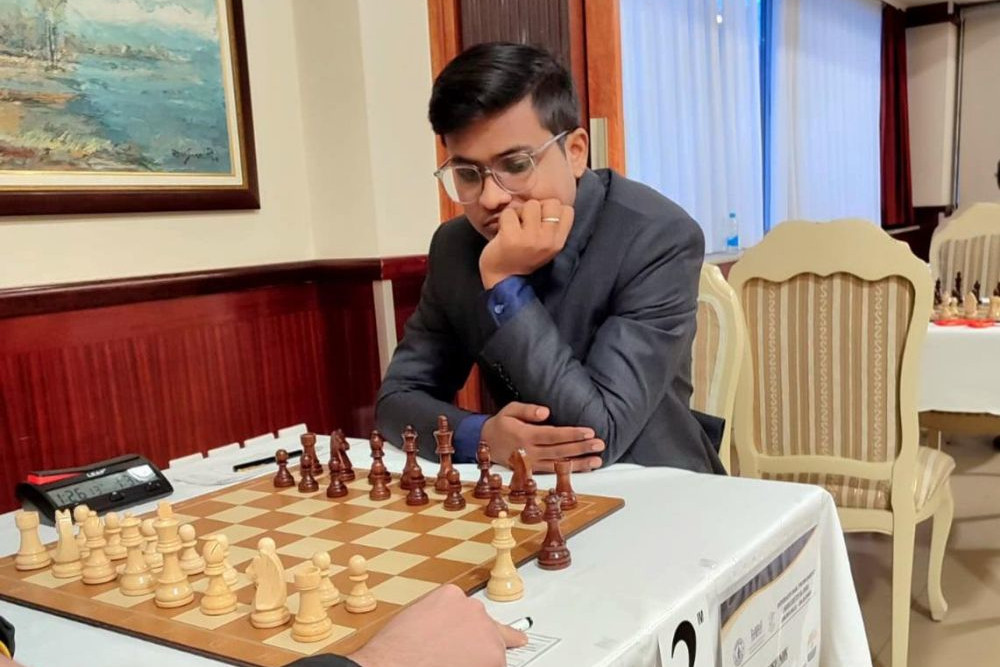
Trust the process… as they say!
By Deboushnik De
1962 to 2430 in just one year! | Photo: Deboushnik’s FIDE Profile
Reaching 2430 Elo and securing two International Master norms was not a single magical moment. It was the result of years of persistence, careful planning and, most importantly, learning to trust my process even when results did not immediately follow. In January 2025, my FIDE rating stood at 1927. At that stage, I was already competing in strong open tournaments, playing decent chess, but something was clearly missing. While I could hold my own, I lacked consistency against higher-rated opponents. The gap was not about talent. It was about execution. I had to focus on three things:
- Converting better positions
- Handling pressure
- Choosing the right tournaments instead of simply playing many events
This realisation changed how I approached everything. Fast-forward to January 2026: my rating is 2430, I have two IM norms, and a completely different understanding of competitive chess. This is a deep dive into that journey: what I fixed, what went wrong and how small changes created a massive impact.
Planning the trip: Strategy off the board
One of the most underrated aspects of increasing rating and earning norms is logistics and planning. Instead of randomly selecting tournaments, I focused on:
- Strong open and norm-friendly events with balanced fields
- Playing back-to-back tournaments in Europe over a span of 1 to 1.5 months, which significantly reduced travel costs
- Choosing events where I would consistently face higher-rated opposition
In January 2025, I played the Goa GM Open, where my rating rose to 2038. That gave me confidence, but I knew the real test would come in Europe.
First Europe trip: Playing without fear
During April–May 2025, I planned my first Europe trip, choosing some of the strongest open tournaments:
- Reykjavík Open
- Grenke Open
- Sardinia Open
These events are massive, packed with strong GMs and IMs. For me, they provided the perfect opportunity to fight against players rated significantly higher than me, without fear. Across these three tournaments, I gained around 234 rating points, pushing my rating to 2272. More importantly, I started believing that I truly belonged at that level. After this stretch, I took a short break from tournaments and worked extremely hard on:
- My weak points
- Opening preparation
- Calculation and decision-making
This phase of training with my coaches laid the foundation for what was to come next.
Second Europe trip: Learning the hard way
In November 2025, I planned my second Europe trip, this time focusing on round-robin events and norm chances. I started with my first-ever round-robin tournament in Serbia. Mentally, it was overwhelming. For the first time, I was constantly thinking:
- How many wins do I need for a norm?
- Against whom should I push?
- Where should I play it safe?
This mindset proved disastrous. I began misplaying equal and even better positions. I was not playing my natural chess. Immediately after, I played a team event with the same mentality, which again led to time trouble in almost every game and mistakes in critical moments. Across these two events, I lost 38 rating points. At that moment, I knew something was wrong.
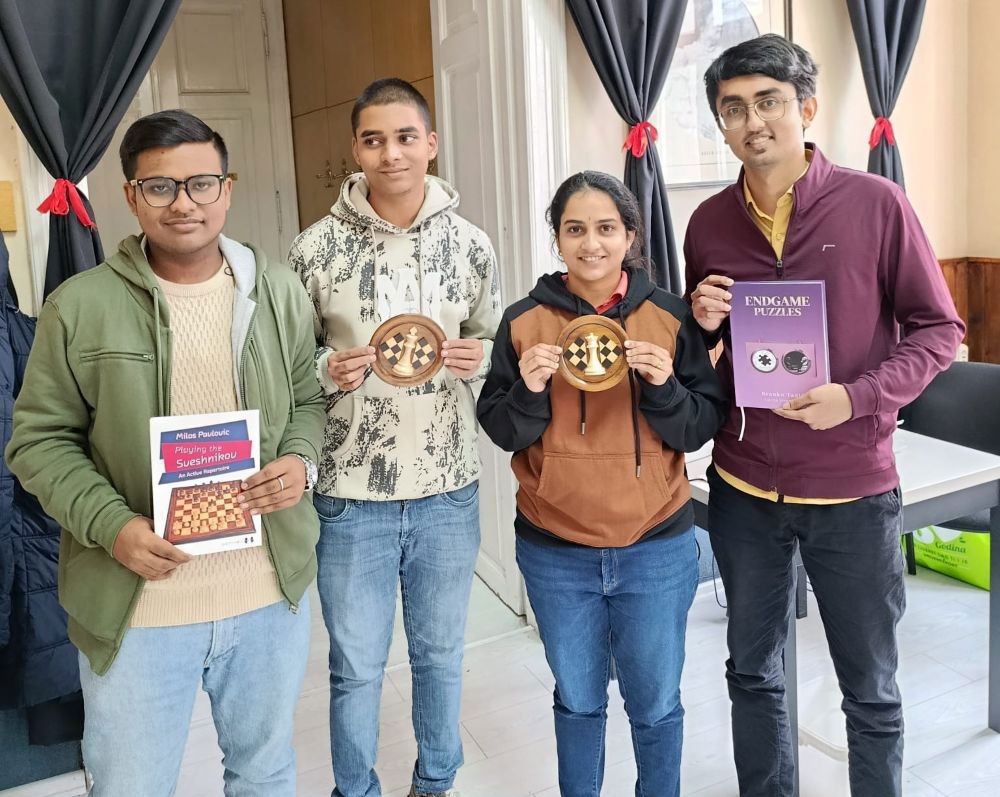
Deboushnik De with his fellow competitors Ajay Parvathareddy, Isha Sharma, and Sharan Rao (from right to left) at the IM RR SahArt Subotica
The turning point: Resetting my mindset
I had about one week before my next tournament, and I used that time to speak openly with my coaches, family and friends. I owe a huge thank you to them. They helped me realise one simple truth: I was chasing norms instead of playing chess. My coaches and friends advised me to:
- Completely forget about norms and ratings
- Focus only on the position in front of me
- Trust my instincts, especially since I play well in faster time controls
- Avoid spending unnecessary time on non-critical decisions
That conversation changed everything.
Bosnia: When chess finally flowed
My third and fourth tournaments, both played in Bosnia, marked a complete mental reset. I stopped thinking about norm chances, rating gains and tournament standings. I focused on one game at a time. By the end of the tournaments, I felt genuinely happy with my chess. Then my friends called and told me something unbelievable. I had already scored my IM norms and gained a massive amount of rating. Ironically, the moment I stopped chasing success, success followed!
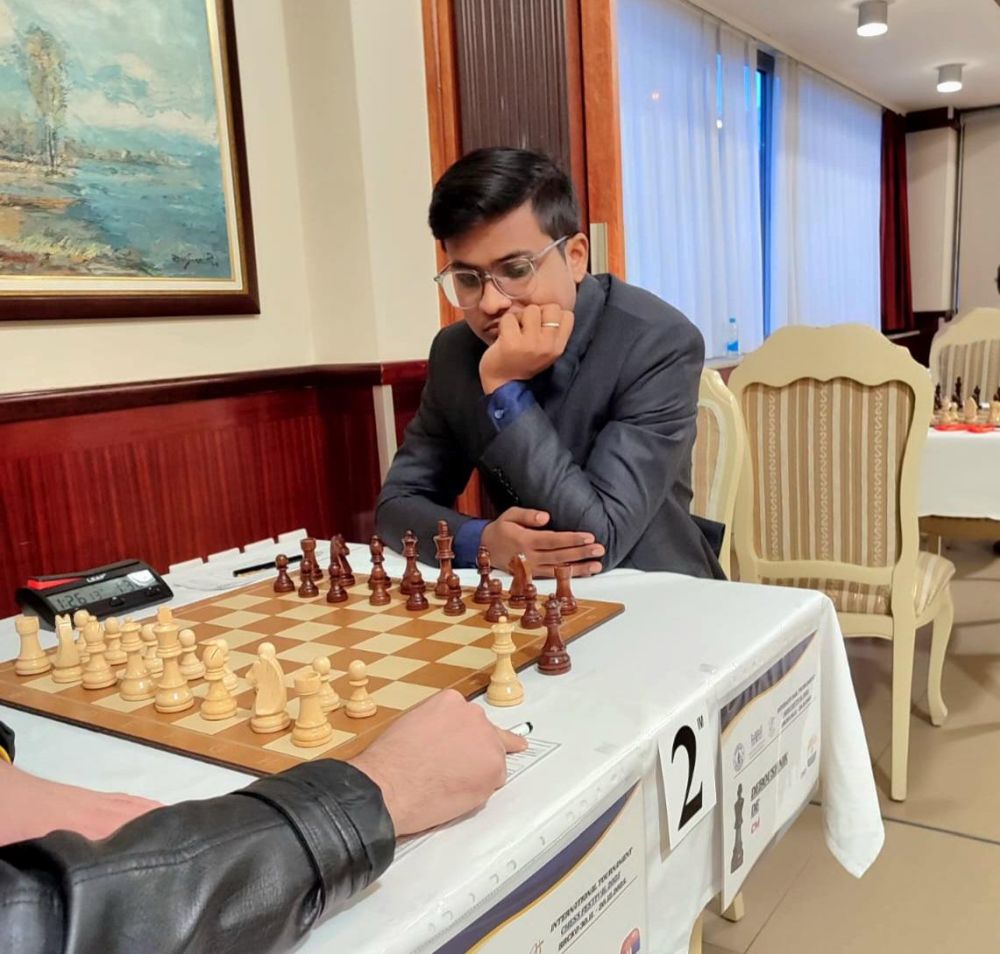
Deboushnik in action during the Brcko 2025 – IM tournament
In this video course, Grandmaster Ivan Sokolov explores one of the most intriguing and under-examined areas of modern chess: reversed opening systems, focusing on the Reversed Grünfeld and the Reversed Dutch. At first glance, these two systems seem unrelated. However, they share a common strategic challenge: the value of tempi, structure, and psychology when familiar openings are played with colours reversed. Drawing on his long professional experience, Sokolov explains why these positions are far more subtle than they appear and why traditional engine evaluations often fail to capture their true complexity.
Free sample video: Introduction
Free sample video: Larsen’s b4 Plan vs Reversed Stonewall Setups: Larsen – Spassky
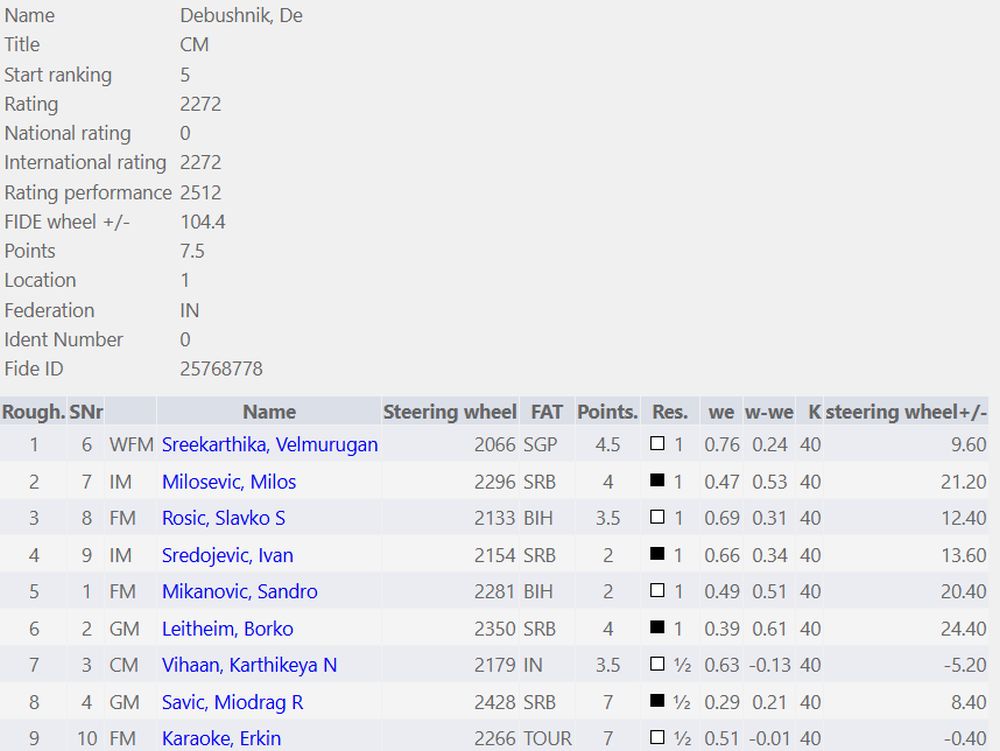
Deboushnik finished third at the “Brcko 2025 – IM1” event with a score of 7½/9 | Photo: Chess-Results
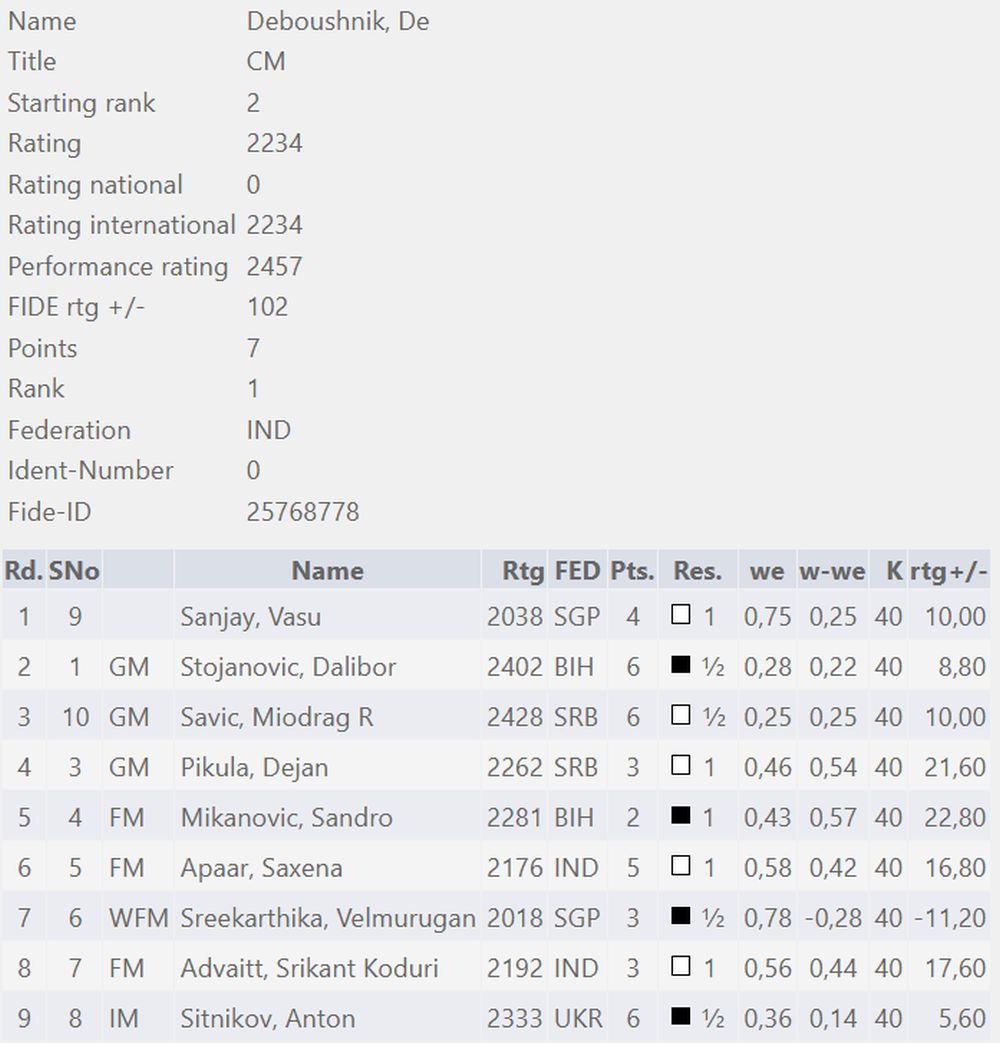
Victory continued at “Brcko 2025 – IM2”! In this tournament, he also remained unbeaten and scored 7/9. | Photo: Chess-Results
Handling pressure in normal situations
Norm situations are mentally brutal. Once you realise a norm is possible, every move feels heavier. What helped me was:
- Treating norm games like any other round
- Focusing on the position, not the result
- Accepting that nervousness is completely normal
Once I let go of the pressure, my chess became freer and more confident.
People often see a rating jump and think it happened overnight. In reality, it was a delayed success. The improvement had already happened earlier. Positions that I once lost were now being saved. Equal positions became pressing. Winning positions were finally converted. When preparation aligns with mindset, ratings catch up fast.
Looking ahead
As of January 2026, with two IM norms and a peak rating of 2430, this feels like a checkpoint, not the destination. The hunger to improve remains the same. If there is one takeaway from my journey, it is this: Progress in chess is not linear, but consistency always gets rewarded. After returning home, I deeply analysed my games with my coaches and realised I had played some truly memorable ones.
Deboushnik De v. Advaitt Srikant Koduri
Black chose the Slav Defence, a byword for solidity, but deviated on move 12 with an unusual and possibly unsound plan, moving the knight twice for little return. I reacted precisely, opening the centre at the right moment and turning my opponent’s lack of clear direction into a decisive attack.
The typical plan for Black in this position is 12…b5, followed by …a6 and later the …c5 break. In the game, however, Black chose 12…Nd5, intending to harass the white queen with …Nb4. As a general rule, repeated moves with the same piece in the opening require concrete justification – otherwise, they tend to concede valuable time and invite trouble.
White responded with textbook precision, expanding in the centre and offering the d-pawn. Black could have minimised the damage here with a solid move such as 16…Rd8, but instead took the bait and captured on d4, granting White the decisive opening advantage he was seeking.
After 16…Qxd4 17.Be3 Qe5 18.a3 Na6, White piled on further sacrifices to breach Black’s defences. See the game below for how this was carried out.
Deboushnik De vs Apaar Saxena
4.0-0, the most popular choice for White, leads to the (in)famous queenless endgame after 4…Nxe4 5.d4 Nd6 6.Bxc6 dxc6 7.dxe5 Nf5 8.Qxd8+ Kxd8.
White, however, opted for 4.d3 Anti-Berlin system, inspired by a recent Abdusattorov v. Fedoseev game, sidestepping this well-trodden line. What followed was an instructive game in which White steadily improved his pieces and gradually outplayed his opponent.
I would like to express my heartfelt gratitude to my coaches, GMs Alexander Moiseenko and Michael Roiz, who supported me as a team through both my highs and lows. A huge thank you to my parents and friends for their constant belief.
Coming from Assam, a North-Eastern state of India, the journey has never been easy. But despite all challenges, I stayed focused on my chess and, in the end, it paid off!
In this Fritztrainer: “Attack like a Super GM” with Gukesh we touch upon all aspects of his play, with special emphasis on how you can become a better attacking player.
