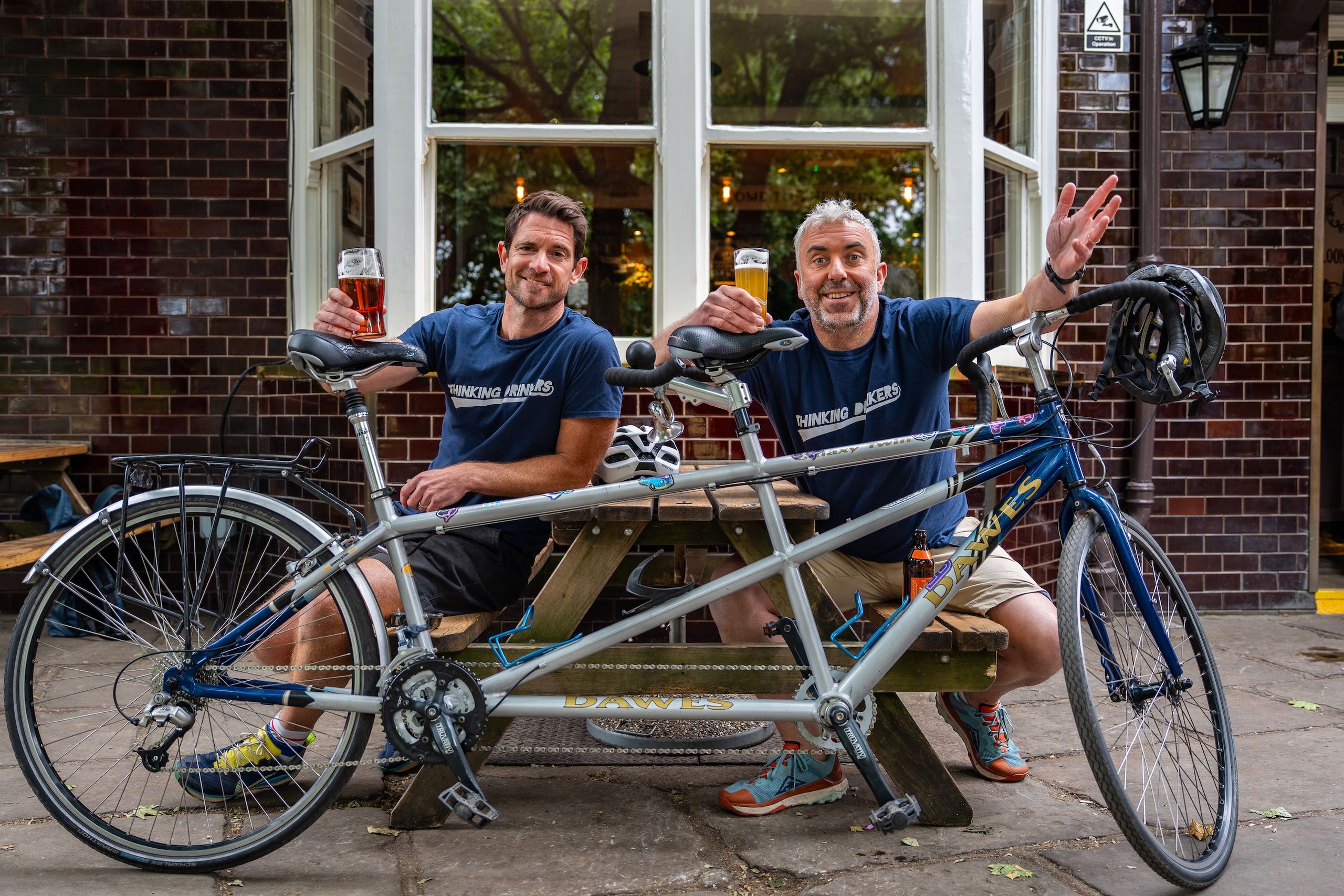
Dry January? Not a chance. While the country’s lightweights are swearing off booze for the new year, the Thinking Drinkers – Ben McFarland and Tom Sandham – are doubling down on their mission to save the British pub. Over the summer they rode the length of the country on a tandem, relying solely on pubs for shelter, sustenance and of course beverages. Here, they explain why bikes and beer belong together – and why Britain’s beleaguered boozers urgently need our support.
Why cyclists should go to the pub
Since 2000, the UK has lost a quarter of its ‘locals’ and, facing a host of economic headwinds and hardships, the number of British boozers continues to shrink quicker than a crisp packet in a roaring open fire. The costs of running a pub are simply too high. Even busy pubs are struggling to survive. No other business sector in the economy is taxed so heavily, with £1 in every £3 spent in the pub going to the Chancellor. The profit on a £5 pint is just 12p. And that’s about to get worse, as in her latest budget Rachel Reeves announced that alcohol duty would rise in line with inflation, currently 3.66%. Pubs and the wider beer sector collectively generate over £15bn in tax revenues each year.
In 1912, beer-loving writer Hilaire Belloc warned the English: “Change your hearts or you will lose your inns, and you will deserve to have lost them… and when you have lost your inns, drown your empty selves, for you will have lost the last of England”. If we don’t use them, we will lose them.
Caution is the order of the day
OK, boozers and bikes are not natural bedfellows. There is, all things considered, an inherent imbalance to partnering pints with pedalling. When consumed in excess, alcohol turns your cleats into clown-shoes and makes a mockery of your motor function. Every gentle bend of your elbow shoves a stick further into our central nervous system, slams the brakes on your brain activity, and can even cause memory loss. Have I said that already?
Sending your blood-sugar levels awry, booze fuels foolish food choices and makes you crave sweet and starchy stuff that have no business being part of an elite cyclist’s diet: Scampi Fries instead of oily fish, pork scratchings instead of chia seeds, a full English instead of oats, that kind of thing. And, of course, riding under the influence is illegal.
Booze and elite racing have a long history
The history of pro cycling is drenched in drink. In the early days of the Tour de France, with rules regarding water consumption notoriously rigid, alcohol fuelled the engines of some of history’s greatest cyclists. Booze was safer to drink than some of the lurgy-laden water drawn from roadside wells and, during three long weeks in the saddle, it not only helped numb the pain but also acted as a crucial camaraderie catalyst among team-mates.
Drinking raids were regular occurrences right up until the 1960s. In their quest for calories, and to quench their rapacious thirst, riders raided local bars and ‘estaminets’, grabbing as much booze as they could and cycling off without paying – leaving it to Tour officials to settle up with bemused bar owners.
Maurice ‘the Chimney Sweep’ Garin rode to victory in the inaugural 1903 Tour De France on a liquid diet consisting of champagne and red wine; the entire peloton pit-stopped for a ‘pint’ during the 1935 Tour de France, while Eddy Merckx, it’s claimed, filled his bidon with ‘bubbles’ during his famous victory in the Pyrenees in 1969. Jacques Anquetil, the bon-vivant, five-time winner of Le Tour with a penchant for pastis and whisky, famously proclaimed: “You can’t ride the Tour de France on mineral water”. Tell that to your health-obsessed pal the next time they frown upon your pint.
You’ll miss them when they’re gone
Pubs are the perfect pitstops for cyclists because they’re everywhere – and provide rationale to any route whether you’re doing Land’s End to John o’ Groat’s (LEJOG) on a rickety old tandem as we did, or a simple Sunday morning loop.
Boozer-counting boffins reckon that, wherever you happen to be in England, you are never more than 10 miles from a pub – with that number rising to around 34 miles once you venture north into the more remote regions of Scotland.
In contrast to cafes and soulless coffee chains, clustered to capture footfall, pubs are democratically dotted across the land. They welcome everyone and remain the heartbeat of the nation’s network of economic arteries. Eighteenth and 19th-century coaching inns provided travellers and their horses with sustenance and somewhere to sleep – and many of them remain in operation as pubs.
It’s in the more remote regions of the country that pubs really reveal their splendour. While many have sadly been shuttered over the last few decades, you’ll still find rural boozers in places where the likes of Gregg’s and Londis fear to tread. Numerous times on our two-week journey, just as our morale was ebbing, a pub would appear out of nowhere like a mirage, surrounded by nothing but insouciant sheep and stunning views. Heaven knows how they survive or, indeed, how they got there – but they rely on the passing trade from the likes of us cyclists. Only by stopping for a pint or two and stuffing our faces with peanuts can we ensure they’ll still be there next time.
Alcohol is optional
You don’t have to drink alcohol in a pub. In fact, research has revealed that one in three visits to a boozer involves no alcohol at all. Every pub serves soft drinks and non-alcoholic beers. Both the range and quality of zero and low-alcohol drinks available has, in the last few years, improved immeasurably.
We found Lucky Saint on draught in loads of locals and even kept cans of its lovely Bavarian lager in the bottle cages on our tandem. Other great non-alcoholic alternatives encountered on our journey included ‘Clear Head’, an alcohol-free IPA by the brilliant Bristol Beer Factory and ‘Run Wild IPA’ from the hugely successful Athletic Brewing. When we hit the West Country, we quenched our thirst with a chilled bottle of Thatchers Zero cider, while the non-alcoholic version of Guinness, almost ubiquitous in British boozers, is astonishingly close to the real thing.
Some drinks were literally invented for cyclists
The German word Radler means ‘cyclist’, and is a 50/50 blend of beer and lemonade, better known to us Brits as shandy. Legend has it this blend was the brainchild of Franz Xaver Kugler, a keen cyclist and German innkeeper. His pub, the Kugler Alm, boasted an enormous beer garden and, connected to nearby Munich via a picturesque, purpose-built cycle-path, was immensely popular among thirsty cyclists. On a sweltering summer’s day in 1922, the story goes, around 13,000 parched pedallers turned up at Kugler’s tavern, gasping for a stein. Trouble was, he didn’t have enough beer to go round, so he blended what he did have with lemon soda and christened it ‘Radlermaß’ – the “cyclist’s measure”.
The Bicicletta, meanwhile, is a refreshing iconic Italian aperitivo consisting of Campari, dry white wine and a splash of soda water. A more bitter twist on the Aperol Spritz, it was named after the men who, having had a few too many at the cafe, wobbled their way home on their bikes.
The cafe craze has gone too far
According to some rough sums we scribbled down on a beer mat, if trends carry on as they are, pubs will be outnumbered by faceless coffee chains and Greggs within six years. The coffee shop boom has been accompanied by a 70% rise in cases of anxiety. Coincidence? Of course not.
If we all keep drinking more and more coffee, the entire nation is going to soil itself – and heaven knows our beleaguered water companies can’t cope with that. So, next time you’re on your bike, snub a Starbucks in favour of a beautiful British boozer.

Six of the best LEJOG pubs
Old Success Inn – Sennen Cove, Cornwall
Fifteen minutes from Land’s End, this is a lovely launch pad for LEJOG. Its beautiful bedrooms have uplifting ocean views, and it offers morning yoga on the sundeck.
Salutation Inn – Gloucestershire
‘The Sally’ is a superb alehouse run by a fantastic fellow called Pete, who acutely understands the social value of pubs. He serves great beers and ciders, offers warm pies.
Cholmondeley Arms – Cheshire
Stay the night at ‘The Chum’ if you can, an old Victorian schoolhouse converted into a charming Cheshire country pub. Six lovely rooms, fantastic food and an amazing array of gins.
Mardale Inn – Bampton, Cumbria
This Lakeland Inn was bought by a local community co-operative. It’s a lovely local just round the corner from the famous red telephone box that featured in the cult film Withnail and I. Chin, chin!
Crask Inn – Scotland
Small and cosy with a vast range of whiskies, this is the most remote inn on the British mainland – and was a high point of our trip. It’s an inn set amid seriously stunning scenery.
Barkley Tavern – Wigan
Debbie runs a wonderfully warm, welcoming neighbourhood boozer that really cares for its community. She introduced us to the ‘Wigan Kebab’ – a huge meat pie in a big white bap.
This feature was originally published in the 2 January 2026 print edition of Cycling Weekly magazine – available to buy on the newsstand every Thursday (UK only) while digital versions are available on Apple News and Readly. Subscriptions through Magazine’s Direct.
