For riders of a certain vintage, any mention of string spokes brings to mind John Tomac’s Tioga Disc Drive mountain bike wheel from the early nineties. With its macrame-like myriad of Kevlar spokes and transparent time-trial-style solid disc construction, it was an exotic and futuristic-looking bit of kit.
The Scribe Gravel 40 wheels are altogether more regular-looking, and were it not for the colour of the spokes, I think it would take a while for most folk to notice that they are something a bit special.
(Image credit: Andy Jones)
Without going into technical details just yet, I think that the BERD spokes may well have found their perfect home on a gravel bike. The string-like spokes are very light, strong and damp vibrations but offer no aero advantage, so are unlikely to find favour on road bikes. Equally, now that at least 120mm of travel and 2.4” tyres are de riguer on mountain bikes, the subtle vibration-damping qualities of the spokes are going to get lost in the noise. However, a rapid, rigid gravel bike should benefit from both the low weight and the added comfort without missing the aero gains.
Currently, this 40mm deep wheelset is the only flavour available with BERD spokes offered by Scribe. They are supplied with tubeless rim tape applied and tubeless valves.
Construction
Let’s start with the most impressive thing about the Gravel 40s, and no, it’s not the bright white spokes; it’s the weight. Scribe claim that a pair weighs 1,317 grams, which is very impressive for a 40mm deep, 700c wheelset. However, my scales told a different story…including rim tape, the total weight came to 1,286g, 31g less than claimed and phenomenally light for any type of wheel, let alone a tough, deep, wide gravel set.
Most of that weight saving is thanks to the aforementioned spokes, which are made from Ultra High Molecular Weight Polyethylene (UHMWPE) or Polylight (as the American manufacturer BERD calls them), also known as Dyneema. I am well-versed in the impressive properties of Dyneema from my rock climbing days, where it’s used for making slings that can support a couple of tonnes despite being just a few millimetres wide, so the strength of the spokes was never a cause for concern.

The threaded metal insert is bonded into the Polylight spoke
(Image credit: Tim Russon)
These spokes are laced into the wheel using standard-sized nipples (albeit a bit longer than some to allow for the initial stretch of the material when tensioned), with the threaded section of the spoke bonded into the cord.
There is lots of technical information about the Polylight spokes on BERD’s website, but I will just pull out a few of the more pertinent points here.
– 2.5g per spoke (compared with 3.5g to 5.5g for steel spokes)
-15x the strength-to-weigh-ratio of steel
– Pull strength of 300kg (compared with 175kg for 1.4mm butted steel spoke)
– 200% better vibration damping than a wheel with steel spokes
There is also a dramatic video which shows a metal rod being rammed into a spinning wheel at speed. The rod snaps a spoke or two on the steel-spoked wheel, but does no damage to the Polylight wheel.
Should you damage a Polylight spoke, then Scribe says that it can be replaced with a standard j-bend spoke if required, although they hold all necessary spares and pride themselves on being able to get new spokes supplied very quickly.

Standard hub, exotic spokes
(Image credit: Tim Russon)
Moving away from the spokes, the rim specifications are 700c and 40mm deep with a 24mm wide internal measurement and 30.5mm external width. The rims are made from Toray T700 and T800 carbon with a ramped rim bed for easier tubeless tyre seating, and are hookless compatible too.

(Image credit: Tim Russon)
The hubs are made from alloy and come with endurance bearings, whilst the freehub has a double-disc ratchet design for instant response. The wheels are available with Shimano HG/HG+, Campagnolo, SRAM XDR and Shimano Microspline freehubs and with quick-release, 12mm or 15mm bolt-through axles for the front and quick-release or 12x142mm rear. Both front and rear hubs are drilled for 28 spokes.
The ride
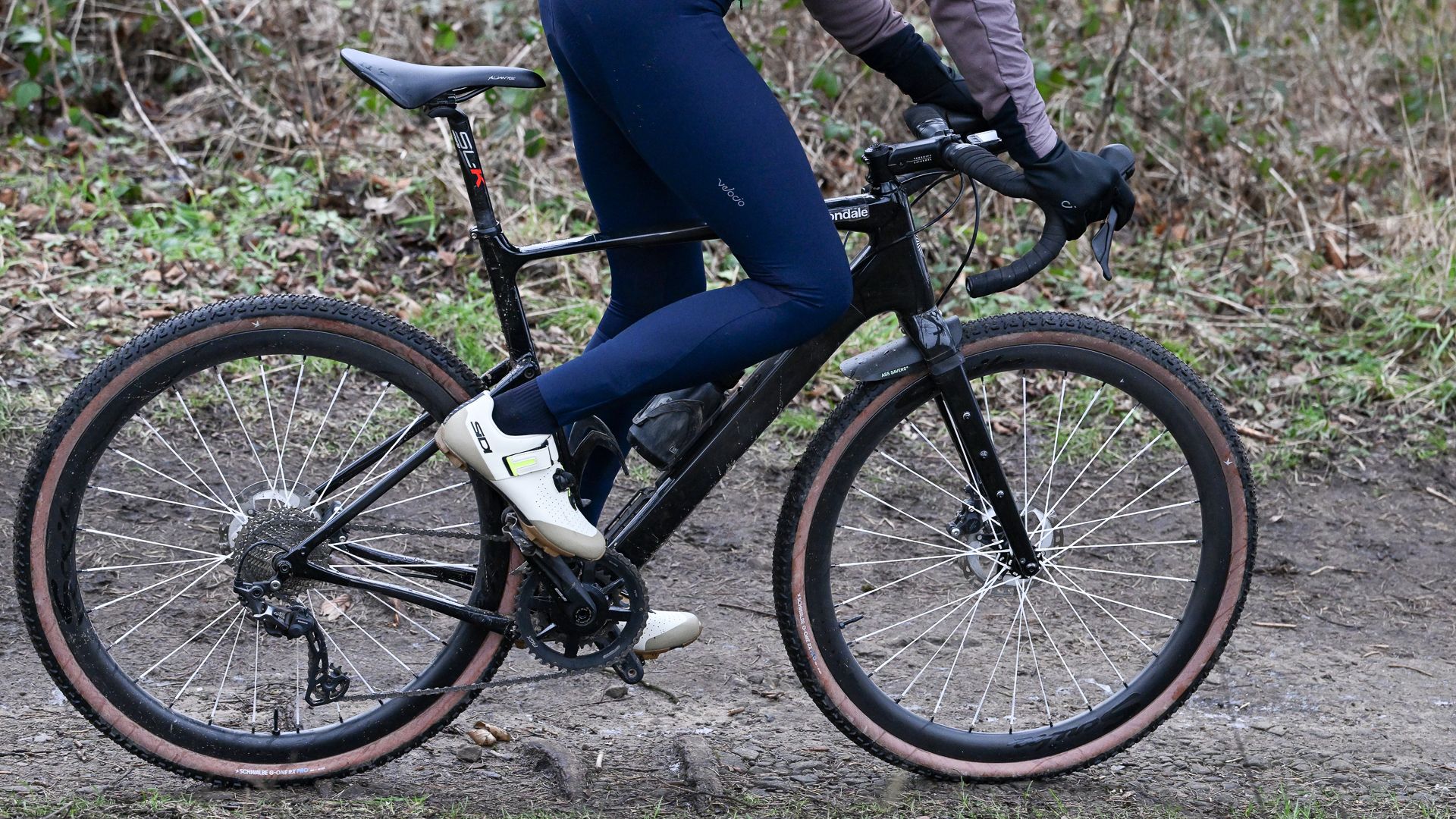
I’m a sucker for aesthetics, and, in my opinion, deep carbon wheels improve the look of most bikes instantly, although I can imagine some people not being entirely sold on the idea of white spokes. Luckily, the white spokes worked quite well with my black Cannondale Topstone, although I did wonder how long they would stay white in UK winter conditions…

The white spokes worked well with my black Cannondale Topstone
(Image credit: Andy Jones)
My first outing on the Gravel 40s was on a wet and sloppy day, when, if I’m honest, it was hard to discern much about the wheels as I slipped and slid around. However, I did contrive a rather unscientific version of BERD’s metal rod test when I managed to flick a stout stick up into my rear wheel. I looked back, fearing the worst, but once I had extricated the branch from the spokes, there was no damage to be seen, and the wheel still ran true.
Whilst aero gets most of the headlines these days, there is something undeniably attractive about a light bike, and the Gravel 40s knocked a few hundred grams off my gravel bike’s weight. This diet was most noticeable on technical off-road sections, where being able to easily accelerate up a steep climb or pick the front end up to get up a rock step is more important than a few watts of aero at 40kph.
Additionally, my bike felt more spritely and nimble with the Gravel 40s fitted, although I can’t separate out the effects of the reduced wheel weight and the potential ‘springiness’ of the BERD spokes. Either way, the Gravel 40s improved the feel of my bike compared to my usual (carbon, 1,500g) wheelset. There was certainly no noticeable lateral flex either.
These benefits are cumulative; at the end of long, tiring rides, the advantages of a light set of wheels were always highly appreciated.
One particularly frigid day, I took the Gravel 40s for a 100km gravel tour of the Peak District. With a high of minus 3°C and a low of minus 6°C, mud was not an issue as everything was frozen solid and the trails were running quite quickly. Shod with Schwalbe’s G-One RX Pro tyres, the Gravel 40s performed faultlessly and offered as comfortable a ride as frozen hoofprint-scarred tracks ever can. Whether the spokes achieved their billed 200% improvement over steel spokes in terms of vibration damping, I cannot say, but after six hours in the saddle, I certainly appreciated their lack of weight on the last couple of hills before the pub.

The rims coped with low tyre pressure knocks
(Image credit: Andy Jones)
Furthermore, in order to extract as much grip and cushioning as possible on the snow and ice, I was running the tyres with quite low pressures, so on more than one occasion during the day, I dinged the rim on a rock or a root. Each time, an anxious glance back revealed no damage, and the wheels are still perfectly true now after a few months of technical winter riding. The spokes, however, are looking a little grubby.
With an internal width of 24mm, the rim allowed the 45mm RX Pros to inflate to just over their stated size, and in fact, the wheel/tyre combination has proven itself to be an excellent tubeless combination with easy inflation and great air retention over the duration of the test.
Value and conclusion
I’m not going to pretend that £1,449 is bargain basement for a set of wheels, but neither is it anywhere close to the maximum that you can pay either.
Roval’s Terra CLX II wheels are £2,200 and weigh about 50g less, whilst Fulcrum’s Rapid Red Carbon wheels are a bit closer to the Gravel 40s price at £1,599 but weigh 200g more. Of course, if you are happy with gravel wheels that tip the scales at a still very reasonable 1,500g -1,600g, then the choice is almost endless and far more wallet-friendly. Scribe themselves offer a 1,449g gravel wheelset using the same rim paired with steel spokes for £899.

(Image credit: Andy Jones)
What the Gravel 40s offer is a compelling combination of aesthetically pleasing, deep, wide carbon rims designed for off-road use, a proven ratchet hub design and an extremely low weight backed by great customer service. Add in the additional vibration damping that the BERD spokes provide, and it makes the price seem very decent.
The Gravel 40s perhaps won’t appeal to everyone, both in terms of their looks and the use of non-standard technology, as well as their price. However, if you are in the market for a high-performance gravel wheelset and fancy something a bit different without having to sell a kidney, then the Gravel 40s would be a great choice.
