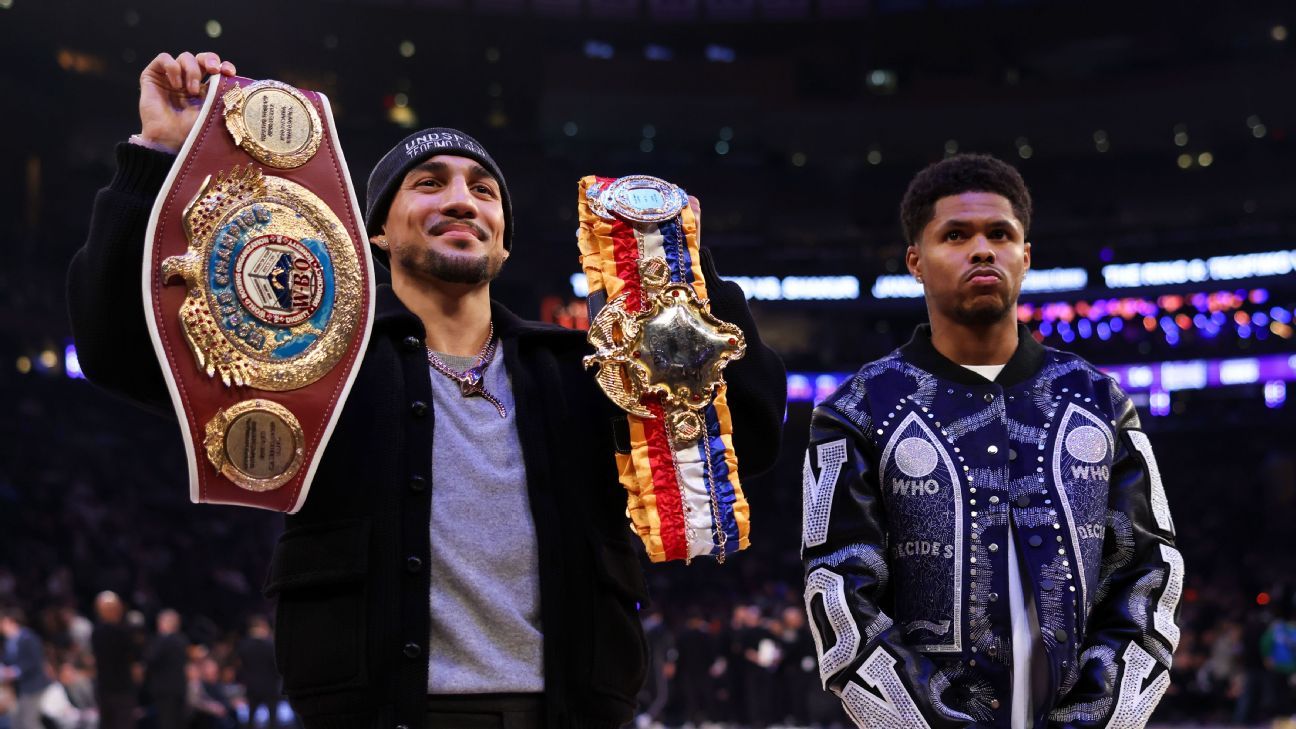
It was the early spring of 2016, and a particularly busy day at Herman Caicedo’s gym in Miami. There were all manner of champions, contenders and aspiring Olympians from Asia to the Americas. But the star of that session was an amateur bantamweight from Newark, New Jersey: a dimpled 18-year-old babyface — I use the term literally, as he might have shaved once, but only in the hope that it would cause something to finally grow. That would be Shakur Stevenson.
“He did 40 rounds of sparring, at least — nonstop, didn’t get out of the ring,” recalls Caicedo, the veteran trainer. “He did eight or 10 rounds with my champ, Juan Carlos Payano.”
Then he gave Claudio Marrero — 19-1 as a junior lightweight — another eight. Chucky Flores? — Moises Flores, out of Guadalajara, Mexico, 24-0 at the time — and Yenifel Vicente, a nine-year vet at super bantamweight with 27 wins, at least eight with each of them, too.
“Weren’t there also a couple of guys from Kazakhstan?” I ask.
“Yes,” Caicedo says. “Gave them good work, too. And didn’t even look tired.”
Though just a kid against hardened men, Stevenson inevitably gave as good or better than he got. But the last fighter he faced that day was a babyface like him, from Florida by way of Brooklyn, New York, and also vying for a spot on the Olympic team. Teofimo Lopez Jr. was a lightweight, just 32 days younger. How it went that day depends on whom you ask (not unlike boxing judges, actually). The friend who tipped me to this epic session — four-minute rounds with 30 seconds of rest in between — recalls Stevenson getting the better of Lopez. But Caicedo, who’s on the record, remembers otherwise: “Look, it was good work, not some kind of drag out fight. Shakur had just done 40 rounds and Teo was fresh. But it was probably Teo who had the better performance. Shakur was very well-rounded, well-schooled, no mistakes. But Teo seemed a little faster, more athletic, more explosive, more Roy Jones-y, you know what I’m saying? I left impressed with both of them.”
One gleans lessons from sparring at one’s peril. I know that. The most courageous fighters I’ve ever seen — Muhammad Ali and Evander Holyfield — were each notoriously underwhelming in the gym. Still. A decade hence, that day in Miami says something about each fighter, about what they’ve become and how they’ll emerge from their 140-pound title fight Saturday night at Madison Square Garden. If they were princes back then, they’re fighting to be kings now, to be seen as the successor (at least in this hemisphere) to Terence Crawford and the ever-present ghost of Floyd Mayweather Jr.
“We signed both guys thinking they could be great,” says Carl Moretti, the Top Rank vice president who signed them each coming out of the 2016 Olympics. “But the truth is, they’re even better than we thought.”
That they’re no longer considered Top Rank fighters is another story, a sad one at that. But the larger point remains. All the talk earlier this decade of another Four Kings era (or was it five?) proved to be a typical boxing hoax. But Stevenson and Lopez, now each 28, represent the best of their generation, the most accomplished fighters with the deepest résumés. “Two guys in their prime willing to face each other,” Lopez tells me. “It helps the sport. It sets an example.”
I’m obliged to note that such examples are subsidized and made possible by the Saudi financier, Turki Alalshikh. But the compelling element here is the fighters themselves — not merely their talent, but the great disparity in their temperaments and career arcs that seem diametrically opposite.
Stevenson is not unlike the kid of 2016. If there’s something almost heroic about his sparring, it’s based on his undiminished obsession with the sport. “His life is boxing,” says Antonio Leonard, Stevenson’s co-promoter from the beginning. “He’ll go anywhere, never turns down work. I’ve seen him spar [Gervonta] ‘Tank’ Davis — twice — in Baltimore. Tank couldn’t do nothing with Shakur. I remember when he first started sparring Terence.”
Crawford, he means. “I said, ‘Terence, you taking it easy on him, right?”‘
“Hell, no,” Crawford said. “I’m trying to kill him.” Stevenson, unlike Crawford, is not an especially violent fighter. He won’t take you out with a single punch. And if you still want to criticize his lackluster win over Edwin De Los Santos, understand that he still won easily despite injuries to his power hand, the left, and shoulder. Understand, too, that he comprehends distance as Albert Einstein grasped physics. He’s the best defensive fighter of his generation, and because of it, the most avoided. Fighters don’t fear a beating; they fear being humiliated, looking silly and helpless. That’s what makes Stevenson a great fighter.
Now there’s a photograph circulating on the internet: Mayweather, Andre Ward, Crawford and Stevenson. It’s crystallized the perception that he’s next in line, an all-timer, a pound-for-pound No. 1. That might well be true, but only if he performs as the oddsmakers expect him to and beats Lopez. And that in itself — predicting Teofimo — is the most confounding of propositions.
Lopez is about a 2-1 underdog to Stevenson, according to DraftKings Sportsbook. In other words, Stevenson is a bigger favorite against Lopez than Lopez was in his last fight against Arnold Barboza Jr. Now consider this: Lopez was a 4-1 dog in his signature win over Vasiliy Lomachenko.
“He kept asking for Loma when nobody thought he had a chance — so what does anybody really know?” asks Lopez’s manager, Keith Connolly. “The truth is, we’ve beaten the unbeatable southpaw twice.”
In 2020, it was Lomachenko. In 2023, it was the best (or so thought) 140-pounder in the world, the much-tested former Olympian, Josh Taylor. I’ll always remember the lead-up to that fight, Teofimo telling me his low-key fantasy of dying in the ring. Then he got into it with his father/trainer, Teofimo Lopez Sr., on camera. I thought he was coming apart and sure to lose. Then he made easy work of Taylor.
Therein lies the difference between Lopez and Stevenson. Where Stevenson is rational, ever-calculating and all about boxing, Lopez is performative, charismatic and always with a whiff of family drama. Stevenson wants more than anything to be a great fighter. Lopez wants that, too, but even more to be loved and adored.
Some years back, Stevenson lost his belts on the scales. He had been urinating blood for hours and reached a point where merely trying to make weight was endangering all that he loved. Lopez, by contrast, endured a horrific weight cut that could have easily killed him, and lost his title (albeit narrowly) in the ring against George Kambosos Jr. Then he bragged about it.
“Best thing that could’ve happened to me,” he told me.
Given Lopez’s undeniable talent for making things difficult for himself, it’s worth noting that he turned down what was widely considered an easier and even more marketable fight against Devin Haney. As Haney is also trained by a voluble father, it could’ve gone down as the Super Bowl of boxing dads. But that would’ve made Lopez a favorite.
“It was just timing,” Lopez told me Wednesday afternoon. “I was dealing with personal stuff, as you know happens in my career: marriage, family stuff. It worked out like it worked out.”
It worked out — not coincidentally, I believe — with Lopez as the underdog.
Now I remind him of that day in Miami a decade ago. “I remember,” he says. “We were both very smart, high-IQ fighters and very selective with our punching. But you can’t win in sparring. It was just three rounds.”
This one is forever.
