One hundred fifty years ago, on Feb. 2, 1876, in a presumably smoke-filled room at the Grand Central Hotel in New York, the National League was born.
William Hulbert, an officer for the Chicago White Stockings, met with representatives from other teams and formed what was officially titled the National League of Professional Baseball Clubs. The new league was not the first professional league, but rather an outgrowth of the National Association of Baseball Players, which existed from 1871 to 1875. (That league was a loose affiliation of clubs that had problems with competitive balance — the Boston Red Stockings won the final championship with a 71-8 record while the Brooklyn Atlantics finished 2-42 — and teams from small cities unable to meet their expenses; Hulbert’s vision was to create an improved business model.)
In 1901, the American League declared itself a competitor to the NL, jumping up from its minor league status (where it had been called the Western League). The two leagues agreed to play a World Series in 1903, and for the next 90-odd years the leagues served as heated rivals. The NL’s dominance in the All-Star Game from 1963 to 1982 — it won 19 of the 20 contests — was offered as proof of its superiority, certainly by its players and fans. The leagues had different presidents, different umpires and even different rules starting in 1973 with the advent of the designated hitter.
Now, 150 years later, with a labor battle looming as the current collective bargaining agreement expires on Dec. 1, it’s possible that when a new agreement is reached, MLB could look different. After all, commissioner Rob Manfred has already suggested realignment along geographic lines — though that’s more likely to happen when the sport expands.
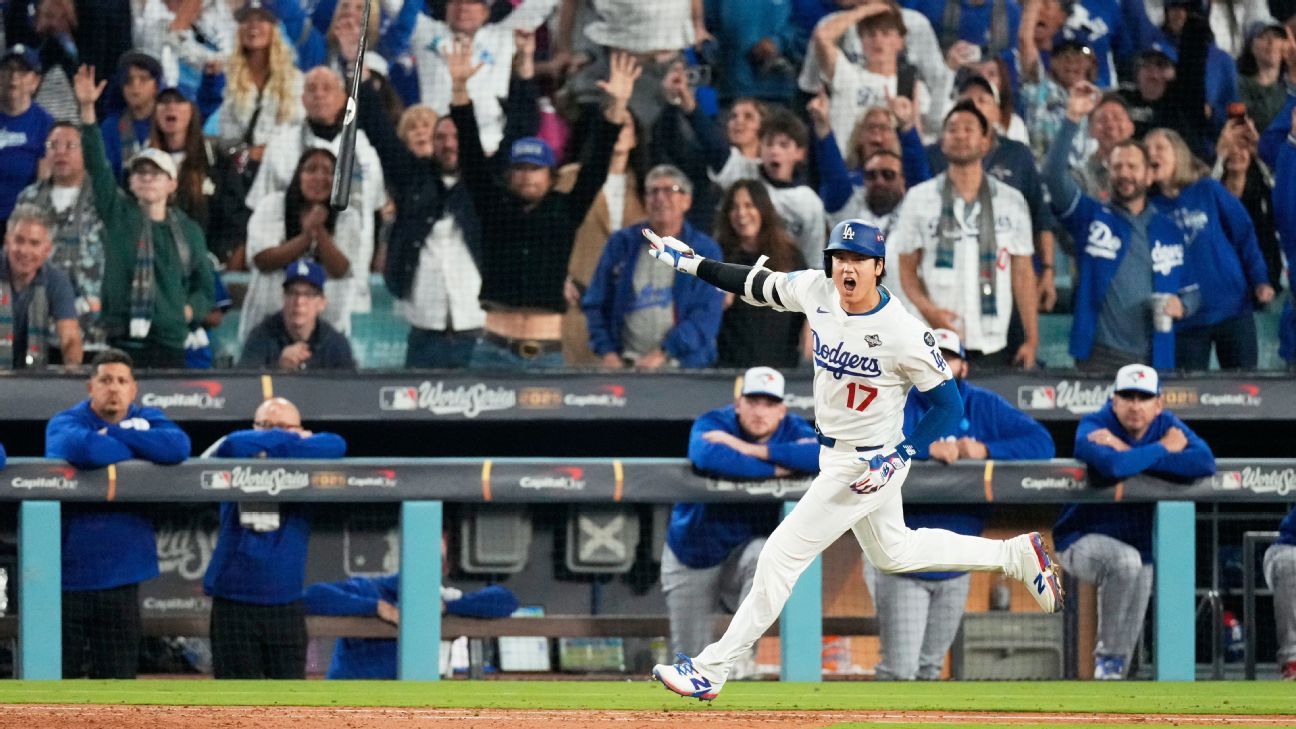
So, entering the 2026 season, and with the Los Angeles Dodgers now chasing a third consecutive World Series title, it feels like a fun question to ask: Which is the stronger league right now?
It’s the Dodgers’ success that prompted this exercise. When the New York Yankees won four World Series in five years from 1996 to 2000, the rest of the American League upped its game, too. The Boston Red Sox increased their payroll to keep up with the Yankees, and for the rest of the league, it was either get better — or get left behind.
Has the Dodgers’ success had a similar effect on the rest of the NL? Let’s find out.
Interleague results
At one point last season, you could have made an argument that the five best teams were in the NL: The Dodgers were the Dodgers, the Philadelphia Phillies were on their way to another playoff appearance, the Milwaukee Brewers and Chicago Cubs actually had a better record than L.A. at the end of July, and the New York Mets hadn’t yet collapsed. Meanwhile, in the AL, the Detroit Tigers had slowed down after a hot start, the Toronto Blue Jays were just starting to get buy-in, the Yankees weren’t doing anything special, the Seattle Mariners hadn’t gotten hot, and the Houston Astros were battling a lot of injuries.
By the end of the 2025 season, however, the AL won interleague play, 367 wins to 353. Take out the Colorado Rockies, who went 12-36 in interleague games, and the NL holds a slight edge, but just as the White Sox’s ineptitude counted against the AL in 2024, so does Colorado’s.
The NL held the overall advantage in 2023 — when the number of interleague games expanded from 300 to 690 (and then to 720 in 2025) — and 2024. That means that in the three seasons since expanded interleague began, the NL holds a 1084-1016 advantage.
In looking just at the six playoff teams from each league, the AL teams in 2025 went 150-138 in interleague action while the NL teams went 162-126. The NL’s advantage is much larger over the three seasons, however, with NL playoff teams winning 58.3% of their games compared to 52.6% for the AL playoff teams.
More telling, in 2025 the six NL playoff teams dominated the six AL playoff teams in head-to-head action, with only the San Diego Padres having a losing record:
Phillies: 15-6
Brewers: 10-8
Cubs: 10-8
Reds: 12-9
Dodgers: 13-5
Padres: 8-13
Add it up and the NL went 68-49 — that’s a .581 winning percentage, good for a 94-win pace. The best in the NL seemed to get especially focused when playing the best in the AL. Taking in all this evidence, the top of the NL does appear to be stronger than the AL — perhaps a sign of the best NL teams trying to keep pace with the Dodgers.
The top free agents
The correlation between payroll and winning has never been higher and four of the six highest payrolls in 2025 (the six teams above $250 million, via Cot’s Contracts) belonged to NL teams, including the small-market Padres coming in at No. 6.
We can see this in free agency spending. I went back to the 2022-23 offseason and checked out ESPN’s top 10 free agents to see where they signed:
2022-23: Six to the NL, four to the AL
The Yankees retained Aaron Judge and signed away Carlos Rodon from the San Francisco Giants while Jacob deGrom went from the Mets to the Texas Rangers (only to barely pitch his first two seasons in Texas). The Mets countered that loss with Justin Verlander and Kodai Senga while also re-signing Brandon Nimmo.
2023-24: Nine to the NL, one to the AL
Shohei Ohtani was the headliner in a relatively weak crop of free agents, and that shifted nearly 10 wins away from the AL to the NL. The only NL-to-AL move was Josh Hader going from the Padres to the Astros. The Dodgers also signed Yoshinobu Yamamoto while the Giants signed Blake Snell and Matt Chapman, with Chapman switching leagues. The Arizona Diamondbacks’ signings of Jordan Montgomery and Eduardo Rodriguez — both from AL teams — didn’t work out.
2024-25: Seven to NL, three to AL
Three of those seven belong to the Mets: Juan Soto plus re-signing Pete Alonso and Sean Manaea. The Dodgers turned to Japan once again with Roki Sasaki while also signing Snell away from the Giants. The three AL signings were Alex Bregman (Astros to Red Sox), Max Fried (Atlanta Braves to Yankees) and Jack Flaherty (Dodgers to Tigers).
2025-26: Five to AL, four to NL, one unsigned.
This offseason has been more evenly distributed, including four players switching leagues: Bregman going to the Cubs, Dylan Cease to the Blue Jays, Bo Bichette to the Mets and Alonso to the Baltimore Orioles. Japanese stars Tatsuya Imai (Astros) and Munetaka Murakami (Chicago White Sox) both landed with AL teams. While the Dodgers and Mets dominated the previous three years of top free agents, the nine players who have signed this winter — Framber Valdez remains unsigned — have done so with nine different teams.
OK, it’s one thing to sign players to big contracts. But are these deals the reason the NL is arguably a little stronger at the top? Let’s look at those 2025 playoff teams and all the $100 million contracts on those rosters.
American League
• Blue Jays (5): Vladimir Guerrero Jr., George Springer, Jose Berrios, Kevin Gausman, Andres Gimenez
• Yankees (5): Aaron Judge, Giancarlo Stanton, Gerrit Cole, Max Fried, Carlos Rodon
• Mariners (3): Julio Rodriguez, Luis Castillo, Cal Raleigh
• Red Sox (2): Trevor Story, Alex Bregman
• Cleveland Guardians (1): Jose Ramirez
• Tigers (1): Javier Baez
Total players: 17. Average bWAR: 4.0.
National League
• Dodgers (7): Shohei Ohtani, Mookie Betts, Yoshinobu Yamamoto, Blake Snell, Freddie Freeman, Will Smith, Tyler Glasnow
• Phillies (6): Bryce Harper, Trea Turner, Aaron Nola, Zack Wheeler, J.T. Realmuto, Nick Castellanos
• Padres (5): Manny Machado, Fernando Tatis Jr., Xander Bogaerts, Yu Darvish, Joe Musgrove
• Brewers (1): Christian Yelich
• Cubs (1): Dansby Swanson
• Cincinnati Reds (0)
Total players: 20. Average bWAR: 3.2.
The answer is … no, the big free agents aren’t the reason for the NL’s margins at the top. The AL received more total value (67.5 WAR) from its $100 million players than the NL did (63.2), even though the NL had three more such players.
That means small margins in other areas, including spending in that mid-tier free agent department. Yes, the Dodgers’ big signings are what everyone complains about, but their mid-tier deals are ones that few franchises can risk — such as spending $72 million for Tanner Scott and then doubling down on Edwin Diaz for $69 million this offseason after Scott had a rough 2025 campaign. How many teams would give $74 million to Tommy Edman, a useful player but hardly a star?
The Phillies originally did that with Kyle Schwarber, when they signed him to a four-year, $79 million deal in 2022. Most teams weren’t willing to do that for a DH, but it paid huge dividends for the Phillies (and after re-signing with them this offseason, Schwarber is now in the $100 million club).
The Cubs have generally avoided the $100 million deals in recent years — they’ll now have Bregman to go along with Dansby Swanson as their recent two — but have had success in the mid-tier market with Ian Happ, Seiya Suzuki, Matthew Boyd and Jameson Taillon.
These types of players can backfire though. The Mets paid $100 million in 2025 for Manaea, Starling Marte, Frankie Montas, Senga, Jeff McNeil and Jesse Winker — all for a grand total of 4.1 WAR. The Phillies paid over $36 million for Taijuan Walker, Max Kepler and Jordan Romano, who combined for negative WAR (that doesn’t even include the $20 million for Castellanos and his minus-0.8 WAR).
Who is going all-in to compete with the Dodgers?
In the NL, the Phillies have consistently run high payrolls, ranking fourth in 2025, but it’s mostly been about maintaining the same roster since signing Trea Turner before the 2023 season. Their big signings since then have been bringing back Aaron Nola and Schwarber plus extending Zack Wheeler. However, Ranger Suarez left this offseason for the Red Sox and they didn’t add an impact bat at third base or the outfield like they needed.
The Mets led the majors in payroll in 2022 and 2023 and reached the NLCS in 2024 with the second-highest payroll but missed the playoffs in 2025. There hasn’t been a coherent plan along the way other than to spend money, although David Stearns, now in his third season as head of baseball operations, is finally formulating one, ditching some of the long-time franchise faces and leaning into more of a pitching-and-defense operation. We’ll see how the Alonso/Bichette flip works and the Freddy Peralta trade is certainly an “all-in” deal, trading two top-100 prospects for a rental pitcher.
The Brewers are very good at what they do — they won more games than the Dodgers last season after all — but that usually means trading away a key player (such as Corbin Burnes or Peralta) for prospects rather than going all-in. Meanwhile, the Cubs are the most obvious example of a big-market team that should be willing to go toe-to-toe with the biggest spenders in the sport but hasn’t. The Cubs ran the second highest payroll in 2019 but came in 11th in 2025. They traded for Kyle Tucker, but didn’t engage in bringing him back — although, the Bregman signing was a minor surprise. That payroll ranking will climb a few spots in 2026, but they’re still about $150 million below the Dodgers.
Under their late owner Peter Seidler, the Padres certainly tried to beat the Dodgers — extending their payroll beyond their market size more than any other franchise while A.J. Preller emptied the farm system in win-now trades. As some of the core players get older and remain on expensive long-term contracts, their window may be closing.
The one AL team pushing all its chips to the center of the table is the Blue Jays. They added a sixth $100 million player in Cease while also signing third baseman Kazuma Okamoto out of Japan to a four-year, $60 million contract. They lost Bichette to the Mets, but their estimated payroll, via Roster Resource, has jumped from $217 million in 2024 to $258 million in 2025 to $282 million for 2026.
The Yankees also added a sixth $100 million with the re-signing of Cody Bellinger.
The Red Sox, who spent two decades battling the Yankees for wins and running high payrolls to do so, have backed off in recent years. Boston began 2025 with three $100 million players but traded Rafael Devers in what was essentially a salary dump of a contract that had eight-plus years remaining. While the Red Sox lost Bregman when he opted out of his deal, they will have three additional $100 million players besides Story for 2026: Garrett Crochet’s $170 million deal kicks in, they signed Suarez to a five-year, $130 million deal and Roman Anthony’s eight-year, $130 million deal also begins. Still, the Red Sox are holding a line: Their estimated 2026 payroll remains about $17 million less than 2025.
If anything, perhaps the Blue Jays’ spending will force other AL teams into more action. While disciplined about its overall payroll, Boston’s core of young and expensive players did allow it to sign Suarez and trade for Sonny Gray and Willson Contreras, which can be considered “all-in” types of moves. The Orioles, after a disappointing season, haven’t acquired that No. 1 pitcher they need — maybe it will be Valdez — but they did sign Alonso and trade for Taylor Ward to boost the offense.
On the other hand, the Mariners and Tigers, after making the playoffs, haven’t done much to change their rosters, with the Mariners re-signing Josh Naylor and signing Rob Refsnyder, and the Tigers signing closer Kenley Jansen and starter Drew Anderson out of Korea. The Mariners’ payroll is currently about $9 million less than last season, at $157 million, while the Tigers are up about $16 million to $171 million. It should be noted that both organizations have strong farm systems so should have a pipeline of talent on the way, but clearly neither has gone the Padres’ route of spending above their market size (the Tigers, who used to run top-five payrolls, are arguably spending below their market size).
The future
Here’s what’s a little scary. The best time to beat the Dodgers was probably in 2024 and 2025 — the two years they won the World Series. Check out their win-loss records and run differentials since 2017:
2017: 104-58, +190 run differential
2018: 92-71, +194
2019: 106-56, +273
2020: 116-46, +367 (prorated)
2021: 106-56, +269
2022: 111-51, +334
2023: 100-62, +207
2024: 98-64, +156
2025: 93-69, +142
The Dodgers won in 2024 despite an injury-ravaged starting rotation. They won in 2025 despite a bullpen that had mostly fallen apart in the regular season. Via run differential, those were the two weakest Dodgers teams since 2016. More than anything, this is probably the best testament to how the rest of the NL has improved: The Dodgers haven’t crushed the regular season the last two years. With a healthier rotation in 2026, however, plus a highly rated farm system (No. 4 in Kiley McDaniel’s latest rankings), we’ll see if the Dodgers return to those plus-200 run differentials.
To compete with the Dodgers, teams will need young talent. Using FanGraphs WAR, here are the teams with the most value from their age-26 and younger players in 2025:
1. Brewers: 23.9
2. Red Sox: 20.9
3. Diamondbacks: 18.0
4. Dodgers: 16.4
5. Athletics: 16.0
You’d love to see the Brewers go all-in more than they do — instead, they traded Peralta to the Mets. The Red Sox are poised for a long run of success with their position players and starters Payton Tolle and Connelly Early ready as well. The Blue Jays came in eighth — although much of that value came from Guerrero, Gimenez and Alejandro Kirk, who will be entering their age-27 seasons. But you can see why they are all-in, with their core players all in their prime and now Trey Yesavage joining the rotation after his impressive postseason run. The Tigers are worth watching, with a solid core of young players plus potential stars Kevin McGonigle and Max Clark on the way.
One reason the AL hasn’t quite matched the NL is the Orioles haven’t received much value from their much-hyped young players — they ranked 23rd in young player value in 2025. As a result, they’ve dipped from 101 wins in 2023 to 75 in 2025. The Minnesota Twins, who rely as much as any team on a homegrown roster, ranked just 28th and likewise have fallen from where they were two years ago.
For now, everyone is chasing the Dodgers, even if that margin of dominance has been acutely exaggerated, and the National League does seem to have a slight edge on the American League. The Dodgers, meanwhile, will be chasing history in 2026: No NL team has ever won three straight World Series.
