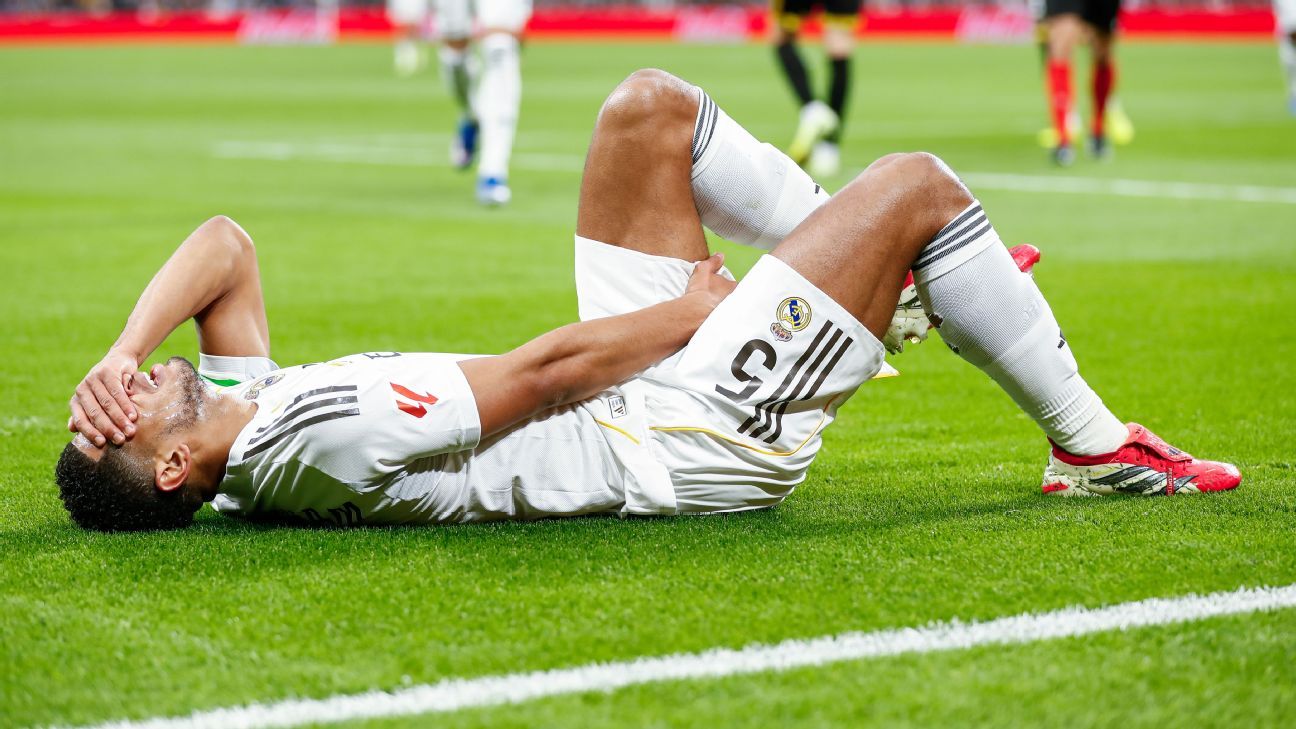
Given the level of chaotic mediocrity Real Madrid showed on Sunday, squeaking past nine-man Rayo Vallecano 2-1 in LaLiga, there was a nice comic touch from coach Álvaro Arbeloa in reminding his critical postmatch audience: “Look, I’m not Gandalf the Wizard!”
Maybe Arbeloa reached for the “Lord of the Rings” reference because he knows that in the next couple of weeks, he’s about to put his squad under the control of a man many have felt to be as merciless as any dark J.R.R. Tolkien character.
Antonio Pintus is pocket-sized, affable, wrinkled and grizzled. He is easily one of football’s most notorious, successful, occasionally controversial fitness coaches, but also one of the game’s most revered and interesting. Watch his interactions with his footballers on matchday, or while they’re traveling to matches, and you’d easily think: “My god, they adore him!” But trust me, there will be moments in the coming days when Madrid’s players will curse his name, pray for respite and glower resentfully at the 63-year-old Italian.
– Champions League playoff picks: Can Mourinho shock Madrid again?
– Arsenal, Barça target Álvarez in wrong place at wrong time at Atlético
– NBA greats Kerr, Nash on ups and downs of owning LaLiga’s Mallorca
His re-appointment as head of Real Madrid’s physical conditioning was the breaking point for former head coach Xabi Alonso’s reign. Amid the array of problems that Alonso faced via his relationship with the squad or his bosses — most notably, club president Florentino Pérez — it was when the 44-year-old refused to dump his fitness coach (Ismael Camenforte-López) and reintegrate Pintus last month that brought an instant end to his employment.
Arbeloa was moved up from the academy ranks and Pintus ascended with him; not only because he’s been the (literal) power behind 30 trophy wins across his professional career at Juventus, Inter Milan, Chelsea, AS Monaco and so on, but because he was the team’s physical coach when Madrid won four of their past five UEFA Champions League crowns.
At face value, it’s easy to understand why Pérez was utterly determined to have his talismanic fitness guru back in charge of first team matters, right? But this, in stark terms, is by far the toughest, most explosive and risky assignment Pintus has ever taken on.
The first time I met him and watched his methods close at hand, it was late 1995 and then early 1996. I was a guest of Juventus and, across two visits totaling five days, I was allowed to watch training, interview the legendary manager Marcello Lippi, talk to the fitness staff (led by Pintus’ then-boss Gian Piero Ventrone), study their fitness regime and get the first-hand views of their team leader and captain, Gianluca Vialli.
It was midseason, but Ventrone and Pintus had been in charge for years, and the fitness schedule seemed extraordinary. Double sessions most non-matchdays, extra hours in the gym, running and running and running. I was an observer, not an investigator, and what I saw was the immense effort put into being stronger, more intense and sharper than any other rival. By May that season, they had won the Champions League.
Whenever you speak to any player who’s come under the unforgiving regime, they talk about it being brutally hard — often feeling the need to stop, to throw up, to beg for mercy and to resent his “extreme” intensity. But, usually, then balancing that resentment and fury with an acceptance that supreme physical conditioning and, subsequently, trophies follow. In this instance, out on Madrid’s Valdebebas training complex 30 years later, in what has been a cold, grimy, wet winter in Spain’s capital, Pintus now has to conjure up intensity, durability, sharpness and prime conditioning against a backdrop of most of this squad having had pitifully short preseasons since August 2024.
Too much football, too much traveling, too much pressure, not enough sleep, not enough respite, a strange playing surface at the Bernabéu where players keep slipping — all of these are problems that Pintus needs to take into account. He is trying to push Arbeloa’s injury-prone squad to limits that will hurt their legs and lungs in the short term, but, all concerned will hope, bring dividends of increased, power, confidence, consistency and intensity as the weeks tick by toward key fixtures like the Champions League playoff against Benfica, further rounds if they progress, the Madrid Derbi, and a decisive Clásico. You get the picture.
The potential for this “mini-preseason” exists for the sole reason that Madrid were embarrassingly eliminated from the Copa del Rey by second-tier Albacete in Arbeloa’s first match in charge. That was held, by media and fans alike, to be a shameful, badly handled experience.
But even in the space of the two weeks since, Arbeloa is able to talk about it in the following terms: “Obviously, as I’ve been saying here for many days, we have a lot of things to develop; it’s time to improve. During these weeks without a midweek match, we’ll try to get the team working and moving in the direction we want … You need to work, you need hours on the training pitch, and that, fortunately, is what we’re going to have these next two weeks.”
He used the word “fortunately,” and I pick it out because that’s not a word he could have dared use in the aftermath of defeat to a second-division team as another piece of silverware slipped out of reach. Now, and I agree with Arbeloa here, he can risk talking about it like a piece of good fortune, a benevolent happenstance.
Enter Pintus. The first thing to say is that with Vinícius Júnior suspended for the always-volcanic visit to Valencia‘s Mestalla, you can absolutely bet your bottom dollar that the Italian will be let loose on him.
One of the things that happens, absolutely guaranteed, is if a squad opts for a dramatic midseason boost in power, intensity, resilience and athletic sharpness, there will be, initially, a tiredness before the work bears fruit. Because Vinícius’ next time of pulling on the famous white strip competitively is Valentine’s Day at home to Real Sociedad, he’ll be worked. Hard. And, knowing the Brazil international, he’ll be right up for that. Look out for Pintus-Vinícius results when that tasty rematch with José Mourinho’s Benfica comes around in the second half of the month.
This next fortnight is a tiny glimpse of an opportunity for Los Blancos. Pintus needs to produce the work of his lifetime and then, if successful, double down on it during the coming months.
There’s an iconic image of what can be achieved. It came four years ago in the Bernabéu dressing room when Madrid had just scored twice in second-half stoppage time, then got the winner in extra time to oust Pep Guardiola’s Manchester City from a semifinal tie that, to all intents and purposes, was lost. Down, out and beaten by three goals as the clock hit 90 minutes in the second leg, but victorious and through to win the final in Paris because the players had more reserves and intensity, in extremis, than City did.
That night, Luka Modric embraced the Italian and roared, “We’ve reached the summit, this is the Pintus method!” Given the chance to clarify the legendary Croatia captain’s words to Spanish media, the Italian said: “I’m not sure if there’s a ‘Pintus method’ — I don’t cut and paste. Coaching Inter or Chelsea or Madrid is different. You have to adapt, which is also a matter of intuition.
“You talk to the players, look them in the eyes and see how far we can go to beyond the thresholds. The most beautiful thing about football is the training, and the relationship with the players, the athletes. That’s what I like most. And pushing the players to the limit … not always, but sometimes because it’s important. I know that they might hate me, but it’s important they understand that we do it for them. Then, sometimes, they make you happy because they say, ‘¡Madre Mia! Look what we’ve achieved because we worked so well and so hard!'”
