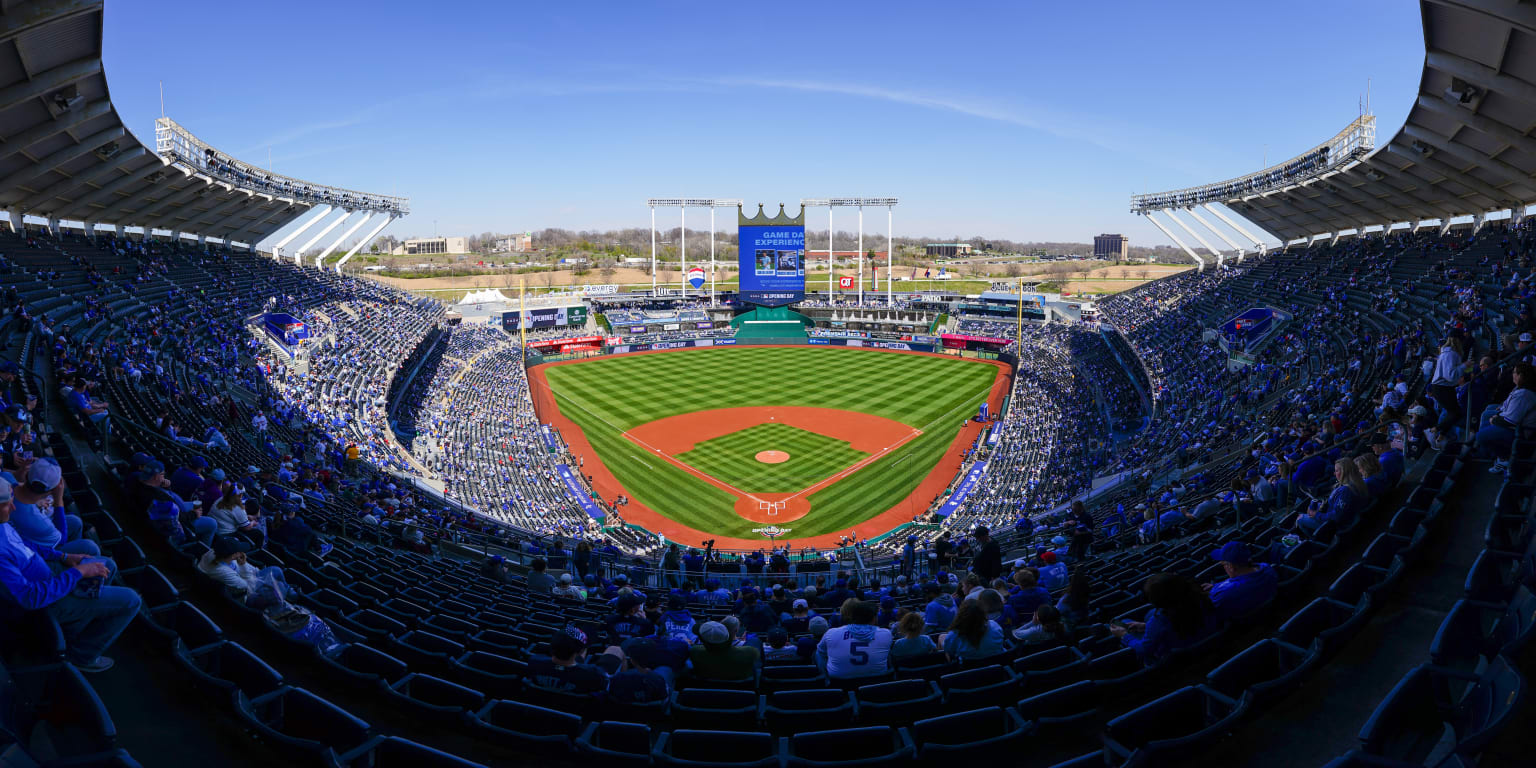
Last month, the Royals announced a most unexpected change for the 2026 season: After years of having the second-most spacious park in the Majors – and first among those that aren’t located a mile high – they’d be pulling in the fences at Kauffman Stadium. The fences in left field and right field are coming in by 9-10 feet, and the wall heights along much of the outfield are coming down by up to 18 inches.
“Our goal here isn’t to have an offensive ballpark,” general manager J.J. Picollo said. “It’s to have a very fair ballpark. We don’t want it to turn into a bandbox and every ball up in the air turns into a home run. We just want hitters to be rewarded when they hit the ball well, particularly in the gaps.”
Fair enough. While “The K” is a better hitter’s park than you think – in part because the elite batter’s eye helps give it a Coors Field-like ability to reduce strikeouts – it’s also true that only two ballparks had a weaker home run factor. There’s a reason that the average home run distance in Kansas City last year was the second-highest in the bigs, and it’s not because they employed the world’s greatest mashers. It’s because you simply had to hit it that far to get it out.
Looking at the top-down 2D dot charts won’t tell you much, because it doesn’t account for wall height. But using Statcast trajectory data, we can try to see if we can recreate the extensive internal analysis the team did. The data says: Lots of new homers incoming.
While you can see that obviously almost all of this happens in left and right, there were a few home run robberies in center that didn’t quite get out and may play differently now, which is what you’re seeing there. This kind of guesstimate is essentially what we did with the pair of changes in Baltimore over the last few years, and while nothing can ever be predicted perfectly, those expectations ended up working out quite well.
Camden Yards entering 2022 (wall pushed way out)
Camden Yards entering 2025 (wall partially returned back in)
It’s not always that clean, because when the Blue Jays made changes to Rogers Centre entering 2023, the expectation was that there would be more homers, and that didn’t really happen. But for the most part, this works pretty well, and what we’re looking at here is … well, yes. More homers. For sure.
Over the past five seasons, this says that an average of 46 non-homers per season might have flown out of the newly updated K, instead of, as Jac Caglianone found out last year, softly falling into an outfielder’s glove. This would have been a home run in 25 of the 30 parks, but as the Royals broadcast aptly noted: “Wrong ballpark.”
As Dr. Daniel Mack, the Royals’ vice president of research and development/assistant general manager, said at the time, “the idea was to find a way to improve [the run value per fly ball] without improving it to a point that it hurts our pitching staff. Do it in a way that helps our players.”
It’s easy to see what he means. Among the 28 ballparks in regular use the past three years, The K’s run value per fly ball was … 27th, or next-to last. It was less than half the value gained in fly balls at Fenway Park, for example. Putting the ball in the air at The K just hasn’t been worth the same effort as it’s been elsewhere, and the team and players have long been aware of that.
For example: A week after the World Series ended, but months before it was publicly known the ballpark would undergo changes, Royals director of hyitting development Alec Zumwalt appeared on MLB Network Radio’s “Power Alley,” speaking to how the organization has helped instruct young hitters on their way to the Majors.
“I always think about it as a perspective,” said Zumwalt. “If your mindset is to lift the ball and hit really high fly balls, then Kauffman is a really good place for you to get a lot of outs.”
Or, it had been right, at least. Looking at the changes based on Statcast data, the top-level numbers would initially say: Mission accomplished. Of the 231 presumed homers we missed out on over the past five seasons, nearly three-quarters of them had been extra-base hits, either doubles (62%) or triples (10%). Turning those into homers adds a bit of run value, but turning the nearly one-quarter of these that had been outs into homers adds a lot of run value.
For example, go back and look at the Kyle Isbel rocket in the 2024 ALDS. It came in the seventh inning of Game 4, with the Royals trailing the Yankees by two with two outs, and a runner on base. A home run would have tied the game rather than allowing Gerrit Cole to escape with the lead when Juan Soto hauled in a ball that would likely have gone out with the new dimensions. The run value here is enormous but also barely scrapes the surface of the actual value a moment like that might have meant for a potential championship run.
Of the 231 total “lost” homers in our data, 54% of them would have been gains by Royals hitters with the new dimensions, and 46% would have been gains by opposing hitters, at Royals pitchers’ expense. No Royals pitcher would have eaten more than eight additional homers over the past five seasons:
Projected HR added, Royals pitchers 2021-25
But as you’d expect, several of their hitters would have piled up a lot more than that:
Projected HR added, Royals hitters 2021-25
Consider this: That’s approximately four homers more per season for Perez over the past half-decade. He’s played the equivalent of 12 full seasons, counting partial years across his 14-year career. Were you to apply four homers to each of those 12 seasons – and you shouldn’t, really, because he’s a player who has aged and changed over time, but bear with us here – that’s 48 more.
In reality, the career gap between Perez’s 132 home-field homers and 171 road dingers is 39, which isn’t all that far off from the roughly estimated missing 48. Perez has 303 career homers as it is, 14 behind George Brett for the franchise record. But playing with these dimensions all along, he might have already cracked the 350 mark, or at least be close to doing so.
Witt, Pasquantino, and Garcia, the heart of the current lineup, weren’t there for the full five-season span, of course. So, if we just look at 2024-25, then it’s eight lost homers for Perez, seven for Witt, and five apiece for Garcia and Pasquantino.
That’s all as expected, based on the data, but we have more than just data in this case. We’ve actually seen this movie already, because the Royals already did this once.
Back in 1995, the Royals pulled in the fences “10 feet from bullpen to bullpen,” lowering the 12-foot fences down to nine feet in most places, which all sounds a lot like what we just heard they plan to do. It remained that way for nine years, moving back to the original (and, until recently, current) dimensions prior to the 2004 season.
Guess what happened: There were more homers. In the image below, “100” is set as “MLB average for that season,” and for every single season of The K’s existence, before and after that almost-decade, it’s been a harder-than-average park in which to go deep. Not one single time did it even play “average” for homers. But with the fences pulled in, it played a whole lot closer to average, sometimes even above. In 2002, it was actually a great place to crush, and Carlos Beltrán hit nearly twice as many homers there (19) as he did on the road (10). It’s not hard to look back to look ahead.
Of course, that came with a corresponding drop in doubles, many of which either became home runs or found gloves. (As we said: 62% of the “new” homers from the last five years had been doubles.) Using Park Factor again, where 100 is average, Kansas City’s park had been 18% above average for doubles in the nine years before that wall change, then 4% below average with the walls in, then went back up to 9% above average in the next nine years after they went back out.
That’s all as expected, so: Full speed ahead then, right? More homers, fewer extra-base hits, overall more value found in the air?
Could be. There are a few caveats here.
First, by lowering the height of the walls, the team is also hoping for more exciting home run robberies, and while those are relatively infrequent, they’re also difficult to account for. It’s at least possible that some of those 46 extra balls we see as “flying over the fence” might in reality still be snagged by Isbel, or Byron Buxton, or Parker Meadows, or any of the other excellent fielders who come through town.
Second, of course, it’s not just about homers, because the smaller dimensions give outfielders less ground to cover. While The K is a poor homer field, it’s been an excellent place to get hits, doubles, and triples. As Pasquantino told Rogers, “what I don’t know is whether I got, like, seven more hits because the outfield was playing bigger.” Might some of those non-homer hits now find gloves, too? Probably yes.
Third, and importantly: This is a unique situation among recent MLB ballpark changes, because while the Orioles and Blue Jays made changes to fields they expect to call home for many years to come, it’s also well-known that the Royals hope to be in a new ballpark by the time the lease at The K ends following the 2030 season. Unlike other situations, where the change probably won’t affect the home team terribly more than the visitors, since that will even out over time, the Royals really can focus somewhat more on their current roster here.
That’s most notable both in what Picollo said, and the interesting year-to-year trend that popped out at us.
“During the course of the season, we just started doing some research, running some numbers and trying to figure out how much this really impacts our offense,” he said. “Consequently, how would it affect our pitching staff? Ultimately, we concluded that we would be a better team offensively. With our current pitching staff, the changes in the dimensions wouldn’t impact [pitching] negatively as much as it impacts our offense positively.”
Focus on the with our current pitching staff part of that, because it’s notable. Bring back that first table, and you’ll see the impact to the Royals’ offense has been consistent, and steady. That’s not quite true for the pitching.
Long-term, that shouldn’t matter, and it won’t. But the Royals, at least in this park, don’t have to think that long-term, either.
But there’s one last consideration, and this is a huge unknown: What might the different feel do to players as they approach their game?
“We’ve been told that we change our approach [home vs. road], and I don’t know if there’s a way to quantify that,” Pasquantino said. “But it’s not something I’ve ever done, at least consciously.”
While the team as a whole didn’t have obviously noticeable home/road approach differences, it’s not hard to find a few individual moments, like Isbel, who had a 56% ground ball rate at home in 2025, compared to a 42% mark on the road.
The K, for years, has been a very difficult place to hit homers (1973-94, and 2004-25), except when the walls came in and it wasn’t (1995-2003). It’s not suddenly going to become Cincinnati or Colorado or any of the other famously homer-friendly parks, certainly. It’s not going to be what it was, either. It’s going to be something you’re not quite used to, for however many years the old park has left in it.
