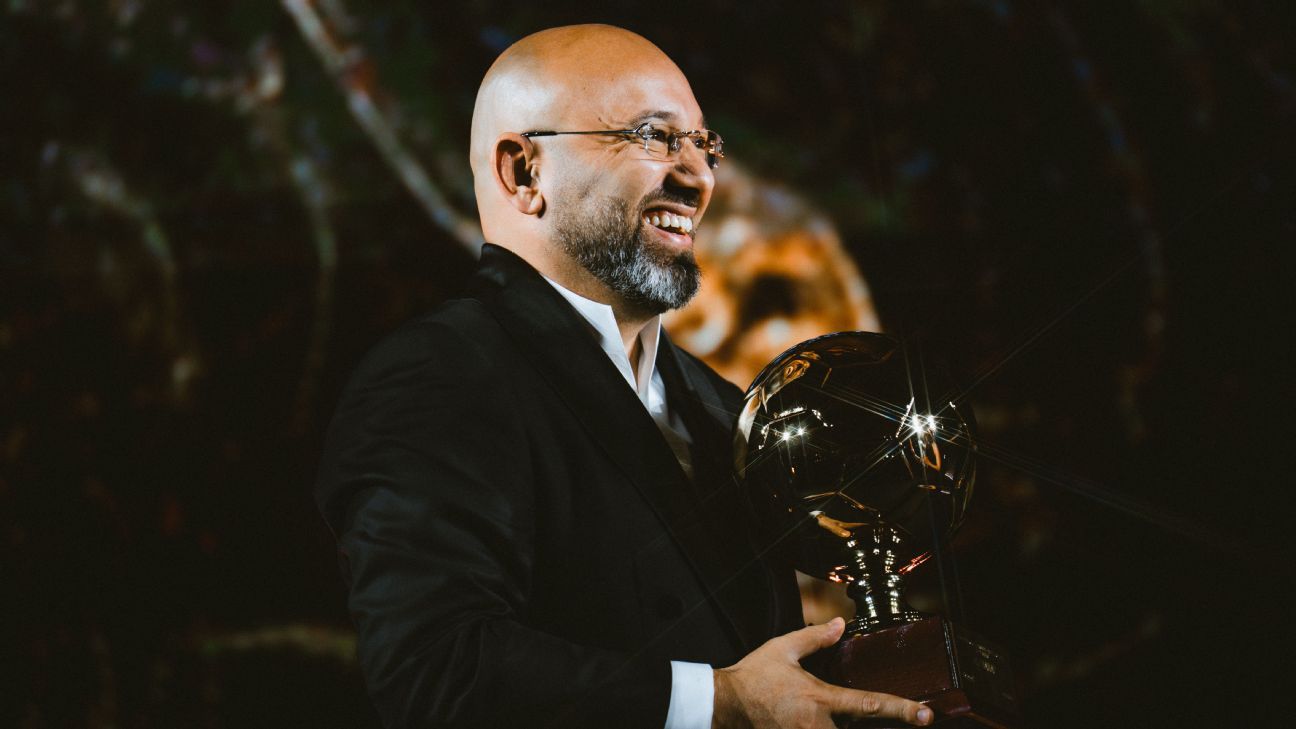
TURIN, Italy — Where was Ali? Nobody knew. Ali Barat, the world’s hottest soccer agent, was supposed to be at the Museo Nazionale dell’Automobile by 5:30 p.m. But it was after 6, and nobody had seen him.
Later that December evening, Paris Saint-Germain‘s Désiré Doué would be given the 2025 Golden Boy award as the sport’s top young player. In the spirit of every award ceremony ever, a full undercard of other honors was dispensed first. That included Best Agent, which Barat would win for the second time in three years.
As usual, Barat was staying at a more exclusive hotel than his colleagues at Epic, the agency he founded and runs, which meant he was getting to the event on his own. It should have been easy enough — a driver had been dispatched — but now it was 6:15. Where had he gone? And why wasn’t he answering texts? Ali was probably on a call somewhere working a deal, Yann Guerin, who handles Epic’s media, told me. “He’ll be here.”
And then, as if on command, Barat appeared over Guerin’s shoulder, striding through the glass doors. He wore a charcoal-colored tuxedo with no tie and a gold watch — all dials and knobs — that wouldn’t have seemed out of place on a James Bond villain. He looked like he ran a record label and within moments, Barat had nestled between two Sky Sports hosts who were covering the event, where he recounted the extraordinary summer of transfers that won him the award. Then he did a group interview with print reporters, and quick one-on-ones. Guerin looked on approvingly.
Guerin joined Epic in January from PSG, where he worked for 11 years. He was hired, as he explains it, to run Epic’s public relations as though the agency was a major international club. In practice, that has meant hyping its transfers — and the people responsible for them — to the point that Barat is now one of the most famous agents in the world.
To be fair, there have been plenty of transfers to hype — 15 last summer alone, a preposterous number for a small independent agency. They included all-caps done deals that emerged from nowhere — like center back Dean Huijsen to Real Madrid — and also several extended sagas, notably striker Nicolas Jackson‘s move from Chelsea to Bayern Munich and Tottenham’s pursuit of playmaker Xavi Simons, which occupied soccer Instagram for weeks. Each was accompanied by a breathless news release from Guerin, topped with a headline like “Ali Barat redefines the game again” or “Ali Barat delivers another masterclass.”
Fewer than 15 minutes after the window ended with the Jackson signing, Epic issued a self-congratulatory release. “Where others react, he builds,” it said about Barat. “Where others stall, he delivers.”
It’s important to understand that other agents don’t promote themselves like that. The few of them whose names are out in the world, such as Jorge Mendes and the late Mino Raiola, really don’t promote themselves at all. Even their client lists are shrouded in secrecy. (The Wasserman agency website, for example, requires a password to access player names.)
That doesn’t work for Barat. “Ali is building his brand,” explains Tiago Pinto, the Bournemouth sporting director, who signed Barat’s first client, Tomás Araújo, in 2021 when he was director of professional football at Benfica. “You can see all the hype he gives himself for these awards.”
To Barat, the publicity helps him win the awards, and winning the awards gets him clients. Players’ families get solicited by “thousands of agents,” he explains. “They get bombarded. So how can you make yourself different than the others? The families see that I have won the award and they are like, ‘OK, he’s the best, let me listen to him. He’s different from the thousand other agents who are calling me.'”
“I think he’s right in his assessment,” says an executive of a North American-based company that represents hundreds of international players. “You’ve got the bigger agencies who have a format that clearly works for them, putting their clients forward and staying behind the scenes. I guess he feels like he needs to advertise what he’s doing to be able to compete.”
At first, those histrionic emails felt unseemly. And yet, as the deals accumulated, I began to wonder if this might not be merely a public relations campaign but a true phenomenon. When I asked Guerin, he smiled. “In a few years,” he said, “he’ll have all the best players.”
On the stage, a woman and a man toggled between Italian and English as they presented the awards. When Barat won Best Agent in 2023, mostly for getting Moisés Caicedo to Chelsea from Brighton and Jackson to Chelsea from Villarreal, he was the youngest recipient ever at 43. Then Mendes, who remains soccer’s premier agent of the stars — his company, Gestifute, represents Lamine Yamal, Jose Mourinho and, until recently, Cristiano Ronaldo — won in 2024.
When he heard his name this time, Barat bounded up the steps to accept the trophy from the presenters. His face lit up in a broad smile.
“I missed you guys,” he said. “Two years was too long.”
UNTIL 2021, BARAT had never consummated a transfer. Beginning in the early 2010s, he operated as an intermediary, helping agents match players with clubs. “Lower-level players, signing in leagues like Bulgaria,” he says. His biggest commission was €20,000. Before that, he was exporting bauxite and other minerals from South America. “I literally didn’t know what a football agent was,” he says. “I didn’t know that existed it as a job because my world was completely different.”
The son of a diplomat whose family was forced to flee Iran at the start of the 1980s because of the war with Iraq, Barat was 2 years old when his family arrived in England. He grew up in South London as a Chelsea supporter. He’d spend hour after hour immersed in the popular video game Championship Manager, the precursor to Football Manager. “I was always trading players,” he says. “I was building my club. I was obsessed with every single player around the world.”
Eventually, soccer faded into the background. Barat became an international businessman and based himself in Abu Dhabi, United Arab Emirates, where he developed a close friendship with a cousin of Sheikh Mansour bin Zayed Al Nahyan, who runs the entity that owns City Football Group. He spent time with Roberto Mancini, then the Manchester City manager. Eventually, he got involved in the soccer business as something of a hobby, helping broker Edin Dzeko’s 2015 move to Roma.
Barat loved that soccer had again become part of his life, but he didn’t consider it a potential career. “It was only after I understood the fees that were involved and how much money agents made that I thought, ‘I can do that,'” he says.
He was confident because he’s always confident, and because, to him anyway, most agents didn’t seem to be particularly good at their jobs. The family members who represented many players, perhaps with help from a local attorney, didn’t have the skills or connections to do much more than accept the biggest offer. The larger firms often employed boilerplate strategies to take their players’ services to market.
Barat understood how to sell commodities. And what were soccer players, according to Barat, but highly specialized and valued commodities? So he laid the groundwork: accumulating phone numbers, nurturing relationships, gaining insight into the sport’s inner workings. By 2020, he says, “I really knew in depth how to deal with clubs. What they were looking for, what they needed, how to approach them.”
Barat launched Epic that January, spending the rest of that pandemic year researching players to target. That meant evaluating statistics, but also digging deeper. “I can be a stalker on Instagram,” he says. “You can learn so much about players from the stories they post, and so on. Or sitting in the stands analyzing their family and their entourage.”
Were they on good terms with parents and siblings? Did it seem like they could learn a foreign language? “For me, those things are even more important than the data,” he says. “Because players can be the best talents in the world, but if the environment around them is not right, we’ve often noted that it doesn’t work out.”
In January 2021, he signed Araújo. “He was new,” Araújo, who was 19 and ending his youth trajectory at Benfica’s academy, says of Barat. “But when you sat down with this guy, you could tell that he was different. After that first impression that he made, it was impossible to say no.”
It would have been more lucrative to pull Araújo out of Benfica and offer him around Europe. “We were very, very strict with the contracts at Benfica,” says Pinto. “There’s not much space for players or agents to negotiate money.” Instead, Barat advised Araújo to stay where he felt comfortable and could improve.
The money Barat made from that first signing was minimal, but he was playing the long game, sure that his investment would pay off in a major transfer five or six years down the road. So too would the goodwill he’d generated with Pinto. “My first impression of Ali was very positive,” Pinto says. “He was more focused on the player path than the money or the contract. In that moment, we created the relationship.”
Five years later, Araújo has emerged as one of Europe’s most coveted young defenders. And that neophyte to whom he entrusted his career has been recognized as the world’s Best Agent, at least in the eyes of Tuttosport. “When you work with an agent of this magnitude at 22, it boosts your ego, to be honest,” he gushes.
Whether that will lead to another of Barat’s mega-transfers will become clear this summer. Five years from signing that first deal is right about now. If it does, both Barat’s bet and Araújo’s will have paid off.
THE MORNING AFTER the awards ceremony, a Mercedes pulled up to the Grand Hotel Sitea, where Barat was staying. Barat stood by while the driver loaded his luggage: a hard-sided suitcase the size of a steamer trunk, and three smaller but still formidable auxiliary bags. Earlier this year, Barat moved from France to Dubai, but it hardly matters where he lives. He’s often gone for weeks, from Asia to Europe to Africa, and because his curated appearance is part of his brand, he needs a lot of clothes.
Epic’s challenge is staying small enough to differentiate itself from the corporate agencies that have more money and resources, but with enough heft to replicate last summer’s successes year after year. Winning the Best Agent award again in 2026, Barat assured me, was “definitely the goal.” But because most of his top players recently moved clubs, they are unlikely to be ready to move again. “Full credit to the guy, he’s come on the scene, he’s done some big deals,” Patrick McCabe, who runs the U.S. office for London-based Stellar, would tell me later. “But if you don’t have a lot of clients, how do you keep doing deals?”
The answer is: Barat needs some new ones. Foremost among them is Denzel Dumfries, the Inter Milan right back. I saw Dumfries’ father, Boris, at the Golden Boy ceremony; he was there at Barat’s invitation. He told me that his son had left Jorge Mendes after an impressive presentation by Barat. “What we like is that he plans the steps he wants to take and then he doesn’t deviate,” Boris said. “That’s very important.” To solidify the relationships, Barat hoped to see Dumfries in Milan after leaving Turin.
Before that, Barat told me with evident pride, he was meeting with Fabrizio Romano, whose social media accounts have more than 100 million followers. Romano had only ever done one sit-down interview for his YouTube channel, with Lionel Messi. Barat, not Ronaldo or another superstar, would be the second one.
Such an interview wouldn’t have happened without last summer’s transfers. Whatever you think of Barat — and the industry’s opinions are divided — it was a string of successes as remarkable as Arsenal’s undefeated season, the soccer agent’s equivalent of Jose Mourinho’s Porto team winning the Champions League in 2004.
His run of deals started before the 2024-25 season had even ended, with Bournemouth’s Huijsen. The previous year, Barat had delivered Huijsen from Juventus to Pinto, his old friend from the Araújo signing, who’d recently moved from AS Roma to Bournemouth. The south coast of England seemed a rather unlikely stop for a talent on the rise who’d most recently been playing for one of Italy’s biggest clubs. But Barat had his reasons. For one, he knew Pinto wouldn’t stand in the way when it came time for Huijsen to move on.
“It could have been one year or two years,” Pinto says now. “But the end of the story would always have been the same because Dean is a very special player.”
When Huijsen joined Bournemouth, Barat and Pinto agreed on a €50 million release clause, and after his standout 2024-25 season, several clubs were ready to pay it. One good fit was Liverpool, but they wavered for, Barat claims, the most arbitrary of reasons: Huijsen played with his socks drooping toward his ankles, which sent the message of a lack of attention to detail. “They felt that was not the right attitude for the kind of player they wanted,” Barat says.
It became Barat’s job to communicate who, exactly, his player was — the first to arrive at practice, last to leave, that sort of thing. Eventually, he convinced Liverpool that Huijsen’s talents transcended any sartorial indiscretions, but before Liverpool made an offer, Xabi Alonso, who was about to be hired at Real Madrid, called Bournemouth asking about Huijsen. The deal was done in a day. It was the middle of May, before the window had even opened — or, indeed, before Alonso had been officially hired.
That was the first transfer. The next big one was Noni Madueke: for months, Nico Jackson had been talking up his Chelsea teammate to Barat. “Noni’s amazing in training,” he told Barat. “He’s just not getting his shot.” Madueke was represented by his father at the time, so once the transfer window opened, Barat flew to London to pitch him. Barat believed that Arsenal had a team capable of winning the Premier League, except they lacked a creative winger who could dribble and shoot. In short, they lacked Madueke.
“His father wasn’t 100% convinced,” Barat admits, “but he was open to have a conversation.” Madueke was playing at the Club World Cup, a difficult situation in which to do a transfer. “But I saw the opportunity and reacted quickly,” Barat says.
Soon it was set — Madueke joined Arsenal on July 19, just six days after Chelsea won the Club World Cup over Paris Saint-Germain — and the requisite email blast sent by Guerin. By then, Jackson’s own transfer saga was already in progress.
Barat had a history with Jackson that stretched back further than with any other top player. In 2019, the forward was playing in Senegal and Gambia as a midfielder when Diomansy Kamara — the former Portsmouth, West Brom and Fulham goal scorer — sent Barat a 20-second clip. “I could see his pace, his power, his technical ability,” Barat says. “I was in love with this 20-second video. So I said to Dio, ‘Where are you? I’m coming.'”
In 2021, Barat placed Jackson at Villarreal, where he became a striker, which would lead to a deal with Chelsea in June 2023. At the start of last summer, Bayern Munich came calling, and an agreement was struck. But when Chelsea couldn’t sign a replacement, they decided Jackson had to stay.
Barat could have told Jackson, who is still only 24, to bide his time, but he knew Jackson desperately wanted to move. Barat urged Chelsea to keep looking — except he also then had to keep Bayern from meeting their needs with someone else. “That was the conversation on an hourly basis,” Barat says. “‘Ali, are you sure? Are you sure?’ I had to keep them on the hook.” His relationship with Bayern hung in the balance. “And I’m promising them, I’m giving my word. ‘Chelsea will get a replacement. I know they will.'”
How did Barat know this? Well, he had information. Marc Guiu, whose contract was owned by Chelsea, was on loan at Sunderland and hardly playing, featuring in just two games during the 2024-25 season. Barat had sources at Sunderland telling him Guiu would be recalled, and felt certain that, at worst, Jackson’s replacement was already on the Chelsea payroll, hidden in plain sight. “I couldn’t tell Bayern who it was, but I knew who it was,” he says. “That gave me the confidence to say, ‘Just be patient. It will happen.'”
And so it did, 10 minutes before the summer deadline. Bayern got their striker. Chelsea got a loan fee of more than €16 million, about half of what Jackson had cost Chelsea in transfer fees two years prior. And Barat knew intuitively that the high-profile, down-to-the-wire drama had scripted a compelling ending for what already had been an exceptional summer.
He would be Best Agent again.
IN THE COMING WEEKS, Barat will announce the creation of the “Epic 22.” A collection of players who will form the centerpieces of his client base, it will set him apart from any agents trying to emulate him. The concept is an all-star XI, a player at each position on the field — or, rather, two XIs. Because if someone comes calling for, say, a left back, and his only one has just signed somewhere else, Barat wants to have someone else to offer.
What he’s pitching is exclusivity, a service the larger agencies can’t provide. “When you’ve got a thousand players, and Chelsea asks you for a striker and you’ve got 10 strikers to offer, who gets priority?” Barat asks. “I don’t think the top player wants their agent going to a meeting and offering nine other players at their position.”
The industry has reacted with bemusement. “A club wants a player with specific attributes,” says an executive of a prominent North American firm. “It doesn’t matter if you’re offering one or 10. If they don’t find him there, they’ll find him somewhere else. And you’re telling me that if he has the opportunity to represent three elite players at one position, he’s going to turn around and say, ‘I can’t take you, I have two others?’ That’s total nonsense.”
Regardless, Barat has been explaining the concept to the marquee players he moved last summer. He’ll also include Justin Kluivert, who signed with Epic in October. Kluivert had been represented by Raiola’s agency since his early teens, but had grown restless. “I knew there was more that somebody could do for me,” he says. “I was looking around, and I heard a lot of great stories about Ali.” Kluivert was with the Dutch national team last fall when he mentioned Barat to Xavi Simons, whose move from Spurs to RB Leipzig had also been orchestrated by Barat. That led to a connection of his own with the agent.
Kluivert says that he’ll eventually want to play for a bigger club. For now, Barat is willing to spend whatever it takes to get his new client the next move he’s looking for. “Every two days, a chef comes and brings my food, and the company pays for that,” Kluivert says. “Ali makes things easier. He thinks, ‘What can I do to give my players everything so that they can be the best version of themselves?”‘
2:44
Is Weston McKennie Juventus’ best player?
The “Futbol Americas” crew discuss Weston McKennie’s recent form for Juventus and the impact it will have on the USMNT.
That investment is already paying dividends in other ways. When Dumfries, another Dutch teammate, called Kluivert inquiring about Barat, “I spoke so highly about him,” Kluivert says. “But it’s all true. Denzel did his research like I did mine. Now we’ve both ended up with him.” (Dumfries was linked with a late-January move to Liverpool, which ultimately didn’t come to pass, but it’s highly likely the fullback leaves Inter Milan this summer amid a busy window.)
Stellar’s McCabe admits the allure is enticing. “Players say ‘I want to get more attention, I want to be with this group of elite guys,'” he says. “But when you’re going to market yourself like that, invariably other agents will say, ‘This guy’s going to come for my top talent.’ I’m not sure that’s a great long-term strategy.”
And not every player whom Barat works with ends up signing with him. In October, Chelsea’s Caicedo split with his former agent, Manu Sierra, but he made it clear that, although Barat had brokered his deal to Chelsea, he was not his official representative. Soon after, Caicedo signed with Chris Farnell, a British agent.
Back in the Mercedes, Barat’s phone buzzed just as he reached the outskirts of Milan — it was Dumfries, returning Barat’s call. “How’s the best right back in the world?” Barat answered. He was in Milan, he said, and wanted to see him. He asked Dumfries, who was out of the Inter team with an ankle injury, to bring his wife. “So we can understand everything about your life,” he said. “In my experience, players of your level get these kind of injuries when something’s not right mentally. So we need to understand. Maybe there’s too much going on in your life. Maybe it was the disappointment of not getting a transfer.”
He also wanted to discuss media strategy. “I did a little homework, and it’s too quiet around you,” he said. He revealed that he was about to see Romano, who happens to be a prominent supporter of Inter Milan. “He’s going to ask me about new players I’m getting,” he said. “I’m going to say, look, there’s actually one maybe from your team.” He proposed sitting down with Dumfries and Romano together at some point. “I did it with Caicedo, I did it with Xavi,” he said. “Fabrizio was a big part of how Xavi was able to get the biggest contract in Tottenham’s history.”
The call ended when the car pulled up to another luxury hotel, where the Romano interview would be held in a small conference room. It hadn’t even started when Barat mentioned Dumfries, knowing that Romano breaking the news to all those followers would benefit both of them. Then he invited Romano to his home in Dubai for a second part of the interview.
That too would be a coup for Romano — and it would guarantee Barat even more coverage. Barat turned on the charm. “How many days do you want to come?” he asked. “You tell me. One? Two?” He smiled. “Three?”
IN ADDITION TO the Epic 22, Barat is curating a roster of under-21 prospects he calls “Elite Future,” so that when all of his current stars are set and settled he’ll still have players to move around. One is Joao Gabriel Castro Santos, known as Veneno, a 16-year-old Brazilian who plays for Athletic Mineiro. Veneno was bitten by a cobra as a child and survived, a backstory that makes him marketable — so do a reported 93 goals that he scored in 2024-25. “He is about to debut with the first team,” Barat says. “Then a transfer will happen.”
Barat has other hopefuls in the works, including a 16-year old from Burkina Faso named Mohamed Zongo who recently signed for Strasbourg, a club that is essentially owned by Chelsea. Barat was supposed to be in Dortmund at a meeting with a young English prospect, but he needed to fly to Dubai at the last minute because Chelsea’s owners wanted him there. Theoretically, any of his executives could complete these kinds of deals, but everyone demands Ali. It is a byproduct of being anointed Best Agent, the dirty underbelly of a successful marketing campaign. If you hire Ali, you want Ali.
And then, without warning, Barat suddenly disappeared. He stopped answering calls and texts. Plans to fly to Brazil for yet another deal seemed to have been abandoned, or else became top secret.
Could he be in a bunker somewhere with Corinthians, negotiating for the next great prospect on behalf of a Premier League suitor? Was he in Dubai, entertaining Romano with lavish meals? Was he off courting more players for his Epic 22, perhaps a missing box-to-box midfielder or a false nine to round out the squad? Or maybe scrolling through some phenom’s girlfriend’s TikTok videos? Guerin was frustrated. “I can’t find him,” he said.
But that too is part of Barat’s mystique. Others in his profession are on call day and night, but it makes sense that a Best Agent would feel that he shouldn’t be too accessible. Barat is a limited edition, after all, like his client list — or his absurd watch. As his players were being served by the staff and the agency continued functioning, his voicemails piled up.
Guerin wasn’t too concerned, he told me, but he admitted to being curious. Where was Ali? Nobody knew.
