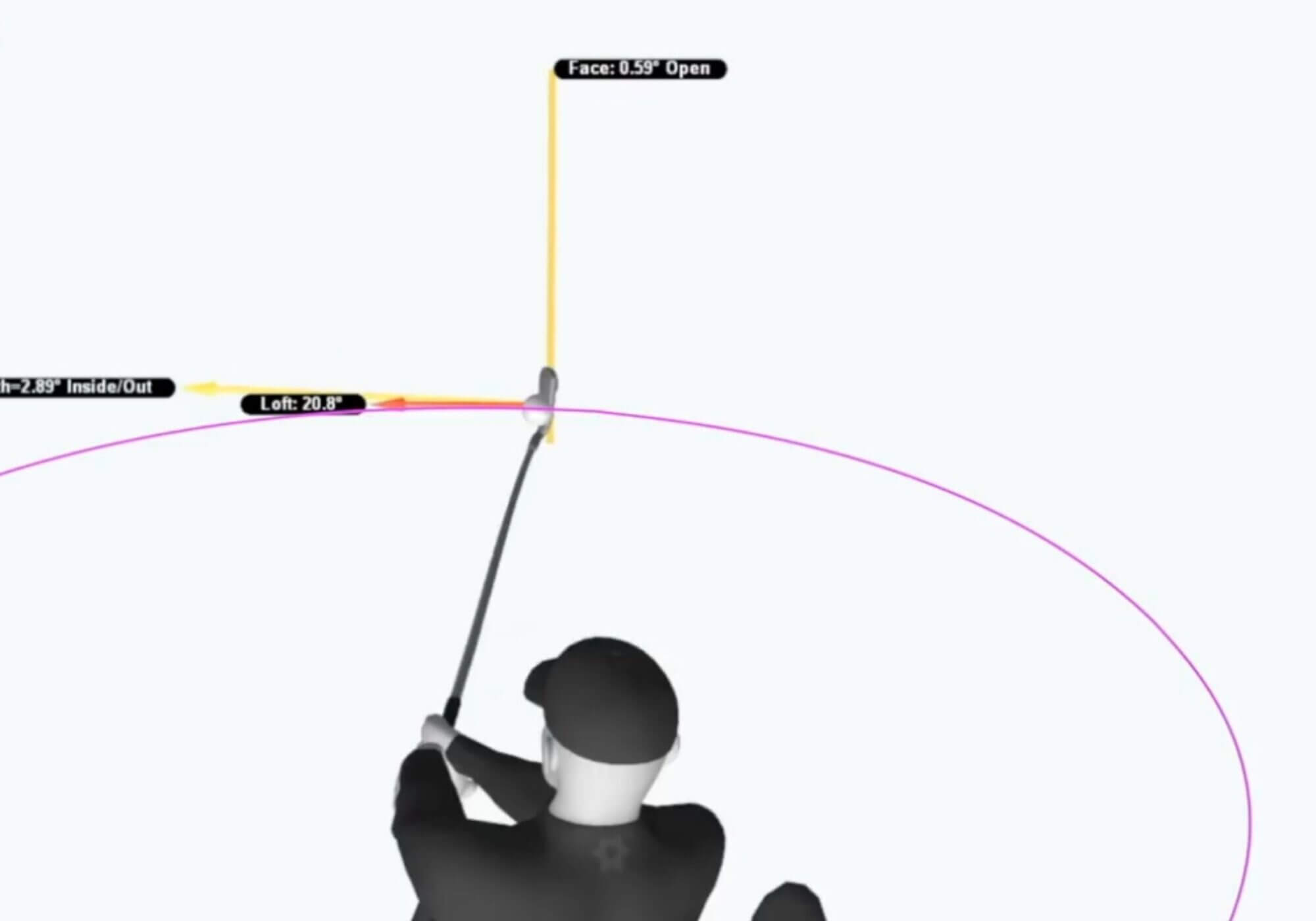
If you know you’re slicing because the clubface is open at impact, that’s a good start. A lot of golfers never even identify that part of the problem.
Where things usually go wrong is what happens next.
Instead of learning how the clubface is supposed to rotate through the swing, many golfers try to fix a slice by keeping the face square or holding it shut for as long as possible. It sounds logical. But trying to hold the clubface square is one of the most common ways to make a slice harder to fix.
The myth: Keep the clubface square to the path
This theory has been recited for years but Athletic Motion Golf has shown it does not reflect what good players do.
In one of their analyses, AMG looked at three of the most accurate ball strikers in the world and tracked the relationship between clubface angle and club path during the downswing.
What they found was consistent across all three players:
- None of them kept the clubface square to the path.
- The face was open to the path early in the downswing.
- The relationship between face and path was constantly changing.
- The face only became close to square very late, near impact.
Even elite players are not holding the clubface in a square position as they swing down.
Why this advice makes slices worse
When golfers hear “keep the clubface square,” they often respond by trying to lock it in place. Locking the clubface into a square position right from the start leads to:
- less rotation
- tension in the hands and arms
- a forced or delayed release
Instead of learning how the clubface rotates naturally, golfers end up fighting it. The slice often stays or it turns into blocks and weak fades with the occasional pull hook mixed in. You can’t try to stop rotating the clubface throughout the swing.
What happens in a functional swing
In a golf swing that’s working well, there is rotation in the clubface. This rotation is what makes it possible to have a square face at impact.
In the backswing
During the backswing, the clubface is not held square. It opens naturally as the club moves on an arc and the wrists hinge. This motion:
- creates width in the swing
- allows speed to build
- sets up a face that can return to impact without manipulation
Trying to prevent the face from opening early often restricts motion and creates timing problems later in the swing.
In the downswing
On the way down, the clubface does not stay fixed. It opens relative to the path and then closes relative to the path. It only lines up briefly near impact.
That closing happens because the body keeps rotating and the club is allowed to release. It does not happen because the golfer held the face in position. Squareness is a result of motion, not a position any great player tries to maintain throughout their swing.
Give it a try
If you’re trying to fix a slice, the goal is not to hold the clubface square or shut. The goal is to learn how the clubface rotates naturally through the swing.
A simple way to start working on this is with slow, half-speed swings where your only focus is:
- letting the clubface open naturally going back
- continuing to rotate through the swing
- avoiding any effort to hold or freeze the face
If the ball flight starts to curve less without you trying to manipulate the clubface, that’s a sign you’re moving in the right direction. Start with just waist-high to waist-high swings and learn how the clubface rotates. Then start adding length to the drill.
Final thought
Learning how the clubface rotates, instead of trying to stop it from rotating, can transform just understanding why you slice into fixing it.
The post Stop Trying To “Fix” Your Slice Like This appeared first on MyGolfSpy.
