With pitchers and catchers reporting to spring training across Arizona and Florida next week and all of Kiley McDaniel’s top 10 free agents now signed, there is light at the end of the offseason tunnel for baseball fans.
But before we say goodbye to the 2025-26 MLB offseason, it is a perfect time to make sense of the biggest themes of a wild winter and examine what they mean for the 2026 season — and the future of MLB.
How do the latest spending sprees by the Los Angeles Dodgers and New York Mets impact the mindset of baseball’s 28 other teams? What does an offseason of trade rumors mean for next summer’s trade deadline? And how should fans of contenders that went big — and others that decided to run it back with the same roster — feel about the season ahead?
We asked ESPN MLB insiders Buster Olney and Jeff Passan to break it all down.
The Dodgers’ spending created plenty of outcry (again). What does it mean for the future of MLB?
Olney: Financial disparity among teams has long existed, but the Dodgers’ payroll will serve to galvanize the effort of other owners to rebuild the sport’s financial system through some kind of proposed cap-and-floor design. As one former player said: “It’s like we’re back in 1994 — you’ve got some owners looking for the players to solve ownership issues.”
The players went on strike in August of 1994, of course, and that fall’s World Series was canceled. But it remains to be seen how far the owners will push to revamp the system, and whether the players’ coalition will hold together as strongly as it did three decades ago.
Passan: Let’s not forget the Mets, either. Their Opening Day payroll is upward of $50 million more than the Dodgers’. But Buster’s points stand regardless: The spending of the top two teams has reinforced to 28 others that change is necessary. They believe that change comes via a salary cap.
Regardless of whether the league can ever convince players to accept one, the vast majority of people in baseball — even among the Dodgers and Mets — acknowledge that significant changes need to come following the expiration of the collective bargaining agreement on Dec. 1. How significant will determine the length of a potential work stoppage and whether it affects the 2027 season.
Overall spending was healthy in the last winter of the current CBA. What does it mean for next offseason?
Olney: Just as there was before the last owners’ lockout, there will be a rush of signings of high-end free agents before Dec. 1, and the big-market teams will presumably lead the splurge. With a lot of unknowns about what the sport’s financial system will look like after the next collective bargaining agreement, there are agents and club executives who believe that the big spenders — the Dodgers, the Mets, the Yankees, the Phillies, the Jays, maybe others — will be hyperaggressive to make moves under the existing rules, knowing that those rules are going to change. In theory: They could look to take advantage of the current system while they still can.
Passan: That’s what the Dodgers and Mets have done already, right? They recognized cash was an unchecked advantage and levered it into bountiful rosters. I’m not sure the spending this winter is particularly indicative of anything going forward, though, because of the uncertainty.
And while I was with Buster on the deluge of signings leading up to Dec. 1, multiple executives and agents wonder whether the wide range of outcomes in a new basic agreement will mitigate that mad scramble to transact before the lockout. It’s probably the likeliest outcome, yes, but a slow November could be a canary in the coal mine for the months of inaction expected to follow.
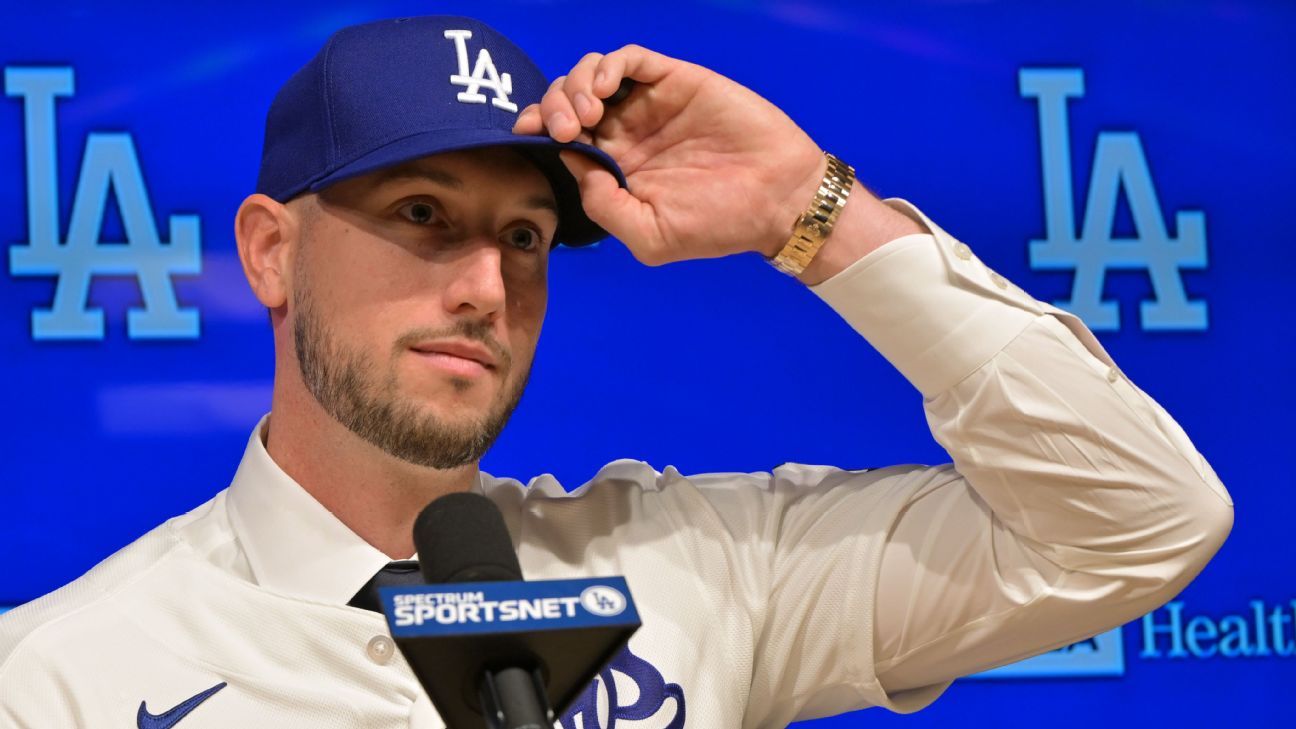
Kyle Tucker took the Dodgers’ high-AAV offer over a longer-term deal. What does it mean for the future of free agency?
Olney: Some agents and teams believe that yes, the model for the big-money deals is shifting, and that teams are more interested in paying more money annually over deals of shorter terms — which is what happened with Tucker, and Bo Bichette and Framber Valdez.
“I think there’s a feeling that those really long-term deals become stale for the teams,” said one league source, citing this winter’s flashpoint between the Phillies’ David Dombrowski and Bryce Harper. “A lot of teams can’t afford these kinds of deals, but for the teams that can, paying a player aggressively in the short term might be more attractive.”
Passan: Just because it needs to be said: Every team can afford that kind of deal. Maybe not multiple $300 million-plus deals. But if the Royals can sign Bobby Witt Jr. and Minnesota can sign Carlos Correa and Colorado can sign Nolan Arenado, anyone can sign anyone to a big-dollar deal spread out over time.
What I fear, actually, is that even though the shorter-term, higher-average-annual-value contract strips away the less-productive years at the end of a contract, the cash-flow crunch that realistically does affect some of the lower-revenue teams will discourage them from engaging in such deals. Between that and the signing bonuses that are a hallmark of such contracts, middle- and small-market teams are at a disadvantage when competing for the best free agents with Los Angeles and New York.
Tarik Skubal and Ketel Marte were in many trade rumors — but ultimately stayed put. What does it mean for the 2026 MLB trade deadline?
Olney: The midsummer fallback for a Skubal trade has always seemed unrealistic to me, especially with the Tigers inhabiting the favorable landscape of the AL Central. How in the world could Detroit trade the AL’s best pitcher if they are within four or five games of first place in a very winnable division? Tigers fans — and maybe players — would revolt.
In April, Marte will acquire 10-and-5 rights to veto any trade, but if Arizona falls out of contention — certainly a possibility in the highly competitive National League — the D-backs could revisit the question in midseason. By then, however, his trade value could be impacted by performance, the labor uncertainty, and his ability to block any deal.
The vast majority of the trade deadline moves figure to involve players who are impending free agents, because the trade offers of some teams for players signed into 2027 could be diminished because of concern over the CBA.
Passan: True, but it didn’t stop Seattle from giving up a hefty package for Brendan Donovan or Washington getting five prospects in return for MacKenzie Gore from Texas. At the end of the day, the smartest people — and, consequently, the smartest teams — know what they don’t know and don’t try to control things they can’t. And regardless of what their owners are telling them about the likelihood of a capped system, if front offices feel as if moves at the deadline will allow them to beat the Dodgers in 2026, they won’t hesitate to be aggressive. Great seasons are too valuable and rare not to chase.
As for Skubal and Marte: While Buster is spot on with the Tigers’ value proposition, teams that allow perceived fan pressure to dictate moves rarely end up better for it and Detroit knows that. Did the signing of Framber Valdez on Wednesday to a three-year, $115 million contract change that calculus, though? Perhaps the result of Skubal’s arbitration hearing, expected Thursday, will provide additional clarity. As with Arizona and Marte, at the end of the day, it’s a projection question: Is the gain from a trade minus the grief it brings worth more than what the player will produce plus the compensation he’d bring if he wasn’t traded and eventually left via free agency?
The Mets opted for a complete overhaul after their 2025 collapse. What does it mean for their 2026 chances?
Olney: Maybe more than any other high-dollar contender, the possible outcomes for the Mets cover a wide range. If Bo Bichette hits, if Luis Robert stays on the field, if Freddy Peralta makes 30-plus starts, if the corner infielders adapt to their new positions, if Nolan McLean continues to pitch as well as he did at the end of last year … If all of that goes well, this could be a really, really good team, and perhaps the greatest threat to the Dodgers’ championship reign.
But with all due respect to the late, great Mets announcer Bob Murphy, if the ’26 Mets turn into a Murphy’s Law team — where a lot of the decisions backfire — this would rival the ’93 Mets (known as the Worst Team Money Can Buy) in franchise history because of resources spent and fan expectations. This is why no one in the sport is operating under greater pressure in ’26 than David Stearns, the Mets’ head of baseball operations. He has to get it right; the Mets have to get it right.
Passan: Let’s put it this way: This, I believe, is far closer to how the Mets are likely to be run going forward than the buy-everything-you-can ethos of past Steve Cohen teams. And not because that hasn’t worked but rather because this winter reflected the Mets’ willingness and ability to be in the middle of every consequential free agency and trade possibility while still operating with the value mentality that brings balance. The hard truth is the old Mets weren’t good enough. Are these Mets? They might not be either, but they’re positioned in a way to offer flexibility and balance past Mets incarnations simply didn’t have.
The Yankees and Phillies decided to run it back with mostly the same team as a year ago. What does it mean for their World Series chances?
Olney: With both teams, so much depends on players returning from major injuries — in particular, the Yankees’ Gerrit Cole and Luis Gil, and the Phillies’ Zack Wheeler. It’s easy to forget that the Yankees tied the Blue Jays for the most wins in the AL last year, and the Phillies were the team that the Dodgers feared the most in the march through the NL playoffs. But generally, the rosters of these two teams are older and probably more susceptible to injury.
Passan: I get the fervor in New York and Philadelphia. When a team doesn’t reach the World Series, let alone win it, change is standard operating procedure. And yet Buster’s point about both teams being quite good is salient. Different is different. It isn’t always better. And what the Yankees and Phillies have right now remains quite good. Is it enough? Nobody knows.
But on top of Cole and Gil, the Yankees get a full season of Cam Schlittler, with Elmer Rodriguez and Carlos Lagrange on the doorstep. The Phillies are giving Justin Crawford every chance to win their center field job and Aidan Miller isn’t far behind. Ultimately, maybe these Yankees and Phillies are just like the Mets that were broken up: good, not good enough. But dismissing them at this point is presumptuous. Outside of the Dodgers, they’ve got as strong a chance of winning as anyone.
