Visiting Locker Room: Talking Washington Huskies with The IX Basketball
by
written by
3
For four games, No. 9 Ohio State women’s basketball navigated the absence of forward Kylee Kitts, who missed due to a shoulder injury. It required a four-guard starting lineup for head coach Kevin McGuff and an adjustment to how the team plays.
That is normal for the Washington Huskies, a team thriving with a group of four dynamic and different guards led by Sayvia Sellers and Avery Howell. To learn more about them and head coach Tina Langley’s side, Land-Grant Holy Land reached out to Bella Munson who covers the Huskies with The IX Basketball and the Circling Seattle Sports Husky Women’s Hoop Show.
Advertisement
Munson is up next in the Visiting Locker Room:
Land-Grant Holy Land: Last season, Avery Howell had moments of greatness for the USC Trojans, but seemed to have trouble getting into the regular lineup for head coach Lindsay Gottlieb. How has her game elevated the Huskies?
The IX Basketball: I made the mistake when Avery Howell first transferred, because of her limited playing time at USC, of thinking she was just a spot-up 3-point shooter. While she is fantastic at that, she has contributed significantly more, especially as she has become increasingly comfortable.
Howell has been absolutely critical to the Huskies’ success this season. Averaging 13.3 points, 8.1 rebounds, 1.4 assists and 1.5 steals per game, she is contributing everywhere, but the rebounds are particularly crucial. Washington generally plays with one center and four guards — they are more likely to play five guards than two post players at once — so they are often undersized. As a 6’0 guard, Howell is leading the team in rebounding. Not just that, her defensive rebounds per 40 mins (8.2) and defensive rebound percentage (22.3%) both rank in the 99th percentile nationally according to CBB Analytics. You don’t need to look much further than the losses to Michigan State and Illinois, where they were outrebounded 40-20 and 33-24, respectively (specifically, 15-4 in offensive boards against Illinois), to see that rebounding can be Washington’s downfall.
Her scoring contribution has also been significant as the team’s second-leading scorer behind Sellers. One of the biggest offseason questions for the Huskies was always how and who would replace the 12.8 points per game that Dalayah Daniels contributed. The answer so far has been Howell. Her scoring contributions have also been particularly important while last year’s team-leading scorer, Elle Ladine, has not yet returned to the level she played at last season after missing the start of the season to injury. Howell has also been remarkably efficient in her scoring, shooting 58.4% inside the arc and 41.7% outside the arc — her true shooting percentage of 64.5% ranks in the 99th percentile nationally. Howell’s turnover percentage is also top-notch.
Aside from the statistical contributions, head coach Tina Langley has also talked about how Howell quickly stepped into a leadership role, as a sophomore(!), and how much that has benefited the team. There is also an indescribable grittiness to how Howell plays on both ends of the floor, whether it’s playing defense, forcing jump balls, getting rebounds, or getting herself to the basket through contact; there is this extra level of toughness. It is the kind of intangible quality that can’t be taught but makes all the difference in both her own effectiveness and the team’s success.
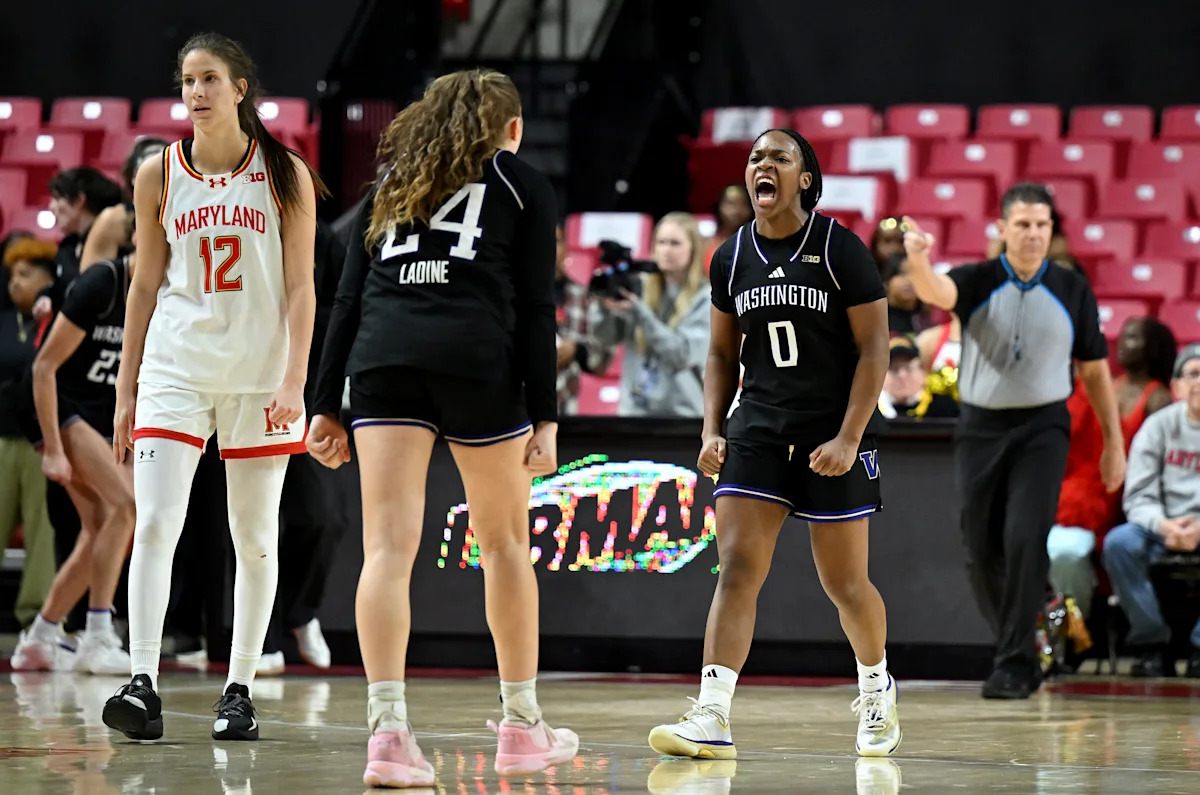
LGHL: Look through the Washington schedule and there are some odd results. They beat the Michigan Wolverines at home, then lose to Purdue and follow that up two weeks later with an upset win over the Maryland Terrapins in College Park. Is that a product of the hectic travel for West Coast sides or part of the growing pains for Washington?
IX: I would say a combination of both. The team has admitted that since joining the conference, the travel is tough, but they would never blame it for a result. Langley even praised her team for their double-overtime win in Maryland after they had to conduct a practice in a hotel ballroom and Uber to shootaround, so they are capable of winning in tough situations. But this is the best women’s basketball team that the University of Washington has had since Kelsey Plum starred and led the team to the Final Four.
They just squeaked into the NCAA Tournament last season for the first time since 2017. So this is not a team that is the most experienced in being ranked, winning big games, or earning huge upsets — they’ve had a few for sure, but this is the best they’ve been for a whole season. So I think they are still trying to find that consistency that is often gained through experience. The talent is there, but how to consistently put it all together has been lacking at times. So I’d overall blame growing pains more.
LGHL: The Huskies are 1-3 against power conference schools when they give up the ball at least 15 times and Ohio State is built on trying to speed teams up. How does Washington handle teams with pace?
IX: I actually think Washington handles teams with pace fine because they have plenty of it themselves; they want to play fast. As I mentioned above, they are guard-heavy. Washington is also similar to Ohio State in this way; they want to turn their opponent over and get quick, easy buckets running in transition. It becomes an issue when they can’t get turnovers or stops themselves to even it out. Implementing full-court press and forcing Washington into its own half-court offense, which I expect Ohio State to use its pace to do, however, has definitely slowed the Huskies at times this season.
In terms of turnovers, Langley felt her team was phenomenal in their last two road games, Maryland and Rutgers, not turning the ball over, even though Maryland pressed a good amount. She said they had worked really hard on their turnovers, and it was a big reason they won on the road. Against Illinois, they had 16 turnovers, yes, but from the eye test, they were uncharacteristic mistakes. Langley attributed the lack of ball security to having her team operate outside of their traditional offensive flow and running new things. She said postgame that she’d look back at that and probably be upset with herself at some of those calls because it put the ball in someone’s hand who’s not used to being in that position.
Illinois also defended very aggressively well outside the three-point line which Washington hasn’t seen as much this year, despite their three-point prowess. My point being, Washington can handle pace and have good ball security, but it might depend on what the coach is running and how locked in they are. The team was visibly disappointed and frustrated with Sunday’s loss to Illinois, so I do expect them to come out determined,
LGHL: Sayvia Sellers gets better each year. What does she bring to the team and the program?
IX: I could talk about Sayvia Sellers for days. It is impossible to overstate her value to the team and the program. It was clear from her freshman season when I wrote about her being one of the top freshmen in the PAC-12 that she is a special player, and as you said, she’s gotten even better each year. This year, I got to write a more focused feature on her where I talk a lot about this in depth, but one of the biggest changes this year, in particular, I believe, is how she’s stepped into a leadership role.
She is one of the quieter players on the team, but she is so knowledgeable about the game and generous with sharing that knowledge, while being one of the kindest people you’ll meet, that her teammates trust her to lead them through anything. On the court, her efficiency has improved every year to the point where she is averaging a team-high 19.1 points per game, shooting 58.7% from 2-point range and 37.7% behind the arc. She is also dishing out a team-high 3.6 assists per game. Where Sayvia Sellers goes, the Huskies go.
There have been some games where Washington got even scoring contributions across the board, and Sellers hasn’t had to carry quite as much of the scoring load, but more often than not it is the Sayvia Sellers show with just enough additional scoring from a couple teammates — see, her career-high 38 points in the double-overtime win at Maryland. There are many times in basically every game where the offense is struggling and stagnant, but Sellers is just able to make things happen all by herself. Her 3-point shooting spaces the floor, her ball-handling gets others involved, and her aggressive drives to the basket collapse defenses and draw foul calls, if she’s not finishing off the layups herself.
She may often be the smallest player on the floor, but she is so crafty about using that to her advantage. Sellers also just has an incredibly bright personality, and her play is fun to watch; you only have to see her play once to get the hype and want to see more.