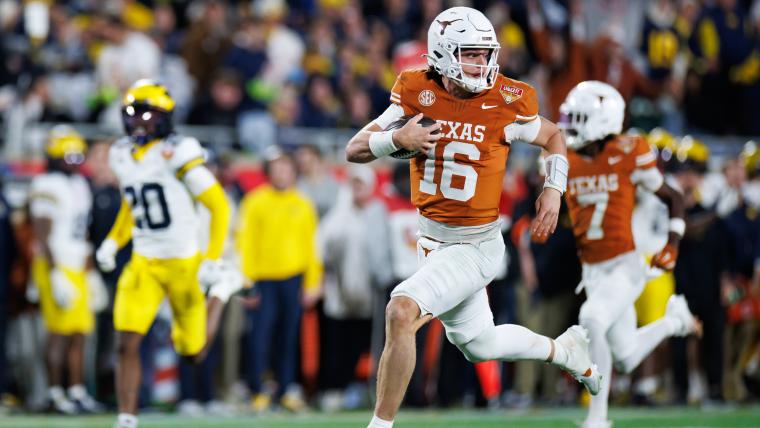
Top 20 most valuable college football programs revealed with two shockers originally appeared on The Sporting News. Add The Sporting News as a Preferred Source by clicking here.
College football has become big business, and they now can add a new “B” word when it comes to the business side of the sport. That word is “Billions”.
Advertisement
According to Yahoo Sports, a valuation report from the Wall Street Journal, 20 programs in 2026 stand above the rest from a ‘value’ standpoint. The teams at the top should come as no surprise, however, five of the last six will be. For varying reasons.
Based on the Wall Street Journal’s findings, the top 20 programs have seen a year-over-year increase of 46% as a collective group. A bulk of which can be attributed to the significant playoff ratings and the introduction of revenue sharing.
The top 20 value list will not simulate a AP top 25 or any other win-loss based list. While all of these teams will not be a murderers row of national title contenders, all of them have shown an ability to garner attention, sell tickets and merchandise.
This ranking is more indicative of financial success and fan involvement than predicting on-field expectations.
Advertisement
The Billions Club – All programs valued over $1B
-
Texas Longhorns – $2.197 Billion
-
Texas A&M Aggies – $1.593 Billion
-
Ohio State Buckeyes – $1.547 Billion
-
LSU Tigers – $1.543 Billion
-
Georgia Bulldogs – $1.472 Billion
-
Michigan Wolverines – $1.462 Billion
-
Notre Dame Fighting Irish – $1.418 Billion
-
Penn State Nittany Lions – $1.411 Billion
-
Alabama Crimson Tide – $1.407 Billion
-
Nebraska Cornhuskers – $1.236 Billion
-
Oklahoma Sooners – $1.153 Billion
-
Washington Huskies – $1.147 Billion
-
Tennessee Volunteers – $1.114 Billion
-
Auburn Tigers – $1.101 Billion
-
Iowa Hawkeyes – $1.017 Billion
The Sub Billions Club – Flirting with a Billion, but not there yet
-
USC Trojans – $999 Million
-
Florida Gators – $978 Million
-
Wisconsin Badgers – $963 Million
-
Oregon Ducks – $873 Million
-
Colorado Buffaloes – $870
Those programs who have crossed over the billion-dollar threshold should not be shocking. Texas and Texas A&M should not require much context. Ohio State and Michigan in the top 10 make sense due to size and history. Notre Dame, Penn State, Alabama and Georgia make sense for the same reasons. LSU feels like recency bias over the last couple decades, but their placement still makes sense.
Oklahoma, Tennessee and Aubun also tracks considering their place in history with dedicated fanbases. Nebraska would make sense based on history of the program, but also from a facilities and donor base standpoint.
Advertisement
Iowa and Washington might seem like a stretch. However, consider the competition for fan dollars in those regions. Washington competes with the Seahawhs, but Huskies fans and donors are consistent.
Iowa simply doesn’t compete with any local sports teams. Iowa is nestled in the middle of Packers, Bears, Chiefs and Vikings territory, but isn’t completely competing with any of them.
The truly baffling realization is that Oregon and Colorado are separated by only $3M. The Oregon Ducks have been a top 15 program for most of the last 15 years. Colorado, on the other hand, has only finished in the top 25 twice in the last 20 years. One of those was the 2016 season under Coach MacIntyre going 10-4. The second being Deion Sanders’ 2024 season that included Heisman trophy winner Travis Hunter, Shedeur Sanders and a 9-4 record.
Oregon and Colorado are two programs that get to similar ranks very differently. Oregon is essentially the program that Nike built. A program that made uniform changes popular and has forced their way into the national conversation. Colorado is completely recent. The arrival of Deion Sanders brought what felt like immeasurable attention and sales. That attention has settled after finishing 2025 with a 5-7 record.
Advertisement
Oregon continues to trend in the right direction on the field, while Colorado aims to reinvent Prime’s wheel, so to speak. Colorado is currently on its third roster overhaul and will attempt to erase an objectively bad 2025.
