EAGAN, Minn. — The Minnesota Vikings reset their organization after the firing of general manager Kwesi Adofo-Mensah last Friday. The Vikings are creating new pathways for communication, establishing workflow and setting the table for an offseason full of important — and, in some cases, far-reaching — decisions.
In three months, they’ll do it again when owners Zygi and Mark Wilf hire Adofo-Mensah’s replacement.
This temporary fix is far outside NFL convention and raises the likelihood that the Vikings’ next general manager will inherit a quarterback depth chart and a draft class that they have no connection to. Unless the Wilfs plan to promote Rob Brzezinski, their longtime executive vice president of football operations who is leading the front office through the NFL draft, the Vikings are now destined to head into next season wearing a figurative Band-Aid.
Mark Wilf said last week that the “kind of organization and the kind of building we have here” will make the job “highly desirable.” That remains to be seen after the public exposure of an unusual set of dynamics as Adofo-Mensah’s tenure ended.
In the meantime, let’s take a closer look at some of the key questions the franchise is facing during this unsettled moment.
Who is really in charge?
Amid league-wide assumptions that coach Kevin O’Connell is now the most prominent voice in the building, it’s important to understand the expanse of Brzezinski’s experience and career.
Although he most recently has focused on contract negotiations and salary cap management, Brzezinski was the Vikings’ top football executive for three seasons from 2003 to 2005, as former owner Red McCombs worked to sell the franchise. In that role, Brzezinski modernized the front office’s process, administered football decisions and managed much of the staff while working alongside coach Mike Tice and director of college scouting Scott Studwell.
The Wilfs purchased the team in 2005, and from 2006 to 2011, Brzezinski was part of a three-person leadership group that ran the team. Ultimately, the Wilfs promoted personnel chief Rick Spielman to general manager in 2012 — a decision Brzezinski fully supported.
In other words, Brzezinski has too much stature in the organization to be a simple conduit for the impulses of O’Connell, defensive coordinator Brian Flores or any other member of the organization. The better way to think of him over the next few months is as a gatekeeper who decides which ideas are implemented, and how.
Is Brzezinski a true candidate for the permanent job?
That will depend in part on what Brzezinski wants. During nearly 27 years with the franchise, he has turned away interest from multiple teams that wanted to interview him for expanded roles. He was part of the search committee that hired Adofo-Mensah after the Wilfs fired Spielman in 2022, but Brzezinski is not believed to have been a candidate at the time.
Mark Wilf would not rule out Brzezinski as a possibility during this hiring cycle but said: “It’s going to be an open process. We’re not going to shut any doors at this point.”
Who else could be a candidate?
It’s striking how many league sources think that the Wilfs will pursue Denver Broncos general manager George Paton, who is under contract through the 2026 season, to change teams. Paton is a close friend and confidant of Spielman, and worked as his top assistant not only with the Vikings from 2007 to 2020 but also with the Miami Dolphins for five years and the Chicago Bears for three.
That’s a total of 22 seasons at Spielman’s side. As a longtime football executive, Paton wouldn’t just embody the opposite of Adofo-Mensah. He would represent the closest way the Vikings could return to their previous regime, short of rehiring Spielman, who now works as the New York Jets‘ senior football advisor.
General manager jobs are subject to the NFL’s Rooney Rule, which means the Vikings must interview at least two external minority candidates for the job. But the first order of business, after determining Brzezinski’s interest, will be to find out whether the Broncos would make Paton available and, if so, if the Vikings would need to compensate them first.
Otherwise, the Vikings will work through a process that has little precedent in recent NFL history. Of the NFL’s 32 general managers/personnel directors, only one was hired as an external candidate after the draft. In 2017, the Buffalo Bills hired Brandon Beane — who had been a Carolina Panthers executive — after firing incumbent Doug Whaley.
What does all of this mean for O’Connell?
It would be wrong to put O’Connell on the so-called “hot seat.” The Vikings are tied for the NFL’s fifth-best regular-season winning percentage (.632) since his arrival in 2022, and he is under contract for another four seasons.
For O’Connell, though, Adofo-Mensah’s departure is best viewed as equal parts liberating and cautionary. To the extent that Adofo-Mensah’s performance was below standard, O’Connell would benefit from better team-building decisions. But it also removes a mitigating factor in the Vikings’ failure to win a playoff game during O’Connell’s tenure. This transition fairly shifts that responsibility to O’Connell’s shoulders moving forward.
In the short term, Brzezinski will give O’Connell the steady and experienced partner he probably needed as a young coach. One way or another, that is likely to be the profile of the Wilfs’ permanent hire. The rest will be up to O’Connell.
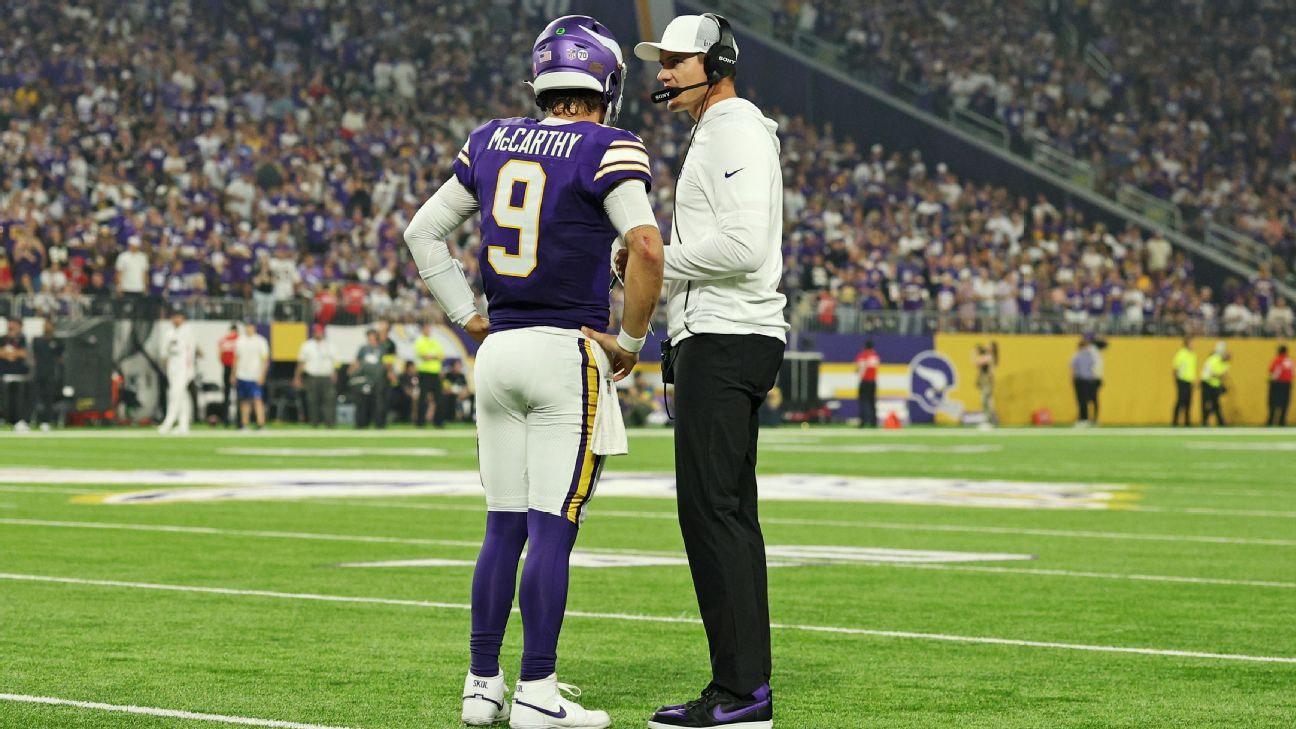
Does this change the Vikings’ plans for QB J.J. McCarthy?
The best way to put this, based on what sources have said, is that all bets are off. The general manager who drafted McCarthy No. 10 in 2024 has been fired, and the coach who was in full agreement with that decision is now under considerably more scrutiny.
In the big picture, McCarthy is a talented player who just turned 23 and has a total of 10 NFL starts. Few NFL teams would give up on a quarterback with that profile, and many team builders are particularly enamored with optimizing a quarterback’s rookie contract. Adofo-Mensah was one of them, but his departure is a reminder of the range of outcomes that approach can lead to.
If anything, these events increase the chances that the Vikings will take a big swing at finding a veteran quarterback who could start in 2026. The only thing more damaging than making the mistakes the Vikings made last season would be to repeat them this year.
Will all offseason decisions be focused on immediate impact?
It’s fair to wonder about the long-term incentives, or lack thereof, for any temporary leadership structure. At this point, the Vikings’ only enduring plan — as it pertains to player acquisition or anything else — is to return to the playoffs in 2026.
But that likely would have been at least part of Adofo-Mensah’s approach as well. The Vikings were the NFL’s third-oldest team in 2025, based on snap-weighted age, and entered the offseason roughly $40 million over the salary cap.
In addition to the looming retirements of safety Harrison Smith and fullback C.J. Ham, the Vikings will have to consider the futures of several other veterans, from running back Aaron Jones Sr. to defensive tackles Jonathan Allen and Javon Hargrave to center Ryan Kelly. Given their relative lack of depth, they’re going to need to find economic but immediate replacements in either free agency or the draft.
