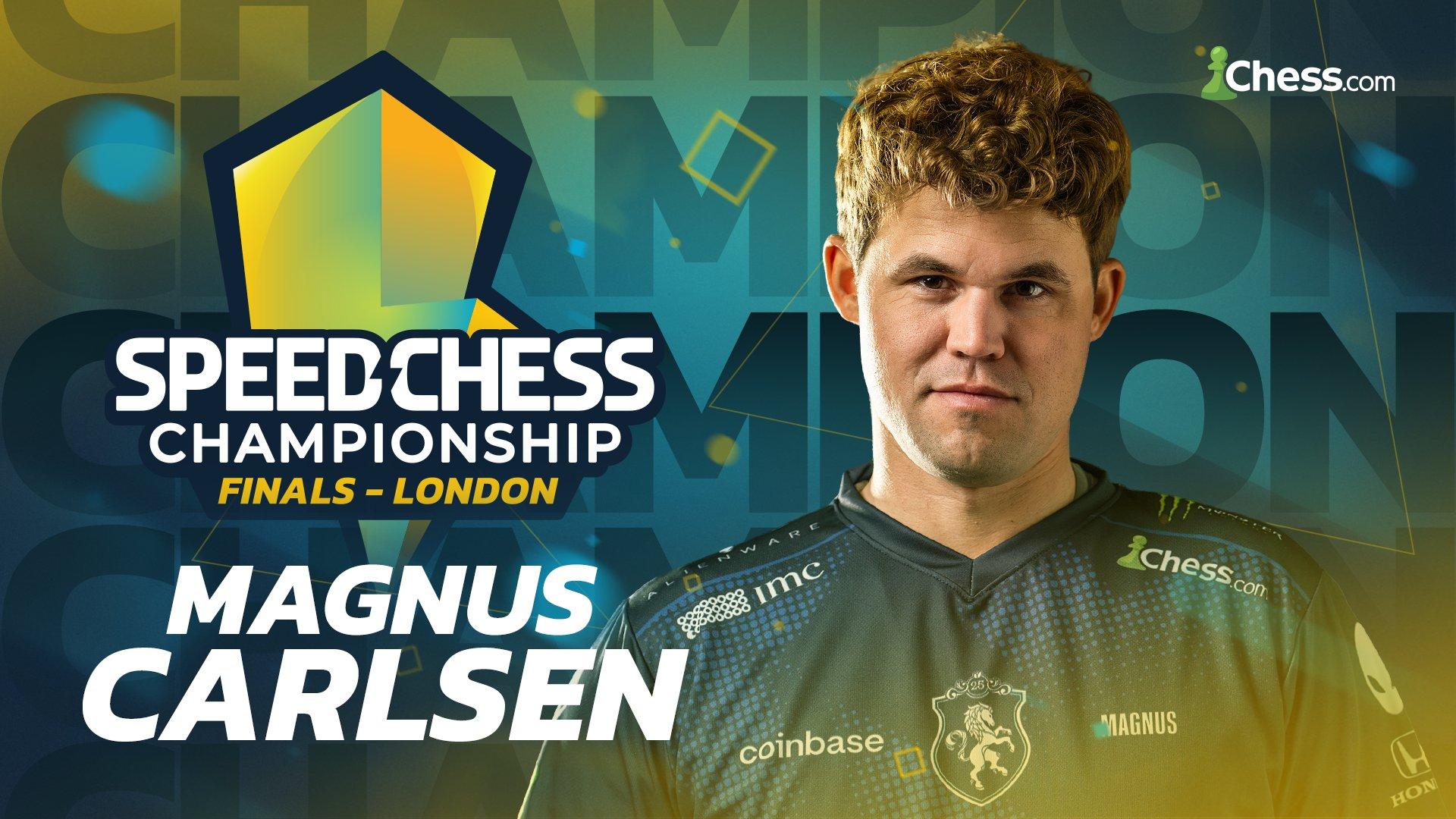
GM Magnus Carlsen succeeded in defending his fifth title at the 2025 Speed Chess Championship by defeating GM Alireza Firouzja 15-12 in the Final. It’s his third title in consecutive years and Carlsen earned $38,888.89 for his efforts, while Firouzja took home $11,111.11 by win percentage.
GM Denis Lazavik won a major upset against GM Hikaru Nakamura 13.5-12.5 in the match for third place to win $11,394.23, with $3,605.77 going to Nakamura by win percentage. The top three players—Carlsen, Firouzja, and Lazavik—qualify for the 2026 Esports World Cup that will take place this summer.
2025 Speed Chess Championship Bracket
Carlsen 15-12 Firouzja
Chess.com predicted Carlsen to be a 72% favorite in the match, but it was certainly a closer encounter than last year’s Final between the same two players. In Paris, Carlsen beat Firouzja 23.5-7.5.

Only two players have won the SCC since 2016, Carlsen and Nakamura, and Firouzja will have to wait till next year for another shot at breaking the trend. The broadcast, featuring two matches, lasted just under 10 hours.

5+1: Carlsen 5.5-3.5 Firouzja
Carlsen pointed out that, like last year, Firouzja was able to take a one-point lead in the first portion—but not after that. Once Carlsen gained the two-point lead in this portion, he never let go.

The players traded wins in the first two games, with Carlsen taking game one. Firouzja handled a Catalan endgame just about flawlessly for 43 moves, but a first mistake on move 44 was all it took to lose the game.
In the next, however, the French GM suddenly won on time (with a pawn up and winning position anyway). And after a draw, we saw the pattern repeat: Carlsen won a game, and Firouzja won right back. This time, the French number-one was just as ruthless with his technique.
Alireza strikes again and evens the score 2.5-2.5 just before the halfway break of the 5+1 segment!
“The killer instinct he showed, phenomenal,” says David Howell!https://t.co/2T3hNkaOVw#SpeedChess pic.twitter.com/gfCwlUzPqO
— chess24 (@chess24com) February 8, 2026
Firouzja won another game to take the lead for the first and only time in the match, but the world number-one won the next three in a row to take a two-point lead. The first of those games featured a wicked time scramble, with Firouzja finding incredible dynamic chances from a worse position. Even Carlsen couldn’t believe it when his opponent lost on time.
The Norwegian grandmaster won two more games, with the last one being extremely one-sided, to finish with an emphatic lead. 20…Ne4? was a decisive mistake that allowed Carlsen to take the center, and then decisively pressure the c-file.
Carlsen told John Sargent during the break, “It’s generally very hard to control matches against him because he raises the complexity level and, honestly, I’m just having a lot of fun! It’s a great match so far.”

3+1: Carlsen 4.5-4.5 Firouzja
Curiously, in all previous SCC Finals, the player to win the 5+1 portion always won the match, and this year was no different. Though Firouzja matched Carlsen’s score in the 3+1 portion, it meant he was still down by two points.
After starting with two draws, Firouzja was the first to win a game in this segment. As IM Levy Rozman pointed out, the game incredibly featured three exchange sacrifices, two by Carlsen out of desperation and one by Firouzja to convert the advantage.
Carlsen not only converted well, but he also saved some dire situations. The next game is a key example, where the champion managed to hold a bishop-down position.
Carlsen won a positional masterpiece the next game, first outplaying his opponent on the kingside and then transferring that advantage to the left side of the board as well. “That could have easily belonged in Nimzovich’s My System,” GM David Howell praised.
That could have easily belonged in Nimzovich’s My System.
—David Howell
Two draws followed, though Carlsen saved another lost position in the second. It was a terrible sign for Firouzja that Carlsen won the next game, after trading down into an equal king and pawn endgame.
That’s our Game of the Day, and it’s a bit reminiscent of Carlsen’s other Game of the Day against GM Nodirbek Abdusattorov in the 2025 FIDE World Blitz Chess Championship Final, where he won an equal knight endgame. Just as he did in December, Carlsen performed a bit for the crowd in this game. When he knew for sure he was going to win, he gave everybody a sign, and he chewed through the black position just as aggressively as he chewed that piece of gum. You can see a clip below.
“Magnus, signaling for the crowd to applaud him 20 moves before the conclusion of the game because he’s counted it out!” (GothamChess)https://t.co/L5oI49E8YY#SpeedChess pic.twitter.com/wB2GDIOACl
— chess24 (@chess24com) February 8, 2026
GM Rafael Leitao goes over the full game.

… and then Carlsen blundered a clean pawn and lost the last game of the segment, which he called a big “gift” to his opponent. He later said, “To say that I was in control would be a massive overstatement, but I always felt that I gave him a couple of games for free.” Still he had a two-point cushion in the final stretch.
Magnus blunders and his face says it all in the last game of 3+1 😱.https://t.co/R0vaZLj7ng#SpeedChess pic.twitter.com/Xg0SYS18u0
— chess24 (@chess24com) February 8, 2026
1+1: Carlsen 5-4 Firouzja
Firouzja wasn’t able to pull the same miracle he did in the previous match against Nakamura.
It started with what Rozman called a “disaster of a first game” for Firouzja, and after a draw, Black won nearly every game that remained.

There was a glimmer of hope for Firouzja in the following game when Carlsen lost a howler. It was a rook and two pawns vs. rook and one pawn—and Carlsen was the side with the extra pawn!
Magnus with two pawns against one, goes on to lose! Alireza is still two points down!https://t.co/s2KSQDXxmY#SpeedChess pic.twitter.com/4jmTVM64pK
— chess24 (@chess24com) February 8, 2026
Firouzja effectively muddied the waters from a bad position in the next game. Had he won that one, he would have been just one point down with about 16 minutes on the match clock. But just as it started to look possible, he hung an entire bishop—and the match was effectively over.
From there, Carlsen won two of the next four games, lost one, and drew the last to finish with a three-point lead. In all, his lead was never realistically at risk.
Firouzja said that his main goal was to qualify for the Esports World Cup and that “today whatever would’ve happened was a bonus.” He also mentioned that his previous marathon match against Nakamura drained him, and he ran out of energy at one point, “I managed to put up a fight, but I completely lost my energy after the 5+1.”
The runner-up left with a positive comment for the fans and the experience: “It was a great experience here with all the fans.”

Carlsen said it was “probably the most fun Speed Chess Championship match I’ve been a part of,” a sentiment that he echoed in a number of the interviews he gave during breaks. He added, “I was thinking halfway [through] this is so much fun, even if I were to lose I could sort of live with it.”
… probably the most fun Speed Chess Championship match I’ve been a part of.
—Magnus Carlsen
Speaking of the match dynamics, he said, “It felt as though I just outlasted him in the end, and as Alireza said, he was kind of not quite there at certain moments, which really made up for the fact that I was giving him a few chances.”
He already said on the previous day that he felt the crowd cheered more for his opponent than for him. So he shared a piece of advice:
Magnus: “I would like to give a little message to the crowd here… you’re allowed to root for the favorite sometimes!”#SpeedChess pic.twitter.com/0SbIsY72qu
— chess24 (@chess24com) February 8, 2026
This year’s Speed Chess Championship introduces the Daniel Naroditsky Cup. Naroditsky loved this event, and his name will live on in all of its future editions. All champions will have their names etched onto the cup, retroactively and in the future.

Nakamura 12.5-13.5 Lazavik: 19-Year-Old Pulls Off The Upset
Chess.com set Nakamura as the 81% favorite in the match, with a predicted score of 14-10. It’s the second time in SCC history that the six-time champion finished outside of the top-two, and Lazavik won by just one point.

5+1: Nakamura 4.5-3.5 Lazavik
There was just one draw in the eight games of this segment, and Nakamura ended with a one-point lead.
Every game of the first half was decisive, with Nakamura winning three games and losing one. Game one was, on a technical level, the best of the first segment. Check out how Nakamura won the following position, which started with four vs. four pawns on the same side of the board:
Lazavik struck back at once and landed a checkmate on the board in game two, but Nakamura again took the lead in game three with a checkmating combination (starting with 50.Rg8+!) that prompted GM Aman Hambleton to exclaim, “Straight out of a Puzzle Rush tactic right there, that’s routine, that’s basic stuff for Hikaru!”
Straight out of a Puzzle Rush tactic right there, that’s routine, that’s basic stuff for Hikaru!
—Aman Hambleton
Nakamura outplayed his opponent in a time scramble in game four to reach the halftime break with a two-point lead.
Lazavik told Sargent by this point, “I will try to improve something. I don’t know what I need to improve, but I will try!” With a stronger second half of the segment, the Belarusian came back and outplayed the American on the black side of an Italian Opening.
I will try to improve something. I don’t know what I need to improve, but I will try!
—Denis Lazavik

Defending a pawn-down position with about four seconds, Nakamura lost on time and claimed technical issues with making the move. After a lengthy pause for investigation—”It was the exact same issue as last night, unfortunately,” Nakamura told Sargent—they resumed the game from the same position and Lazavik went on to win, despite the position being closer to equal than anything else.
In the next game, Lazavik correctly sacrificed a pawn but didn’t follow it up energetically enough—and Nakamura converted the extra pawn advantage. But Lazavik had the stronger finish, holding a critical draw in the penultimate game and then winning the last, cutting Nakamura’s lead down to one point.

3+1: Nakamura 3-6 Lazavik
Lazavik essentially won the match in this portion. He later said, “When we started, he got some lead and I was a bit upset about it, but when I won, it increased my mood and I felt that, okay, now I’m playing better and probably even good, so everything can happen.”
I felt that, okay, now I’m playing better and probably even good, so everything can happen.
—Denis Lazavik

Lazavik won the first two games to take the lead for the first time. Both were nice technical wins, featuring a queen and knight endgame in the first and a heavy-piece endgame in the second. The latter was smooth and one-sided, and perhaps a sign of overambition from Nakamura as 20…Ra6? ceded total control of the b-file. Lazavik made the rest look deceptively easy.
After suffering those three losses in a row, Nakamura won thanks to a simple blunder. The commentators described the following two-move tactic as the biggest gift in the event so far.
After a draw, Lazavik regained the lead with an exchange sacrifice that only led to equality, but one that caused Nakamura to lose on time.
After three fighting draws, Lazavik finished the segment with another win with the black pieces. This one featured his best attack of the match.
Lazavik held a two-point lead going into the final segment, Nakamura’s strongest.
1+1: Nakamura 5-4 Lazavik
Nakamura won the segment, but he stopped short by just one game of evening the score in the time allotted. There were just three decisive games out of nine.
In fact, it was Lazavik who took the first win of the segment in game three, augmenting his lead to three points.
Denis Lazavik takes the first win in the bullet segment, and leads the match by three points!https://t.co/1xA6lX5ale#SpeedChess pic.twitter.com/qbekNpHGF3
— chess24 (@chess24com) February 8, 2026
But in the next five games Nakamura strung together two wins, bringing the deficit down to just one. The second featured a pretty bishop “sacrifice,” though if the piece is taken White immediately regains the piece on e6.

Nakamura came close, and he was winning on demand in the final game. In the final seconds, however, he allowed a perpetual check, and with that Lazavik won the match.
Due to a misunderstanding of the tournament rules, Hikaru starts walking away from his game even though he could have pressed on!
Denis wins the match!https://t.co/4NUFHTo8PR#SpeedChess pic.twitter.com/pyEh7SAqRk
— chess24 (@chess24com) February 8, 2026
Lazavik said in the post-match interview, “Of course I didn’t expect it, but before the match I thought that it will be a bit easier than against Magnus, but anyway, he’s a very strong opponent so I’m very happy to win.”

That’s it for our coverage of the 2025 Speed Chess Championship. Congratulations to the players and thank you to the staff and the fans for making it happen!
The Speed Chess Championship, which starts on October 12 and culminates with Live Finals on February 7-8, 2026 in London, is Chess.com’s most important speed chess event. Some of the biggest names in chess compete to determine the best speed chess player in the world. The games are played with time controls of 5+1, 3+1, and 1+1. The prize fund is $250,000.
Previous Reports:
