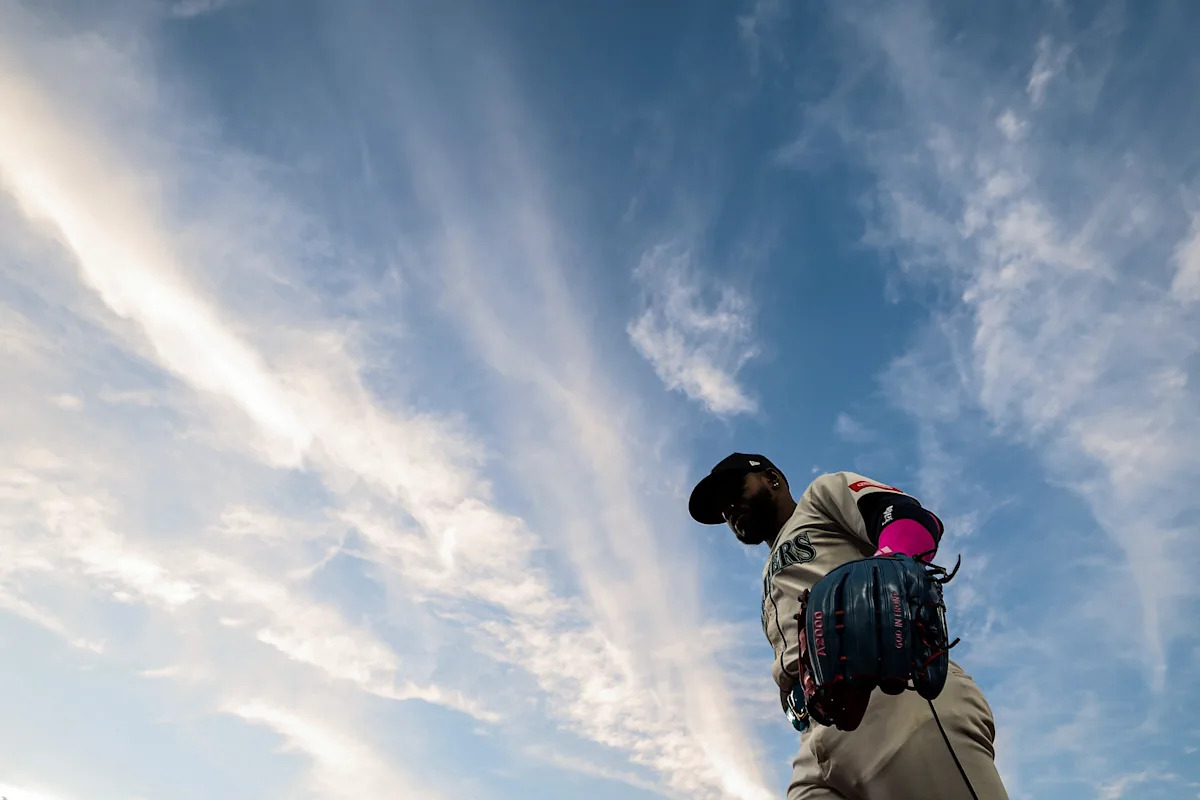
Grief is frightening territory to navigate. There’s no set roadmap for it, and it affects every person differently. It is as if a chaotic roommate moves into your body and assumes the controls part of the time: you make choices you don’t recognize; say things and wonder whose mouth made those words; sleep entirely too much or entirely too little or a fun soft-serve swirl of both. The more you try to pack down the grief into a solvable snowball, something solid and sensible, the more it evaporates around your hands.
After my dad passed away in February of 2024, I thought I had a master plan mapped out for grieving him. I knew, because I had read about it, that grief is the tidal wave of loss that hits you first, and I braced for impact. I also knew, thanks to my studies, that after grief comes grieving: if grief is the big wave, grieving is the lap of waves on the shore in the world where you live now. He died; I fought the wave of grief crashing over me long enough to do all the insulting busywork that death requires. Two weeks later, I finally brought myself to enter his room and clean up the blood on the bathroom floor from where he’d fallen the last time, when we didn’t know yet about the cancer that was swiftly eating into his pancreas, so my mom wouldn’t have to. That felt significant: a tidy metaphor for moving on from grief to grieving. Two weeks after that I packed my stuff and left for spring training, and then the season started, and I fell back into the same comfortable patterns, the sharp edges of the pain worn away by the daily routine of baseball. I was proud of myself; like a player whose rehab is ahead of schedule, I was beating all the projected timelines. I knew about the ball-in-the-box grief analogy and thought with satisfaction about my ball of grief, steadily shrinking down from a beach ball to a baseball.
Advertisement
But grief came to collect the next off-season. It turned out I wasn’t paying out my grief on an installment plan like I’d thought; I was allowing the debt to collect, and the force of it knocked me over anew. I didn’t want to write about this team and their lousy, uninspiring off-season; I didn’t want to write, period, and had to be cajoled by the staff into doing the 40 in 40 series, almost letting it go too late. I didn’t want to read, especially not the collection of self-help books I had carefully amassed as a ladder to lead me out of the hole of grief and back into civilization.
All I wanted to do was sleep. And I did, losing wintery days like a character from a fairytale under a spell, waking in dark rooms from strange dreams. On the odd times I did leave the house, I swiped at people who got too close to my enclosure, mistaking their concern as threats. I think back on that time now and I don’t recognize that person who was wearing my clothes, my name.
What I did recognize: Victor Robles throwing his bat in frustration after getting hit by a pitch in a rehab game. While clips of the incident went viral on social media with people wondering what Robles could have possibly been thinking, I was instantly reminded of every dumb, reckless, cruel decision I made during the winter of my discontent, which is a cute name I’d given to what I now recognize as a depressive episode.
Grief activates the same neural pathways as physical pain. Therefore, “grief brain” can cause a host of processing issues, including difficulty focusing, memory loss, heightened anxiety, and impaired decision-making. It’s not an excuse, but it is an explanation. I watched that bat travel across the infield towards the pitcher and felt like I had thrown it myself.
***
Advertisement
Victor Robles joined the Mariners in June of 2024; by August, he was signing a two-year extension. The high-energy Robles put a charge in a club that was struggling to hang on to a lead they’d built in the AL West, lighting up whatever part of the field he touched. It was a perfect confluence: the Mariners needed Victor Robles, his spark and humor and electricity; and Robles, the former top prospect with a long and tortured history with the only other club he’d known, needed the Mariners. In interviews, he talked about how coming to Seattle allowed him to “leave that load behind me” – the baggage of unfulfilled expectations, left on the other side of the continent. In Seattle, Robles played fast and free, amassing the fourth-most WAR for a position player on the team in his few short months. However, even he couldn’t drag the team out of the offensive tailspin they entered down the stretch, blowing a ten-game lead and losing control of the AL West.
2025 was supposed to be Robles’s shot at a re-do, to show his new better self was here to stay. Instead, grief came calling in the third series of the season, when he dislocated his shoulder in early April trying to make a heroic catch in the netting in San Francisco. Grief, we should remember, isn’t just for mourning those we’ve lost; it’s also for mourning lost relationships, opportunities, versions of ourselves, those visions somehow always bigger and brighter than the one that’s currently in front of us.
But that wasn’t all this annus horribilis had in store for Robles. In June, the 28-year-old lost his mother, quietly announcing it on Instagram with a photo of a pink dawn taken from a plane window on his way back to the Dominican Republic. It was captioned with a simple message to his mother, telling her he missed and loved her.
There’s a saying that none of us are our worst days. But those worst days, the ugliest things we’ve said and done, are still part of us. If you type in “Victor Robles” and the letter “t” to Google it autocompletes with “throws bat.”
Advertisement
After missing most of the season, Robles was finally ready for a rehab assignment in Tacoma in August, playing against the Athletics affiliate in Las Vegas. In Robles’s first competitive game in months, he was hit by Athletics pitchers twice: first by Joey Estes in the third inning, requiring an injury delay, and later by reliever Gustavo Rodriguez in the eighth. The very next day, Robles was again hit by a pitch, this time in the first inning by Mitch Spence. Four games later, with Estes on the mound once more in the series finale, Estes again tried to pitch Robles inside and again, sent a fastball directly towards Robles’s chest (it was ruled Robles swung on the pitch, so not technically counted as a hit by pitch, but that swing was wholly defensive). For context, this minor-league meeting wasn’t the first time Estes and Robles had faced off; in a game in September in 2024, Estes opened the game by hitting Robles, who then stole second and scored on a Cal Raleigh home run. That home run would prove to be the difference-maker in a game the Mariners won, 6-4.
But there was no Cal Raleigh in Tacoma that day. Just anger, and frustration, and so much grief. The kind of grief that makes people make impulsive, reckless, thoughtless decisions. Robles picked up the tool he had closest at hand, and threw.
In his apology statement, Robles wrote about the physical and mental challenges of his lengthy rehab, along with the added context about dealing with the loss of his mother. “I’ve been doing my best to hold it together,” he wrote. This is the unseen work of grief, the days navigating a new normal that are a constant psychic load, like a background application draining a device’s battery. No one notices the days when you’re holding it together, only the days where it all falls apart.
But a caring community can notice, and is the best guide rope out of deep grief. A single text from a friend offering a coffee is worth a stack of self-help books. Having served his suspension, Robles was able to return to his community, his team, and be welcomed back just in time for a playoff run. Robles was there as the Mariners reversed course from 2024, this time seizing control of the AL West, ripping off a stretch of 10 consecutive wins in September. And he was there, crucially, during three thrilling nights in Houston: not just spiritually or mentally, but physically, literally right there when the team needed him:
Advertisement
This time, his instinct led him in the right direction, making a heads-up play to double off the runner at second, ending the game and securing the victory in a season-making moment.
From annus horribilis to annus mirabilis.
I don’t know what 2026 has in store for Victor Robles. If his body will sustain another year of his fearless, full-out style of play. If he’ll carve out a regular place in a crowded right field. If the delicate alchemy that spurred his incandescent 2024 with the Mariners can be repeated. He remains, as always, a mercurial presence, a Puck-like character spiriting around the field, capable of creating both electricity and electroshock. I do know that I’ll always feel a connection to him for watching him walk through his grief journey and still maintain his buoyant presence in the clubhouse, his love for the sport and for his teammates; and for the gift of that catch, the way he flew in like an angel, like something that didn’t need saving.
