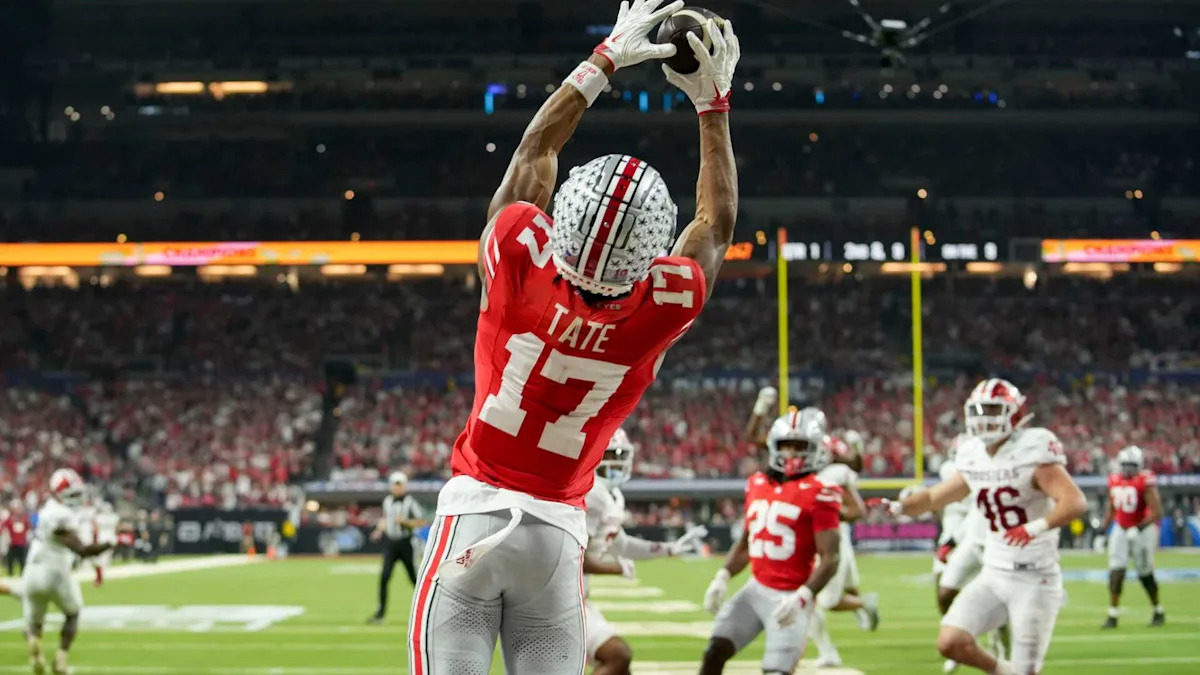
With the Super Bowl in the rearview mirror, its time to focus on the upcoming NFL Draft. With the Combine fast-approaching (February 27-March 2 in Indianapolis), every team is seeking to find their own Kenneth Walker III or Christian Gonzalez. NFL Scouting Departments are scouring every campus across the United States to find that next piece.
The good news? They need look no further than NBC Sports’ College Football and NFL Draft expert Eric Froton’s (@CFFroton) rankings report. It features the top draft-eligible players at the skill positions (WRs, TEs, RBs, and QBs). His breakdowns of the talent looking to hear their names called at the NFL Draft feature criticisms as well as superlatives.
Advertisement
We begin with the Wide Receiver category. They are ranked 1-20. Today, Froton discusses wideouts 11-20. Tomorrow the Top 10 will be unveiled.
Wide Receiver No. 20 – Skyler Bell, UCONN
Skyler Bell (6’0”, 185) revitalized his career after transferring from Wisconsin, securing 102-of-141 targets (72%) for 1,282 yards (12.6 YPC) and 13 touchdowns while posting strong efficiency against both zone (3.16 Y/RR) and man coverage (3.46 Y/RR), topped off by an 85.1 receiving grade. Bell worked primarily outside (61% wide) with a meaningful slot presence, thriving on short and intermediate concepts where his burst and twitch popped (8.2 YAC, 89th-percentile short-area impact). He consistently moved the chains and finished through contact, winning 65% of contested targets and turning structured touches into production with excellent catch-and-go confidence. The vertical profile was more uneven—just 6-of-24 on true deep shots for 170 yards and two scores—despite a willingness to test coverage downfield. Overall, Bell profiles as a reliable, multi-alignment receiver whose best work comes when he’s leveraged into space early, with NFL value tied to maximizing his short-area dynamism rather than forcing vertical volume.
Wide Receiver No. 19 – Caleb Douglas, Texas Tech
A former Florida recruit who transferred in 2024, Caleb Douglas (6’4”, 205) brought size and vertical intent to the boundary with 54 catches for 846 yards (15.7 YPC) and seven touchdowns while lining up outside on 83% of his snaps. His overall efficiency was uneven (68.3 receiving grade, 1.77 Y/RR), but he was notably more productive against man coverage (2.33 Y/RR) and flashed legitimate three-level utility, earning strong 90th percentile+ PFF grades on short, intermediate, and deep targets. Douglas’ downfield usage was heavy—28 deep looks with 12 completions—but contested success lagged (1-of-9 deep CTCs), and concentration lapses showed up in a 7-drop, 11.5% drop-rate season. With 5.4 YAC and just six missed tackles forced, he’s more of a stride-and-separate receiver than a tackle-breaker, winning when he can stack defenders and track the ball in space. Douglas offers intriguing size-speed traits and vertical stress potential, but sharpening hands consistency and improving contested-finishing will determine whether he sticks as a rotational boundary threat or ascends to a fuller NFL role.
Advertisement
Wide Receiver No. 18 – Josh Cameron, Baylor
Josh Cameron (6’1”, 220) is a sturdy boundary target who hauled in 69-of-102 targets for 872 yards and nine touchdowns while lining up outside on 93% of his snaps. His production profile reflects a physical, workmanlike receiver—15 missed tackles forced, 16-of-27 contested catches, and a 71.9 receiving grade—who wins more with toughness and positioning than speed or explosiveness. Cameron’s hands are dependable, and he adjusts well to the ball on downfield and sideline throws, though inconsistency on in-breaking routes exposed a smaller-than-ideal catch radius on targets outside his body. While his feet and breaks are more functional than sharp and he isn’t a vertical separator, he’s crafty at changing tempo, shielding defenders with his frame, and finishing through contact once he gets rolling. Cameron projects as a possession-oriented X who thrives on hitches, curls, and red-zone opportunities, with his NFL outlook hinging on whether his athletic testing can clear baseline thresholds.
Read More: Connor Rogers’ 2026 NFL Mock Draft
Wide Receiver No. 17 – Kevin Coleman, Missouri
A true nomad who attended four different schools in his collegiate career, Kevin Coleman Jr. (5’11”, 180) is a twitchy slot specialist who caught 66-of-88 targets for 732 yards, pairing a near-identical 80th% receiving grade across two seasons with steady per-route efficiency (2.23 Y/RR in 2025). The Senior Bowl standout’s role is clearly defined—87% slot rate and 62% of targets coming within nine yards of the line—but he maximizes it by catching 49-of-52 short targets, posting just two drops, and generating a strong 6.1 career YAC. Coleman is difficult to square up on hitches, curls, and screens, accelerating instantly after the catch and rarely allowing defenders to recover once he gains a step. While short-area work drives his value, he’s more than a gadget, tracking the ball naturally and blowing past slot corners on seam and post routes, including four catches for 119 yards on 20+ yard targets. His thin frame and limited play strength likely confine him to slot-only usage at the next level, but his burst, elusiveness, and confidence transitioning from catch to run give him clear NFL utility as a spacing-and-YAC weapon.
Advertisement
Wide Receiver No. 16 – Eric McAlister, TCU
Eric McAlister (6’3”, 205) put together a big-play season with 71 catches for 1,173 yards (16.5 YPC) and 10 touchdowns, pairing a 77.5 receiving grade with a strong 2.60 yards per route while working both outside and from the slot. He’s a physical, tackle-breaking target with 27 missed tackles forced and an elite 7.9 yards after catch, showing real play strength once the ball is secured and the ability to punish poor pursuit angles. McAlister flashes legit downfield chops—slant-and-goes, posts, and over-the-shoulder grabs in tight coverage—but his 8.7% career drop rate and seven interceptions when targeted in 2025 highlight volatility in his outcomes. Releases remain a work in progress, as he can struggle to get cleanly off the line against strong press corners and at times leans too heavily on physicality, which has led to turnovers when defenders stay connected. When he’s decisive and tracks the ball cleanly, McAlister looks like an NFL boundary weapon with size and YAC juice, but refining his releases and cutting down negative plays will be key to unlocking that upside.
Wide Receiver No. 15 – Chris Brazzell, Tennessee
A former Tulane Green Wave star, Chris Brazzell (6’5”, 200) broke out after his 2024 transfer by hauling in 61-of-86 targets for 1,006 yards (16.5 YPC) and nine touchdowns this season, operating almost exclusively outside (94% wide rate) with a 15.7 aDOT. His efficiency spiked in 2025—an 80.6 receiving grade and 2.57 Y/RR—driven by dramatic ball-security improvement (just two drops on 63 catchable targets after a 17.4% drop rate in 2024). Brazzell’s long-strider speed ramps up quickly, allowing him to get on top of defenders, and his massive catch radius shows up on deep outs and vertical shots, including multiple circus grabs against Mississippi State. He’s more fluid than most 6’5” wideouts, snapping off in-cuts and ship routes with surprising change of direction, and he remains functional on manufactured touches despite sparses tackle-breaking (6.7% career MTF rate). There’s still room for added physicality at the top of the stem and after the catch, but with strong zone production (3.07 Y/RR) and NFL bloodlines, Brazzell profiles as a field-stretching boundary weapon whose best football arrived late and loud.
Advertisement
Wide Receiver No. 14 – Ted Hurst, Georgia State
Ted Hurst (6’3”, 207) emerged as a Senior Bowl standout after enduring a difficult passing environment at Georgia State, finishing the season with 71 catches for 999 yards and six scores on a 12.6 aDOT while rotating 3 quarterbacks throughout the year. A rare size-speed specimen, Hurst posted an 82.1 receiving grade and 2.42 yards per route, consistently stressing defenses vertically with 22% of his targets traveling 20+ yards downfield, where he still earned a sparkling 98.8 PFF deep receiving grade despite erratic QB play. He wins outside (83% wide rate) by elevating and extending beyond his frame, securing 61% of his career contested targets and showing the strength to ward off defenders and finish through contact once the ball is in his hands. Hurst sells the fly route well, snapping off comebacks and releases with nuance, and his tape includes multiple reps where he flat-out ran past Power Four corners, including near-misses caused only by overthrows. Concentration drops (10% career drop rate) and occasional balance issues out of sharp breaks remain areas to clean up, but his burner speed, physicality, and vertical intimidation give him a tantalizing NFL-caliber boundary profile.
Wide Receiver No. 13 – Elijah Sarratt, WR, Indiana
Elijah Sarratt (6’2/213) climbed the ladder from Saint Francis Red Flash to James Madison Dukes and ultimately Indiana alongside Curt Cignetti, earning Second-Team All-Big Ten honors in 2025 after producing 64-of-87 for 824 yards and a gaudy 15 touchdowns. Nicknamed “Waffle House,” Sarratt boasts elite efficiency markers—an 87.3 receiving grade, a 2.5 career Y/RR, and a 75% lifetime first-down rate—while dropping just nine balls on 248 career catchable targets. He wins with savvy and leverage rather than dynamism, posting 3.05 Y/RR vs. man (2.24 vs. zone), lining up as the X on 86% of snaps, and converting 7-of-11 deep chances despite a modest 9.6 aDOT and 12.6% deep target rate. The contested-catch profile took a step back (40% in 2025 after a sparkling 79% at JMU), but Sarratt still dictates terms on back-shoulders and short-area work, using strength and timely stiff-arms to create space. Limited after the catch (13 MTF on 117 Indiana receptions; 4.8 YAC) and not a burner, he profiles as a crafty, physical WR2 whose polish and reliability translate even if the NFL ceiling hinges on separation consistency.
Advertisement
Wide Receiver No. 12 – Malachi Fields, Notre Dame
A Senior Bowl standout, Malachi Fields (6’4”, 222) is a big-bodied vertical target who translated his Virginia production to South Bend by posting 36-of-62 for 630 yards (17.5 YPG) and five scores in 2025 on a lofty 16.4 aDOT. Fields possesses a pair of the steadier hands in the class—just three drops on 84 catchable targets over the last two seasons with 84th-percentile drop grades—while maintaining a consistent 5.2 YAC profile and showing the agility and strength to shed tackles on hitches and extended handoffs. His game is built on tracking and toughness downfield, extending high and bending low while finishing through contact, though a 47.3% career contested rate reflects how often he’s asked to win in tight quarters rather than with clean separation. He’s a long-strider who needs a moment to ramp up and typically must win early or late in routes, as he isn’t particularly sudden and can require extra gather steps on stops, leading to modest efficiency splits (2.05 Y/RR vs. man, 1.98 vs. zone). Fields’ struggles separating against quality coverage—most notably versus Louisville and Clemson in 2024 in the short-to-intermediate range—cap the ceiling, but the reliable hands, size, and downfield utility keep him squarely on the Day 2 radar as a complementary boundary piece.
Wide Receiver No. 11 – Omar Cooper, Indiana
Omar Cooper (6’0”, 204) is a twitchy, high-juice slot weapon whose efficiency has remained strong across alignments, posting 2.55 Y/RR in 2025 and 2.52 in 2024 while flashing real burst when he transitions from glide to full throttle. His 27 missed tackles forced on just 69 receptions this year underscores how dangerous he is once he has space, and he consistently freezes off coverage with savvy footwork, selling double moves and snapping cuts with precise timing. Cooper was primarily a slot threat in 2025 (83% slot rate) after operating outside in 2024 (90% wide), thriving versus zone (3.15 Y/RR) but showing more volatility against man coverage where physical disruption can knock him off schedule. He’s tough to stay with when getting a step on defenders, making acrobatic, high-point and one-handed grabs, though lapses in ball tracking and finishing—especially on deep flies and quick timing routes—remain on tape. The talent is obvious, but refinement off the line, cleaner route flattening, and more consistent hands discipline will determine whether Cooper becomes an effective chain-mover or an explosive yet streaky slot playmaker at the next level.
Advertisement
Wide Receivers 21-35
21 – Deion Burks, Oklahoma
22 – Tyren Montgomery, John Carroll
23 – Bryce Lance, North Dakota State
24 – Reggie Virgil, Texas Tech
25 – Barion Brown, LSU
26 – Lewis Bond, BC
27 – Zavion Thomas, LSU
28 – Vinny Anthony, Wisconsin
29 – Eric Rivers, Georgia Tech
30 – Chase Roberts, BYU
31 – Chris Hilton Jr, LSU
32 – Noah Thomas, Georgia
33 – Aaron Anderson, LSU
34 – Emmanuel Henderson, Kansas
35 – Harrison Wallace III, Ole Miss
Take this information and use it to learn about your team’s potential next star wideout or slot receiver. Tomorrow, we’ll publish Froton’s Top 10 Wide Receivers.
Enjoy the day and enjoy your continued prep for the 2026 NFL Draft.
